The Aviation industry It is one of the most complex that exist, due to the large number of countries in which it operates, the diversity of production methods, the relationship between governments and industry, and a long etcetera of elements, which also make it one of the industries that involves the most risks.
To carry out the analysis of identified risks and opportunities, the main tool is the probability and impact matrix.
The Risk and opportunity management provides a method for identifying, evaluating, and reducing uncertainty in all areas of the organisation (finance, sales, production, etc.) in a structured way. These uncertainties can have a negative impact (risks) or a positive impact (opportunities) on the objectives of the project or activity we are analysing. Therefore, we will have to manage them accepting, mitigating, transferring or abandoning risks, and accepting, enhancing, pursuing or sharing opportunities.
There are a multitude of techniques for identifying risks and opportunities, among the main ones being SWOT analyses, diagramming techniques, or expert judgment. It is highly recommended to always be assisted by risk management specialists, who know how to separate risks from problems, help define the causes and consequences of the risks or opportunities that are identified, and who also participate in their subsequent analysis and categorisation.
Para realizar el análisis de riesgos y oportunidades identificados, la principal herramienta es la matriz de riesgos y oportunidades. Probability and impact matrix, which helps us to prioritise based on the likelihood of them occurring and the impact they could have on the objective of the project/activity we are analysing. In this way, we will be able to separate minor (acceptable) risks and opportunities from more important ones, and on which we will have to take action with more or less urgency.
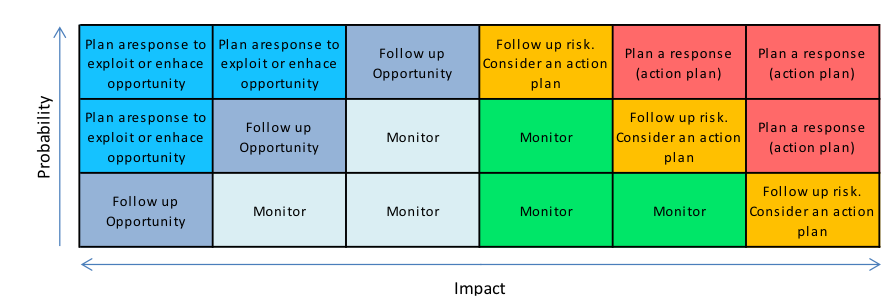 To locate a risk or opportunity within the matrix, we first analyse the probability of the identified uncertainty becoming a reality, rating it as low, moderate, or high, for example. This value will be noted on the Y-axis of the matrix. Secondly, and independently, we must assess the impact on the objective of the project or activity, rating it as low, moderate, or high, just as with probability, and this will be noted on the X-axis of the matrix.
The combination of both valuations (probability and impact), will inform us about the severity of the risk and therefore how to treat it.
Everyone We manage risks every day, when we take out home or car insurance, when we decide where and when to go on holiday, or whenever we have to make an important decision in our personal or professional lives. Risk Management provides us with the tools and rules to make this management more effective and efficient, also helping us to avoid future problems in the case of threats, or to take advantage of them in the case of opportunities.