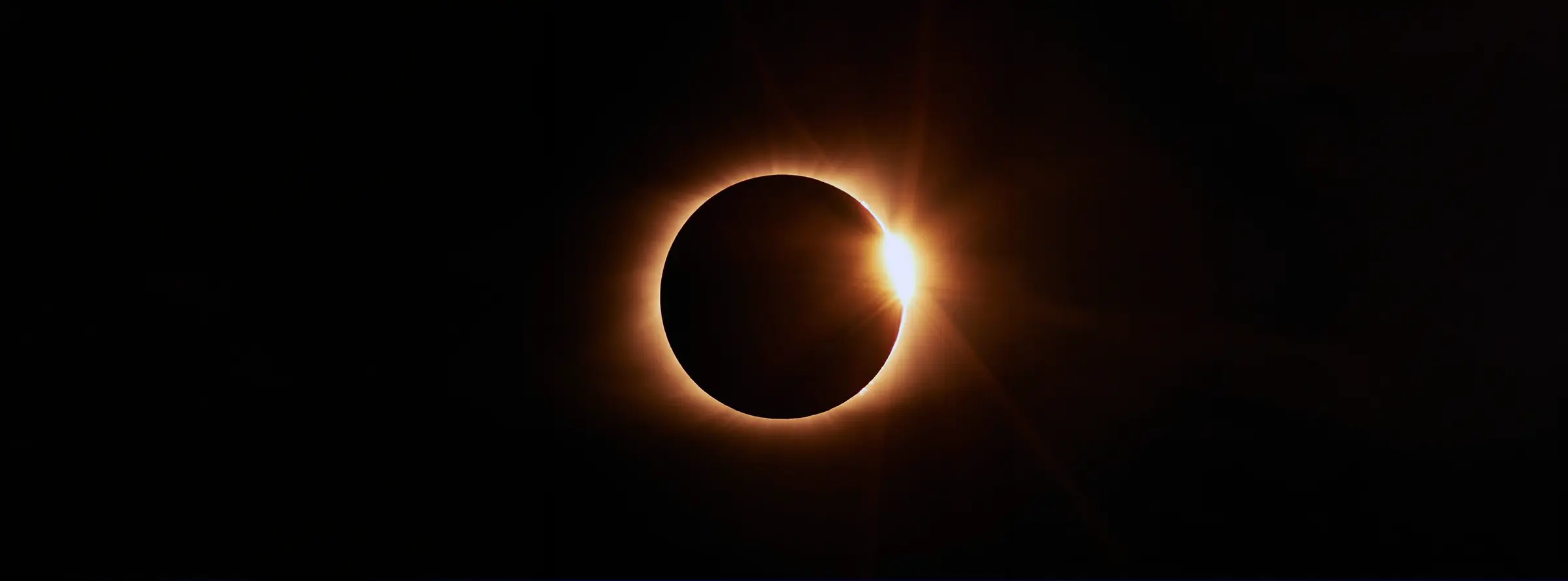
Between 2026 and 2028, the Iberian Peninsula will experience an extraordinary astronomical event: three consecutive solar eclipses visible from Spain in the space of just three years. A total eclipse in 2026, another total eclipse in 2027 and an annular eclipse in 2028 make up an exceptional sequence that will place the country at the centre of the global astronomy scene, attracting scientists, photographers, enthusiasts and thousands of tourists keen to witness one of the most impressive spectacles that nature has to offer.
The first took place on 12 August 2026, when a total solar eclipse traversed the north of the Iberian Peninsula from west to east. It was the first total eclipse visible from Spain in over a century and coincided with sunset, allowing observers to see the Moon completely obscuring the Sun very close to the horizon. It was a phenomenon – not only scientific, but also social – that captured the world’s attention, turning various towns across Spain into the headquarters of global aerospace companies and organisations, all gathered to witness this unique event.
A year later, on 2 August 2027, another total eclipse will cross the southern tip of the peninsula, bringing more than four minutes of darkness to some parts of Andalusia. Finally, on 26 January 2028, there will be an annular eclipse, during which the Moon will not completely cover the Sun’s disc, leaving the characteristic ‘ring of fire’ visible.
The difference between a total and a partial eclipse lies in the observer’s position in relation to the Moon’s shadow. During a total eclipse, anyone within the narrow path of totality sees the Moon completely cover the Sun for a few minutes. During a partial eclipse, the Moon only obscures part of the Sun’s disc, so it never actually gets dark.
Throughout this period, the temperature may drop by several degrees, the light levels fall suddenly and the landscape takes on a twilight-like appearance. Some birds return to their roosts, and the brightest planets and stars may become visible. It is also the only time when the solar corona can be observed directly, and research into this is essential for understanding the solar storms that can affect satellites, navigation systems, communications and electricity grids.
The reason why Spain will be treated to three such significant eclipses in such a short space of time lies in the geometry of the Earth’s and Moon’s orbits. Although several eclipses occur every year in different parts of the world, the narrow band from which a total or annular eclipse is visible is constantly changing. The fact that three consecutive paths cross the Iberian Peninsula is a very rare astronomical coincidence.
In addition to its enormous scientific value, this trilogy represents an opportunity for the aerospace industry. Earth-observation satellites will be able to analyse rapid changes in surface illumination, whilst missions dedicated to studying the Sun will compare their measurements with those obtained from ground-based observatories. Universities, research centres and space agencies will coordinate international campaigns to validate new scientific instruments.
From the perspective of aviation, eclipses do not pose a risk to operational safety. Navigation systems and flight procedures are designed to operate both by day and by night. There may, however, be an increase in astronomical tourism, scientific flights and activity at airports near the path of totality, which will require specific planning on the part of air traffic controllers. The so-called Iberian trilogy of eclipses presents a once-in-a-lifetime opportunity to bring astronomy to the general public and reinforce Spain’s role as a prime location for scientific research and outreach. Few generations will have the chance to witness two total eclipses and one annular eclipse from the same territory in the space of just three years.