When the first Airbus A300 took off from Toulouse, it marked the beginning of a transformation that would have a far-reaching impact on the aviation industry. That flight not only signalled the birth of a new commercial aircraft, but also the realisation of a shared ambition: to prove that Europe could compete, innovate and lead the future of global air transport.
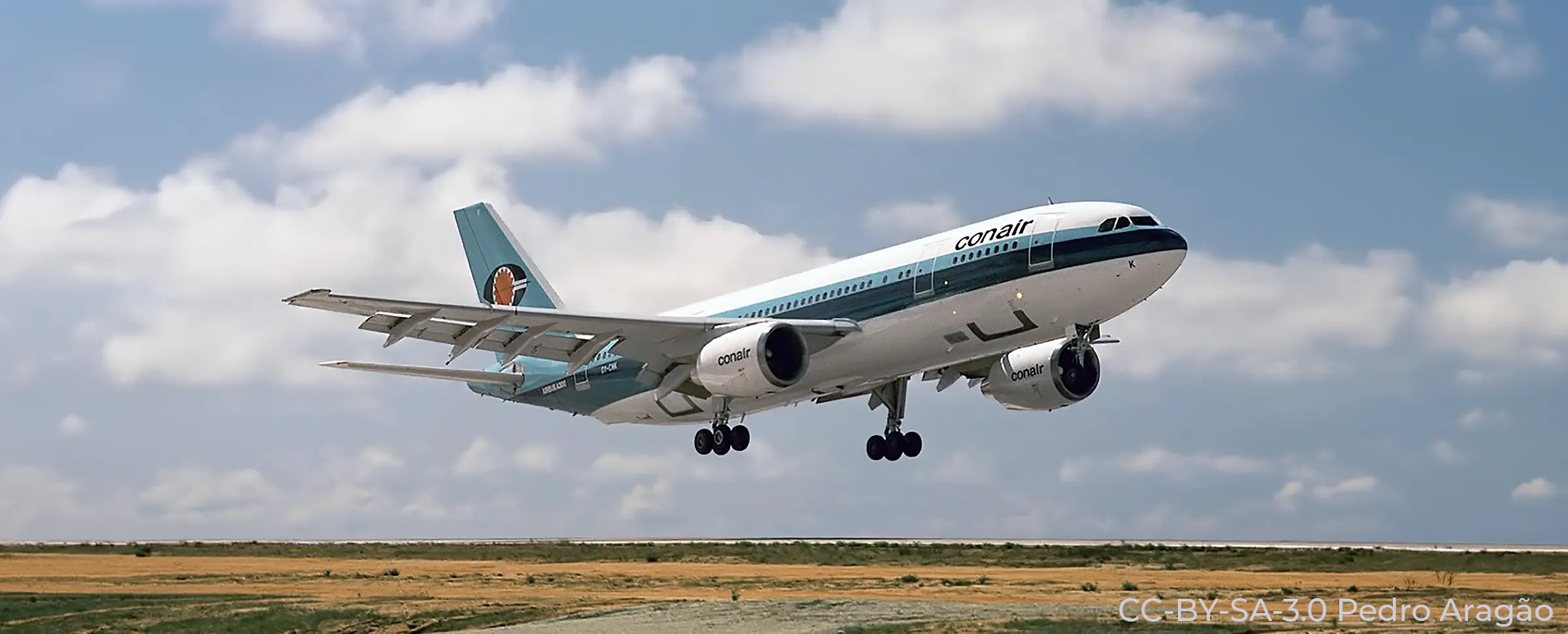
28 October 1972 holds a prominent place in the history of commercial aviation. On that day, the Airbus A300B1, the first twin-engine, wide-body commercial aircraft, took off for the first time from Toulouse-Blagnac. Beyond its technical specifications, that maiden flight symbolised a new approach to European aeronautical engineering: international cooperation, technological innovation and a firm commitment to competitiveness.
In a market then dominated by the major US manufacturers, the Airbus project arose from a conviction shared by several European countries: to pool knowledge, industrial capabilities and technological resources in order to compete on a global scale. Airbus Industrie was formally established on 18 December 1970, initially with French and German partners. The Spanish company CASA joined the consortium in October 1971, whilst the British firm Hawker Siddeley was involved in the development and manufacture of the wings.
The A300 was the realisation of that strategic vision. Designed as a twin-engine wide-body aircraft and initially intended for high-demand short- and medium-haul routes, it represented an innovative concept for its time. In contrast to the large three- or four-engine jets, Airbus opted for a configuration that combined passenger capacity, efficiency and lower operating costs.
Its design was notable for its advanced aerodynamics, optimised structure and solutions designed to improve operation and maintenance. Subsequent developments in the A300 family incorporated further improvements to systems and materials. The programme anticipated priorities that would define subsequent generations of commercial aircraft: energy efficiency, reliability and optimisation of resources.
However, the significance of the A300 cannot be measured solely by its technical specifications. Its development also represented an industrial transformation. The manufacture of components was spread across various European countries, bringing together engineering centres, production plants, specialist suppliers and an international logistics chain. Final assembly took place in Toulouse. That model laid the foundations for one of the world’s most important aerospace networks.
The road to commercial success was not an immediate one. Airbus had to overcome difficulties to win the trust of airlines and demonstrate the competitiveness of its offering. The entry into service of the A300 with Air France in 1974 and its subsequent acceptance by international operators, including those in the United States, helped to cement the new manufacturer’s credibility.
Building on that first programme, Airbus has pursued a path of continuous innovation. In 1988, the A320 family introduced digital fly-by-wire flight controls to a commercial passenger aircraft, whilst programmes such as the A330, the A350 and the A380 demonstrated Europe’s ability to tackle highly complex technological and industrial challenges. Each generation has driven advances in aerodynamics, materials, flight systems and operational efficiency.
This development has had consequences that extend beyond the company itself. The emergence of Airbus transformed global competition in the market for large commercial aircraft, broadened the range of options available to airlines and spurred the development of new technological and operational solutions.
Today, Airbus is one of the leading players in the international aerospace industry and a flagship of European technological and industrial capability. Its activities span commercial aviation, defence, space and helicopters, with an extensive network of facilities, research centres and partner companies.
For Spain, Airbus is also a key component of its aerospace sector. Its facilities are involved in both civil and military programmes and in the design and manufacture of aerostructures, playing a prominent role in the development of industrial and technological capabilities.
And since 1997, AERTEC has also been part of this journey of technological and industrial development in European aviation. Throughout its history, the company has contributed to some of Airbus’s major aeronautical programmes, bringing its expertise in manufacturing engineering, industrialisation and the optimisation of production processes. This collaboration has evolved and expanded into areas of greater technological specialisation, such as the design and development of on-board systems, avionics and advanced electronic solutions for aircraft.
Fifty-four years after that historic take-off, the legacy of the A300 lives on. Its history shows that innovation stems both from technical advances and from the ability to build a shared vision, take risks and transform cooperation into industrial excellence.
On 28 October 1972, it wasn’t just a plane that took off. A new ambition for Europe took off, one that would go on to change the history of global aviation forever.
Key related topics: Aircraft systems