Adverse weather conditions are affecting the capacity of European airspace, but forecasting, data and better coordination are helping to minimise their impact.
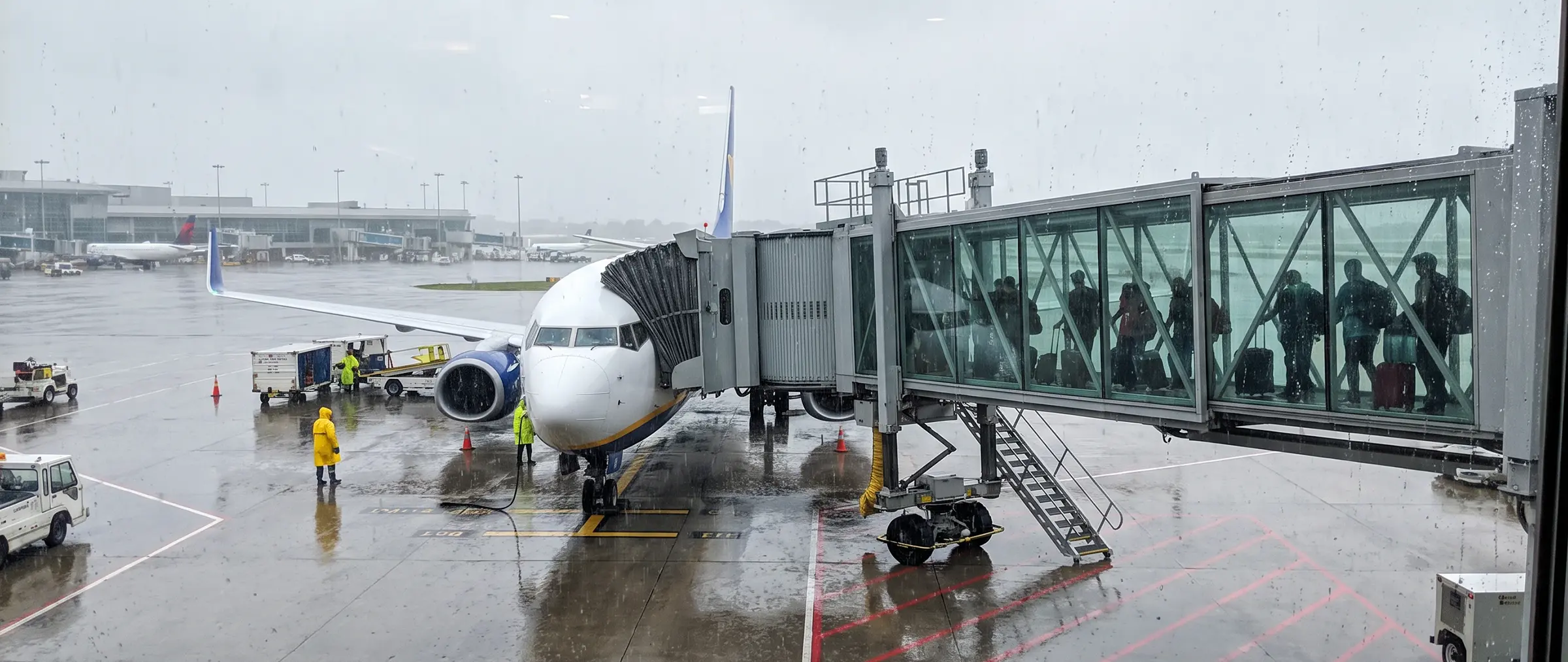
There are days when the sky seems to close in. A line of convective storms appears along a route, forcing flights to be diverted, concentrating traffic in alternative corridors and, in a matter of minutes, a local weather incident can become a problem for the entire network. In European aviation, this scenario is having an increasing operational impact: adverse weather is now the second-largest category of en-route ATFM delays, behind air traffic control restrictions.
The summer of 2026 provided a clear indication of the scale of the challenge. EUROCONTROL reports that 43 per cent of en-route ATFM delays between June and August were linked to severe convective weather, compared with 49 per cent attributable to capacity and air traffic control staffing. Prior to that period and as of September, weather remains the second leading cause of en-route delays, accounting for 33 per cent.
The issue is not simply predicting where a storm will strike. The real engineering challenge lies in turning that forecast into operational decisions before the disturbance spreads. In a network as interdependent as the European one, a reduction in capacity in one sector may necessitate changes to routes, the regulation of traffic flows and alterations to sequences, which ultimately affect flights and airports located hundreds or thousands of kilometres away.
This is where Capacity and Weather-Based Operations (CWBO) comes into play – the set of procedures implemented by EUROCONTROL’s Network Manager in the summer of 2025 and expanded in 2026. CWBO combines weather forecasts, real-time updates and forecast traffic demand to identify capacity shortfalls and trigger coordinated responses when certain thresholds are reached. The Network Manager Operations Centre, air navigation service providers, airports, airlines and meteorological services are all involved in the process.
This change in approach is significant. Rather than a purely reactive management strategy, the network aims to anticipate scenarios and distribute traffic more effectively before the situation becomes critical. The aim is not to eliminate the impact of bad weather – which is impossible – but to reduce last-minute changes, avoid massive uncontrolled diversions and limit so-called ‘reactionary delays’: delays that are passed on from one flight to the next and end up affecting the entire rotation of an aircraft or an airline.
The results published by EUROCONTROL demonstrate the scope of this strategy. Between 1 May and 31 August 2026, the implementation of CWBO resulted in savings of around 3.1 million minutes in delays, compared with some 900,000 minutes during the 2025 implementation period. EUROCONTROL also estimates savings of around 400 million euros for operational stakeholders in 2026 and a 14 per cent improvement in network stability during particularly complex days.
Behind those figures lies a great deal of engineering that passengers never see. Weather data must be integrated with demand and capacity forecasts; the various stakeholders need to share a consistent operational picture; and that information must be translated into decisions on traffic flows, routes, sectors and resources. It is not enough simply to have more data: it must be available in good time, be interoperable and be transformed into useful information for decision-makers.
Technology is also ushering in a new era. EUROCONTROL already uses applications based on artificial intelligence and machine learning in areas such as traffic forecasting, flight planning and route optimisation, and has other solutions currently under research or development. In capacity management and meteorology, these technologies can improve scenario forecasting and decision support, but it is important to distinguish this potential from what is already in use. Today, verifiable progress lies in procedures such as CWBO, in network coordination, in planning and in the ever-increasing integration of meteorological and operational information.
And the challenge does not end there. The resilience of air transport also depends on the modernisation of ATM systems, the sectorisation of airspace, digital communications, airport infrastructure, and the ability of airports and airlines to absorb disruptions. These are aspects that merit their own analysis and which we will address later. In this case, the lesson is more specific: when airspace capacity decreases, planning ahead can be just as important as having more capacity.
The weather will remain unpredictable and storms will continue to force changes to plans. The difference will lie in how much the network knows before they arrive, how it shares that information, and how quickly it turns it into decisions. In an increasingly demanding European airspace, resilience is not about aspiring to a sky free of disturbances, but about designing a system capable of responding better when they occur.