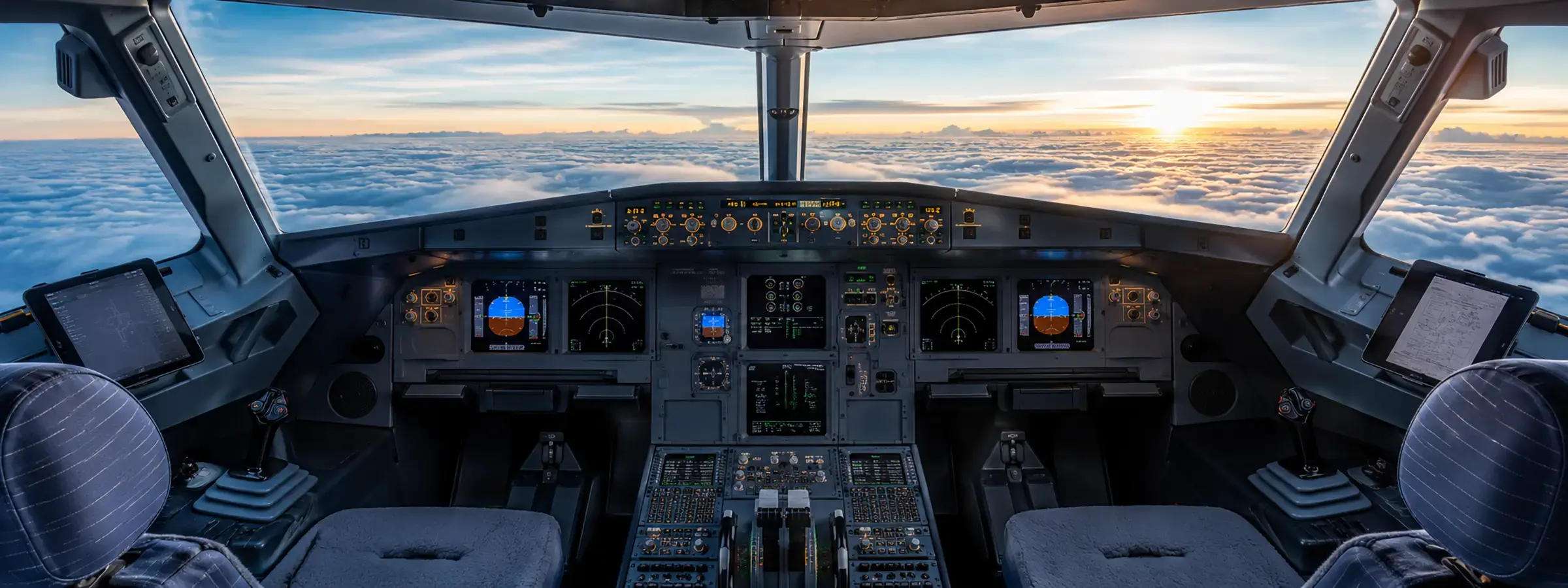
More than a hundred years ago, the first autopilot models were developed, installed and used in aircraft, the concept of which has survived to the present day.
Today we talk about the aircraft autopilot We take it for granted that this technology is an intrinsic part of the aircraft. In fact, this is almost true, especially since this innovation was first used more than a century ago. In essence, the term «autopilot» refers to a system that enables controlling the trajectory of a vehicle autonomously and without the presence of a human being.
It was in 1912 that the American inventor Elmer Ambrose Sperry and the German physicist Hermann Anschütz-Kaempfe proposed a system that would allow any moving vehicle to maintain a certain course. It worked by connecting one or more gyroscopes and a compass to the control elements of the vehicle in question. The worldwide reputation of the new system was immediate thanks to its installation and successful use on several dozen US Navy ships.
It was his son, Lawrence Sperry, a great enthusiast of aeronautics, who took the lead in making a lighter model of the device and adapting it for installation on an aircraft.
Until then, there had not been much interest in applying gyroscope capabilities to an aircraft. Lawrence Sperry thought that the three flight axes of an aircraft (yaw, pitch and roll) could be controlled by an automatic system if it had as a reference one or more gyroscopes that maintained the aircraft's original orientation and state. It was concerned with linking each of the aircraft control surfaces to each gyroscope, which would allow corrections to be made based on the angle of deviation between the direction of flight and the original gyro setting. The gyroscopes were designed to maintain a zero setting for all control surfaces (equilibrium situation), which would allow identification of when corrective action was required. For the actuation of the controls, it was simply a matter of the device mechanically executing what the pilot would do instinctively.
Based on this concept, he solved the problems that arose at each stage of the design. The gyroscopes, for example, required electrical energy to maintain rotational speed (7000 rpm), which was solved by means of a wind-driven generator located on the upper wing, which would supply the necessary power.
The weight and dimensions were also key parameters at a time when aircraft were not overpowered and materials were not optimal. To achieve this, the entire device was reduced to a weight of about 18 kilograms and the size of a small suitcase (45 x 45 x 30 centimetres).
When the time came, it was Lawrence Sperry who was responsible for demonstrating the system's operation within the Concours de la Securité en Aéroplane (Aircraft Safety Competition), which was held in Paris in the early months of 1914.
The 56 aircraft entered in the competition featured a wide variety of innovations ranging from assisted starts, automatic stabilisation, novel carburettor models, extravagant designs and other proposals aimed at improving aircraft safety. Teams from several countries took part, although France had the largest number of participants.
On Sperry's side, the innovation consisted of his system to provide the aircraft with automatic stability and control. It was, as mentioned, a fairly simple device consisting of a quadruple gyro that operated ailerons, elevators and tail rudder. He installed it all on a Curtiss C-2 single-engine aeroplane with a seaplane fuselage.
Lawrence Sperry flew out on 18 June. He was accompanied by Emil Cachin, a newly hired French mechanic with whom he could barely communicate, as neither spoke the other's language. Even so, they were able to understand each other in everything they needed for the test.
When it was time for the demonstration, the Curtiss C-2 took flight from the Buc airfield near Paris to the track where thousands of fans, onlookers and the judges' stand were gathered between the Parisian bridges of Argenteuill and Bezons.
Once the aircraft was level and straight and level, both crewmembers raised their hands to show that they were maintaining their flight without incident..
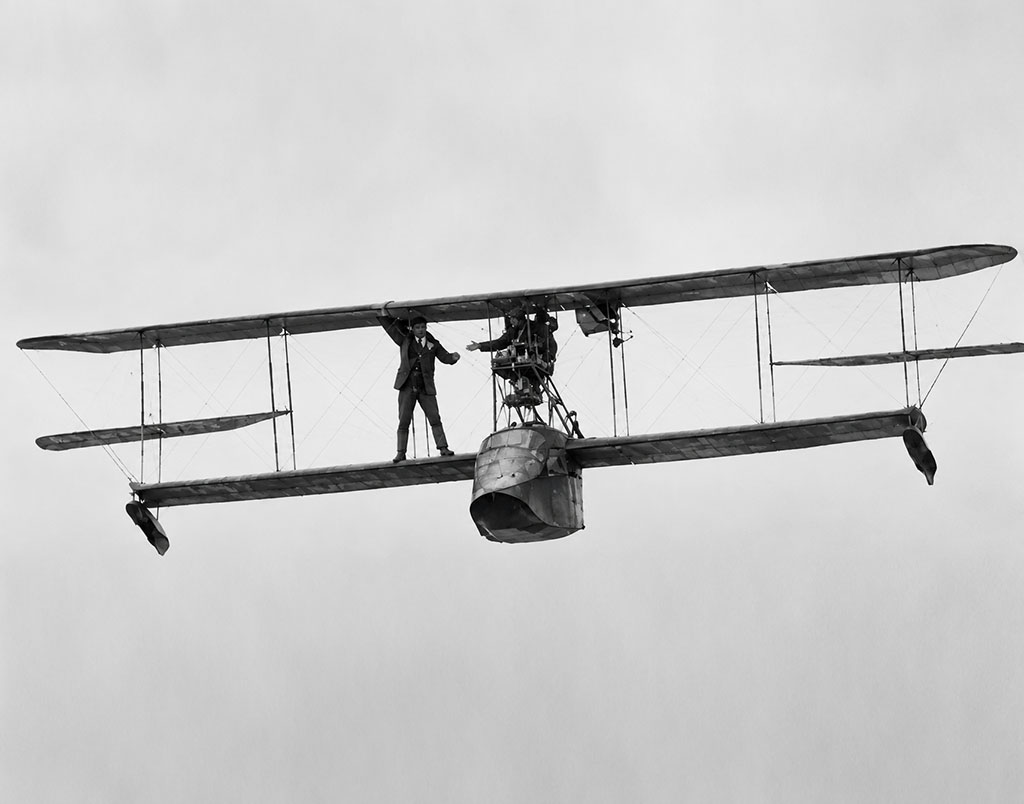
Not satisfied with that, on a second pass over the judges’ stand, Cachin left his seat and climbed onto one of the wings, moving a couple of meters away from the fuselage while Sperry put his hands over his head. The mechanic shifted his weight on the wing to force the aircraft into a tilt and demonstrate that it was capable of regaining its balance on its own. The control surfaces, equipped with gyroscopes, immediately corrected the change in attitude. And the plane continued along the river without any problems. As if that weren’t enough—and amid the frenzy the demonstration had sparked among those present—during another flyby, each of the two crew members climbed onto one of the aircraft’s wings to wave to the crowd and demonstrate that their invention worked.
Afterwards, one of the judges climbed into the device to corroborate how much he had seen. On this occasion, Lawrence Sperry additionally treated him to a take-off and landing partly controlled by the automatic device.
Of course, Sperry won the competitionThis earned him a prize of 50,000 francs and international recognition.
The development of the Sperry autopilot for aircraft coincided in time with another important innovation that has also survived to the present day. Until that time, aircraft had different control systems and mechanisms. Piloting each aircraft required very specific learning and skills in each case, as the handling of each of the control surfaces, mechanisms, engines, as well as the skills to take off and land were very different depending on the manufacturer. The Societé de Production Armand Deperdussin developed a central control lever to manipulate ailerons and elevators, and pedals to control the rudder. This would make it much easier to act on aircraft control surfaces, which would directly benefit the development of Sperry's autopilot.
The next step was the development of a pilotless aircraft which could fly towards a specific target guided by the gyroscopic device. The First World War put paid to some of these innovations, which, as we all know, emerged years later.
Sperry's first autopilot was born out of the need to assist the pilot in his task and relieve him of some of the work. Flying for long periods of time at the controls of a vehicle causes significant strain and fatigue on the arms, shoulders and back. This system solved that problem.
Modern autopilots incorporate many capabilities that Sperry could probably never have imagined, such as maintaining a programmed speed, programmed acceleration or reduction of speed, following a programmed route plan, aligning the aircraft with the runway or performing a fully automated landing. But the essence of the device is the same, and what is certain is that its contribution to aviation has been essential.