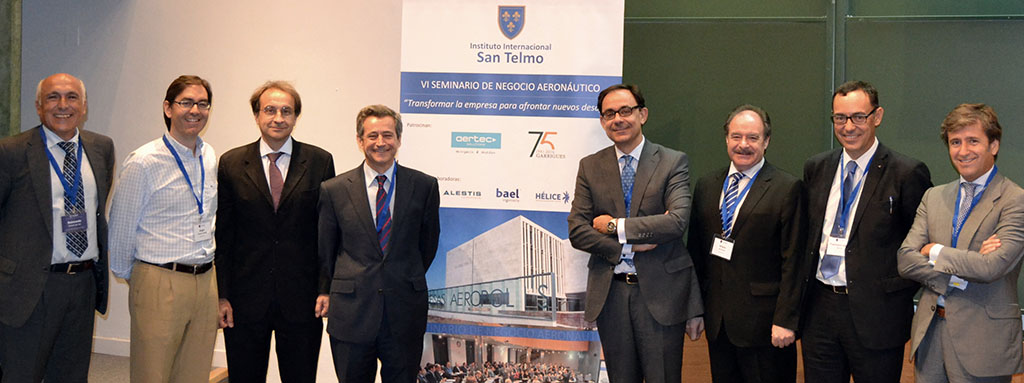
Over 60 directors and business area managers linked to the aerospace sector have met in Seville as part of the VI Aeronautical Business Seminar, organised by the International Institute San Telmo, with the collaboration of AERTEC Solutions and Garrigues, which analysed current aerospace industry innovations and trends, and the challenges for advancing business transformation and improving the supply chain.
Digital transformation, globalisation and emerging business niches are the main challenges for the aerospace industry as it faces new future challenges.
The meeting, which has also had the collaboration of the Andalusian Aerospace Cluster (HÉLICE), Alestis Aerospace and Bael Ingeniería, has been developed with the objective of reflecting on the transformation processes that aeronautical companies must undertake to to face the challenges of the future and seize the opportunities which are posed as a result of the changes and trends occurring in the sector. To this end, relevant speakers from the aerospace industry have participated, sharing their transformation experiences and future vision with the attendees.
The seminar, held under the title of “Transform the company to face new challenges”, was inaugurated by the CEO of AERTEC Solutions and President of the Business Action Council of the HÉLICE Cluster, Antonio Gómez-Guillamón, who presented current trends in the aerospace market and highlighted some of the main challenges for the future of the sector, such as the implementation of information technologies and digital transformation capabilities; the globalisation and internationalisation of companies to ensure their survival and growth; or the emergence of new business niches or emerging sectors in the aerospace industry, such as unmanned aircraft or the space sector, to which existing knowledge and know-how from other areas must be transferred. The new niches in the aerospace industry highlighted by AERTEC's CEO —drones, electrification, the space sector— are precisely the areas in which the company is already developing its own solutions.
In his speech, Gómez-Guillamón outlined some of the Key drivers and technologies to meet these challenges (from connectivity, automation, and new collaboration tools to 3D printing or digital customer access), while also advocating for the need for companies to work and collaborate as a team, through aerospace clusters, in order to tackle large common projects. “The capacity of regional aerospace clusters, organising and joining forces between companies, academia and public administration support, is vital to compete on the world stage,” he highlighted at the end of his presentation. The commitment to automation and digital technologies is materialised in the solutions Advanced industrial AERTEC develops: robotics, artificial vision, IoT and data-driven diagnostics for the aeronautical production chain.
Subsequently, there was a presentation by the secretary-general of Airbus Group in Spain, Pedro Montoya, who shared many of these ideas and delved into aspects such as globalisation, digitalisation and innovation As fundamental factors when facing business transformation processes, which in turn lead to other positive elements for the supply chain of large companies. Likewise, he bet on the sector having most effective financing tools, both public and by banking institutions, to face the challenges ahead, and indicated the MRO (maintenance) area as another of the business niches that will be relevant in the aeronautical industry in the coming years.
The seminar also included a practical element consisting of an analysis of a successful business case, specifically the Nestlé Continuous Excellence programme, from the world's leading company in the food sector. This programme has been underway for 8 years within the company, across all its areas and divisions, with the aim of continuous improvement and increased competitiveness. This section featured the participation of José López Vargas, former global vice-president of operations at Nestlé, who explained the reasons for the development of this initiative and the results achieved as a consequence of the change and transformation experienced by the company.
The day concluded with a round table on other business transformation experiences in which Francisco Javier Díaz Gil, CEO of Alestis Aerospace, and Carlos Rapallo, partner at Garrigues, participated, in addition to Antonio Gómez-Guillamón and José López Vargas.