An airport’s resilience is not measured solely by how much it can withstand, but by its ability to become operational again when the local area needs it most.
The earthquakes that have recently struck Venezuela and Colombia have once again brought to the fore a fundamental issue in airport planning: an airport is not merely a transport infrastructure. In the event of a natural disaster, it also becomes a critical component of a region’s response and recovery.
On 24 June 2026, Venezuela was hit by two consecutive earthquakes, measuring 7.2 and 7.5 on the Richter scale, in the north-central part of the country. The damage was particularly severe in the state of La Guaira, home to Maiquetía International Airport, the country’s main international gateway and Caracas’s principal airport.
The earthquake caused damage to various airport facilities, including landslides and damage to buildings and systems, forcing operations to be suspended whilst the safety of the infrastructure was assessed.
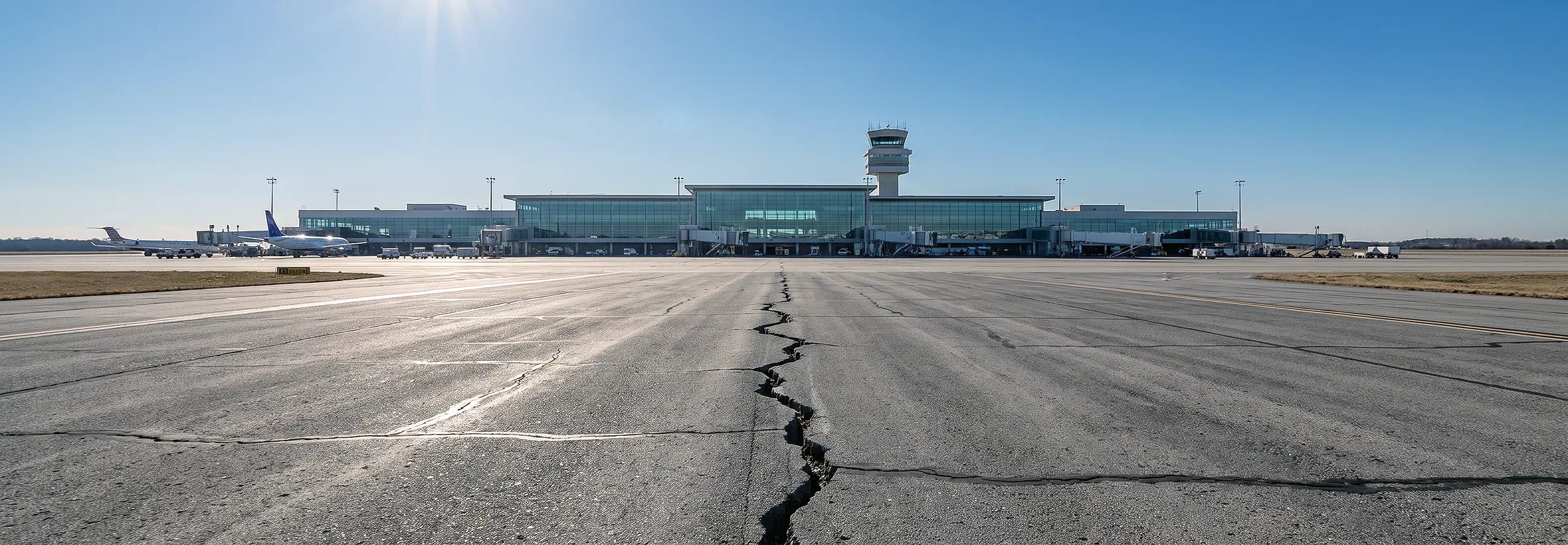
Colombia experienced another incident on 10 August, when an earthquake measuring 7.4 on the Richter scale struck in Chocó at a depth of approximately 110 kilometres. This also had consequences for the airport system. One of the most significant cases was at Matecaña International Airport in Pereira, where cracks were detected on the runway, problems were reported with ATS communications, and damage was found to the terminal and the control tower. Other airports were able to gradually resume operations following the necessary technical inspections.
Both incidents serve as a reminder that damage to an airport need not be confined to the terminal building. A runway may suffer deformation or cracks; a control tower may lose its operational capability; and electrical, navigation or communications systems may be affected even when the buildings remain structurally sound.
An airport is a system
This is one of the key lessons to be learnt from both events. The operational continuity of an airport depends on an extensive chain of infrastructure and services.
Runways, taxiways, aprons, visual aids, navigation and communications systems, electrical installations, fuel, control towers, emergency services and ground access form part of a single operational ecosystem.
The overall vulnerability may lie precisely in one of these elements. A terminal may remain structurally sound, yet the airport may be rendered inoperable because a control tower has been damaged, an electrical substation has stopped working or the access routes have been blocked.
Here, too, a discipline that does not always receive sufficient attention when discussing airport development takes on particular importance: geology. Particularly in areas prone to seismic activity, understanding the seismic characteristics and behaviour of the ground, the presence of faults, geotechnical conditions, susceptibility to liquefaction and the stability of slopes is crucial both for selecting sites and for designing and expanding infrastructure. Incorporating geological knowledge from the earliest stages of airport development enables a better understanding of the risks and allows for the design of solutions tailored to the actual conditions of the area.
From resistance to operational resilience
Airport seismic engineering must, therefore, move beyond the traditional concept of structural resistance and embrace a broader one: operational resilience.
It is not enough for infrastructure simply to survive an earthquake. It must be capable of restoring a minimum level of operational capacity as quickly as possible.
There is also one particular feature that sets airports apart from other major infrastructure projects: following a disaster, their strategic value increases. When roads, bridges or railways are damaged, air transport can become one of the main alternatives for delivering rescue teams, medicines, food, specialist personnel and emergency supplies.
The airport then ceases to function solely as commercial infrastructure and becomes a contingency logistics hub.
This changes one of the fundamental questions in airport design. It is no longer simply a matter of determining whether the airport can withstand an earthquake, but of establishing what operational capacity it will be able to provide immediately afterwards.
In the initial phase, it is not even essential to restore full capacity. An airport operating at reduced capacity can be of enormous strategic value if it is able to receive medical flights, rescue teams or humanitarian supplies.
Designing with recovery in mind
This approach has direct implications for new developments and for the modernisation of existing airports.
La planificación debería incorporar escenarios de degradación operacional desde las primeras fases de diseño, identificando qué instalaciones son imprescindibles para mantener una operación mínima y qué alternativas existen cuando alguna de ellas falla.
Redundancy is essential: alternative power supplies, independent communications, degraded air traffic control procedures, or airspaces capable of handling emergency operations can significantly reduce recovery time.
Post-earthquake inspection procedures are also essential. Runways and taxiways need to be inspected for cracks, differential settlement or deformation. The same applies to air traffic control systems, visual aids, electrical installations, terminals and control towers. Technologies such as drones, structural sensors, GIS systems and digital models can speed up these assessments.
Resilience must also be considered at network level. If an airport is taken out of service, it is necessary to know which alternative facilities can take over part of its operations, which aircraft they can accommodate, what apron capacity they have, what fuel and services are available, and how they are connected to the affected area.
Airports prepared for a multi-hazard environment
In recent years, much of the debate on airport resilience has centred on the effects of climate change: flooding, rising sea levels, extreme temperatures and heavy rainfall. Earthquakes serve as a reminder that planning must necessarily adopt a multi-hazard approach.
The strategy involves anticipating the consequences through geological and geotechnical knowledge, appropriate structural design, the protection of critical facilities, system redundancy and business continuity plans.
The events in Venezuela and Colombia thus offer a lesson that extends beyond both countries. Airport engineering must evolve from the concept of robust infrastructure towards that of resilient infrastructure: infrastructure that not only minimises damage, but is also prepared to continue operating and gradually recover its capacity.
Because in the wake of a major disaster, an airport may temporarily cease to be a gateway for passengers and become something far more important: the infrastructure that enables aid to reach those in need.
At that point, the true measure of its resilience will not be merely how long it lasted, but how long it took to become useful again.
Key related topics: Airport infrastructure design / Airport Planning