«In recent years, our companies have developed competencies that have allowed us to conquer competitive technological niches in the international market.»
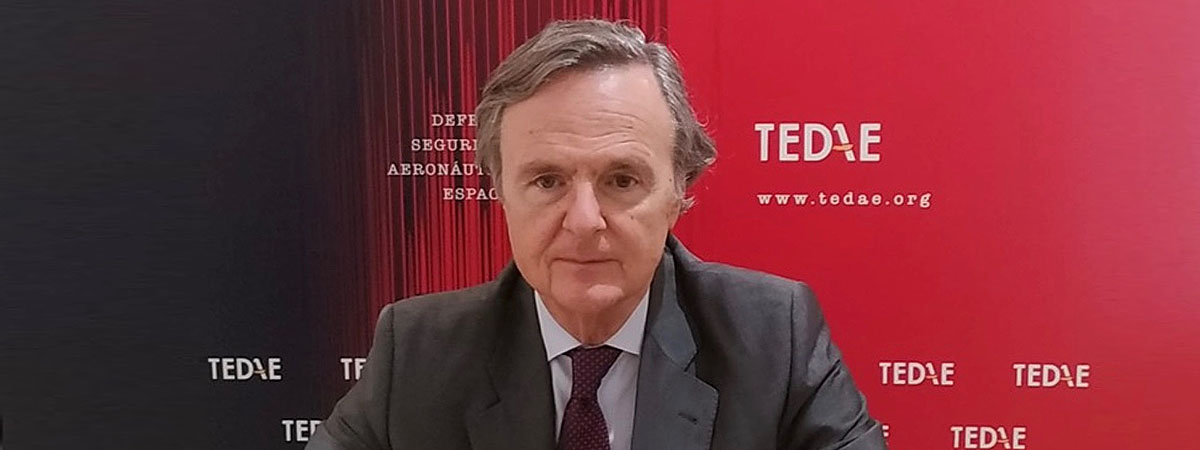
Ricardo Martí Fluxá is President of TEDAE, the Spanish Association of Defence, Security, Aeronautics and Space Technologies.

The Spanish aeronautics, defence, and space industry is going through a major crisis due to Covid-19. As one of the main economic pillars of our country, what measures is TEDAE calling for in order to recover?
Our defence, security, aerospace, and space industries have been profoundly affected by the impact of COVID-19, but with slightly different nuances in each of these industrial sectors. We must defend a national industrial fabric that is strategic and which we must boost and protect so that Spain has its own technological and production capabilities, as well as companies with experience in competitive global markets.
Effective and creative support measures are necessary, with the Government and in conjunction with the various administrations, to recover the encouraging future growth prospects of our industries, which had been dashed by COVID-19.
Aeronautical, defence, security, and space companies always require the support of administrations as they work with very long technology development and amortisation periods, and therefore need stable financial plans and frameworks. Consequently, if public-private collaboration has always been necessary, today it is essential.
Andalusia has been working for months on its Aeronautical Strategic Plan, but the need for a National Strategic Plan is historic. Do you think it will become a reality in the medium term?
I believe that we must stress that today more than ever it is essential to continue working hand in hand with the Administration, under a public-private partnership model, to develop an aeronautical technology plan which, with the necessary budgetary ambition, will allow us to consolidate an activity that is fundamental to our economy and to develop the technology for the aviation of the future. This is what will allow us to maintain the volume of activity and high-quality, value-added jobs. And we are confident that, between all of us, we will manage to give another great boost to our aeronautical sector like the one provided by the PTA I and PTA II technology plans launched in the 1990s. For their part, the Government and the various regional administrations have reiterated the strategic nature of the aeronautical sector for the Spanish economy; an industrial fabric that in 2019, the latest year available, generated 45,000 direct jobs (some 100,000 indirect), contributed 6% to Spain's industrial GDP and had a turnover of 10,500 million euros.
It is also time to adopt supply chain support measures to help them overcome liquidity difficulties, ensure the survival of companies and maintain the technological level we enjoy today – which has been so hard-won – to drive the development of new technologies for the aviation of the future.
The launch of new aeronautical programmes will serve to preserve technological and industrial capabilities, thereby strengthening the sector and its ancillary industries, while minimising the impact on employment caused by COVID-19.
From TEDAE, they are pushing for the development of an Aeronautical Technology Plan, based on public-private collaboration. What would be the key points of this Plan?
The Sectoral Agenda for the Aeronautical Industry, drawn up by TEDAE in collaboration with the Ministry of Industry, Trade and Tourism, and presented in December 2018, already indicated training, R&D&I, the supply chain, companies' environmental response, and competitiveness as pillars to be reinforced in order to maintain the high technological level achieved by Spanish industry in the international context.
The key points to consider are therefore decisive support for R&D&I, new aeronautical programmes, the participation of technological organisations and centres, a programme for the development of priority technologies and the optimisation of industrial processes, Industry 4.0, the adaptation of training programmes to the standards of excellence required by companies, as well as support to increase the response to growing environmental commitments and adequate budgetary allocation.
The TEDAE sectors account for 7.3% of the national industrial GDP. What role will they play in the recovery of industry?
If one thing has become clear during the health emergency, it is the enormous capacity for transformation of our companies and the technologies they develop. Spanish society has been able to witness the speed with which they have adapted their technologies and how they have been capable of providing products and services that were previously completely alien to them.
I believe its character as strategic industries and its will to serve and support Spain's progress, society, and our Armed Forces, as well as the State Security Corps and Forces, have also become evident.
The strength of TEDAE's 81 defence, security, aeronautics and space companies lies in our technologies, our competitive products, our patents and the talent of their professionals. In recent years, our companies have developed skills that have allowed them to conquer competitive technological niches in the international market. This has been decades of investment in R&D&I. All of this makes this industrial fabric an essential factor for the reactivation of our economy.
It is fundamental to continue working with a committed attitude so that our companies participate in new aeronautical and Armed Forces modernisation programmes. Likewise, so that they gain prominence in the new European Union, leading the Spanish industrial presence in major European programmes such as Horizon Europe or the European Defence Fund, and consolidating our presence in the European Space Agency.
The Ministry of Defence, along with TEDAE and AESMIDE, signed the creation of the FEINDEF Foundation a few weeks ago, which will be responsible for organising the biennial fair of the same name. What can you tell us about this new institution and the next edition of FEINDEF?
The Ministry of Defence and the industrial associations, TEDAE and AESMIDE, established the FEINDEF Foundation to enhance the image of the Spanish Defence and Security Industry, to make known the importance and commitment of this industry to R&D, to promote scientific and technical activities, and to foster its internationalisation and integration, especially within Europe. Objectives which should be added to in order to provide continuity to the FEINDEF international defence and security fair, the first edition of which was held in May 2019.,
So I am convinced that with the invaluable support of our Ministry of Defence, the next edition will repeat the success of the first call. There is no doubt that continuing FEINDEF will contribute to Spanish companies consolidating their presence in international consortia and projects and demonstrating their commitment to contributing to the Common Defence Policy of our continent, while at the same time strengthening ties with other countries with which we have been collaborating for some time.