The SAFETERM project addresses the use of state-of-the-art artificial intelligence/machine learning technologies to increase the level of safety in specific emergency situations leading to the termination of a UAS flight.
The ATLAS Experimental Flight Centre, in Villacarrillo (Jaén), has hosted the final stage of the SAFETERM (Safe Autonomous Flight Termination System). Safe Autonomous Flight Termination System), a project sponsored by the European Defence Agency (EDA, European Defence Agency) and developed by the technology companies GMV and AERTEC.
Unmanned aerial systems are undergoing a phase of expansion and development, with safety in all phases of flight and their airspace integration a priority issue. The objective of the SAFETERM project is to improve current RPAS medium altitude long endurance (MALE) flight termination systems and procedures through the application of artificial intelligence/machine learning technologies (Machine Learning) to increase the level of safety in specific emergency situations, in case of failure of both autonomy and remote pilot control capability.
The system aims to provide tools for the aircraft autonomously determines the Alternative Flight Termination Areas (AFTA) where the risk to third parties can be minimised. In the event of loss of communication with the aircraft and the subsequent identification of an emergency that prevents it from reaching the planned Flight Termination Areas, the aircraft quickly identifies a safe area for landing, avoiding buildings, roads or inhabited areas.
Final Flight Campaign
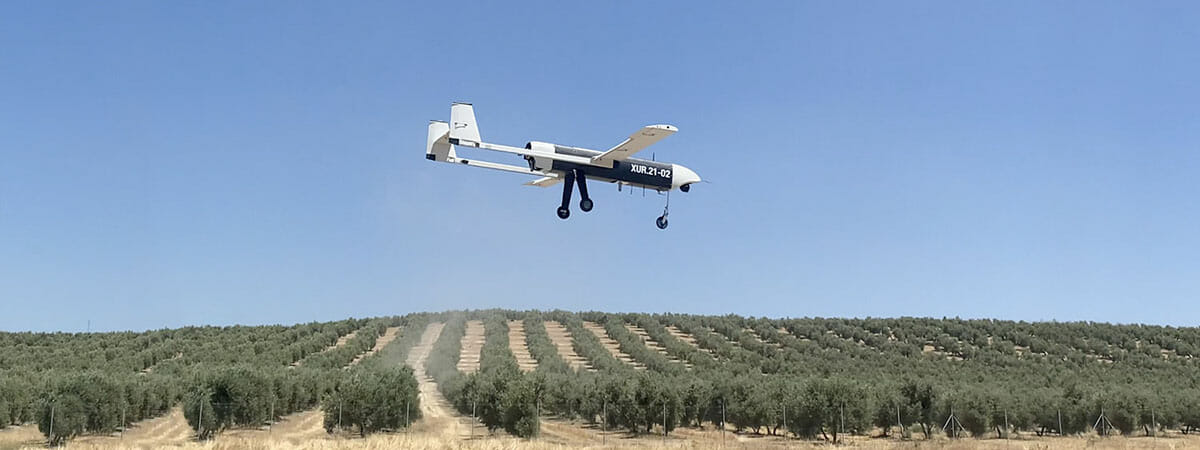
The validation phase of the project has been completed with a flight campaign in a real operational environment, The aircraft was equipped with an on-board prototype of the SAFETERM System to assess its viability. For this purpose, several flights were made over three full days, during which the system behaved as planned in the development of the project.
During the tests, the loss of communications and the subsequent emergency situation were simulated. Then, using the images obtained from the TARSIS sensor, the SAFETERM system autonomously identified the areas where it is possible to land safely. Finally, TARSIS performed the guided flight to the safest landing area.
These tests have attracted the interest of several dozen professionals and heads of agencies and organisations from all over Europe, who attended the European Defence Agency's (EDA) call to present SAFETERM's results.