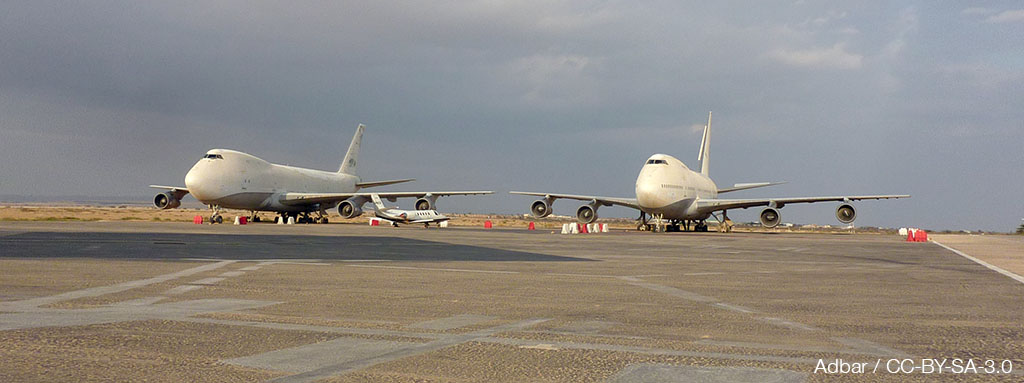
What happens to aircraft after their useful life? After 20 to 30 years of service, aircraft often end up in the so-called “end-of-life" repository, where they can be disposed of as "end-of-life" aircraft.“aircraft graveyards”. They are normally located in desert areas because the climate helps to avoid the oxidation of materials due to humidity. In addition, the square metre of land is much cheaper than in areas closer to towns or other “more” habitable places.
Seen from the air, the vast expanse of land The airfield and its layout can accommodate aircraft of all sizes, giving rise to a unique landscape. Examples are: AMARG (Aerospace Maintenance and Regeneration Group), known as The Boneyard, in Tucson, Arizona, with more than 4,000 US Air Force military aircraft; the Pinal Airpark for commercial aircraft, also in Arizona; or the Khodynka Airfield in Moscow, full of Soviet aircraft abandoned after the Cold War in a curious X-shaped layout. In Europe we also have industrial airports The Teruel airport, whose facilities house dozens of aircraft as parking facilities, is studying the possibility of converting them into official aircraft dismantling centres.
These aircraft scrapyards provide a setting that takes us back to another era. They provide visitors with a sample of retired aircraft which delight aviation enthusiasts. On occasions, this unique setting is also used for filming movies and music videos in a landscape that is undoubtedly eye-catching.
These aircraft storage spaces came into being after the Second World War, increasing in number with the reception of aircraft that had become obsolete after their useful life. Some aircraft were left waiting to be required for new projects, others to be restored with a view to a possible sale at a more affordable price and others to be dismantled in their entirety and their still useful parts to be reused in aircraft in use (the so-called cannibalisations). Finally, it is sometimes decided to recover the raw materials of everything that can no longer be used in any other way.
But they also emerge new opportunities. There are companies that use some aircraft parts to sell them as pieces of furniture with an aeronautical aesthetic. This is an exclusive and growing market.
Amidst so many tons of discarded metallic materials, we are faced with a new problem in the aeronautical waste management. Until very recently, the most commonly used materials were aluminium, titanium and steel, which were easy to recycle. But with the recent introduction of composite materials, this has become more complicated, creating a task to be solved.
It should be noted that the materials we use today will be the aeronautical waste of the future, This brings with it the responsibility to find out what we can or should do with them in the coming years. At the moment, several projects are already underway to investigate the possibilities for recycling and reuse in order to reduce the environmental impact of this type of waste.
Thermoset composites cannot be melted down like thermoplastics to make new products and are therefore particularly difficult to recycle. They are currently recycled mechanically, which results in the destruction of a large part of the properties of the base material. Another option is to incinerate them to at least recover energy.