The real revolution in the RPAS world(1) lies in the ability to grant them certain capacities and uses that are of benefit to a particular activity. The technology needed for flight control, autonomy or communications has already had a long history in conventional aviation, so innovations are mainly focused on potential applications.
RPAS can become an effective tool in firefighting.
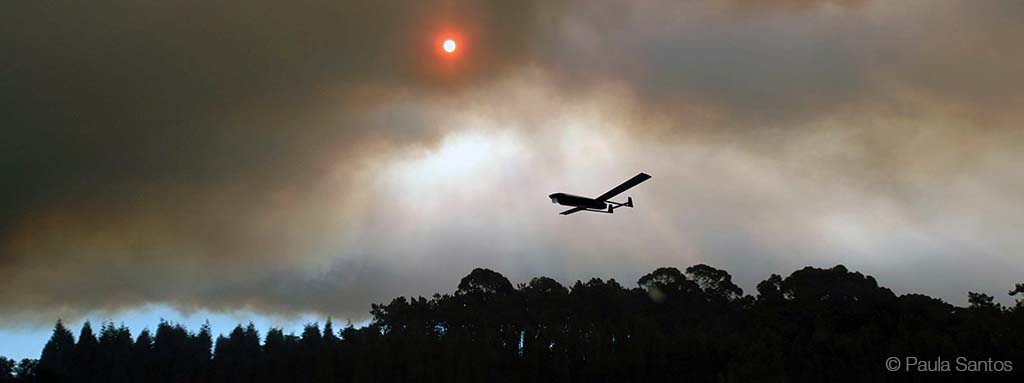
Nowadays, there are many tasks that can be carried out by unmanned aerial vehicles. Every day someone surprises us with a new utility. But let's focus on one that is particularly interesting and useful: fire-fighting. Around the world, tens of thousands of hectares are burned every year, resulting in the loss of hundreds of lives and extensive damage to the natural environment and populations.
Unfortunately, in many situations the authorities are exposed to large fires, which are very difficult to control, where the flames can reach up to 30 and 40 metres in height. On too many occasions seaplanes cannot do their job effectively, The water they release evaporates before it reaches the fire. RPAS, on the other hand, have so far not provided an effective solution because of the limitations imposed by their performance in terms of the burden of payment. However, this seems to be changing.
Some companies, universities and research centres have focused part of their efforts on innovation in this field. They are providing solutions on a number of fronts: achieving higher positioning accuracy to get to the core of the fire, improve the resistance to high temperatures of materials, increase the capacity of liquids or the adaptation of innovative unloading systems.
The Carlos III University of Madrid, for example, is using the system EGNOS to correct the GPS signal and give higher accuracy. In addition, they propose to use sensor fusion (e.g. visual or multispectral) to achieve optimal accuracy. The challenge in this case is to reach the exact point that is key to extinguishing or controlling a fire at any given moment.
Also worth mentioning is a drone called Hopper which innovates with water misting. This device has a capacity of up to 300 litres of fire-fighting liquid and, thanks to its misting system and directed jet technology, it is capable of reaching the ground directly. Even if the water evaporates, it takes advantage of this evaporation to suffocate the fire, displacing the oxygen, thus acting as a firebreak in fires and preventing them from spreading.
What this innovative system does, in short, is to atomise the water, segregating it into small droplets and increasing its efficiency. The ability to control the type of mist, direction and volume of water emission can be adapted to the nature of the fire and be effective in different conditions. It also incorporates the use of magnetic, thermal and geolocation sensors to be autonomous in flight and operation.
Another example is the University of Montana, with the project Dronefire, The project, with which they have made great advances in forest fire monitoring and management. This has been coupled with a spin-off The project is aimed at the development of autonomous firefighting support systems which, in a self-guided manner, will contribute to the stabilisation of recently extinguished areas and firebreaks with relatively small amounts of water. They also innovate with the nature of the liquids to be used and with the fogging systems.
There is still a long way to go in this field, but initiatives such as these are a good starting point for the use of RPAS in something as essential as firefighting.
(1) Remotely Piloted Aircraft System