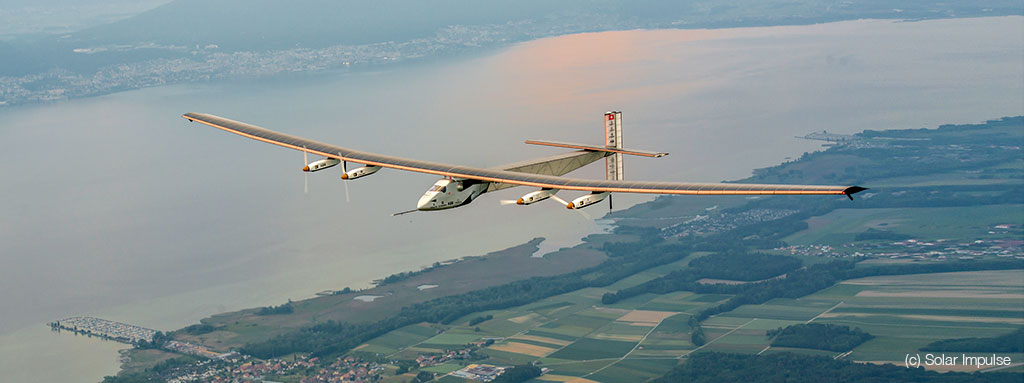
In 2005, when the Airbus A380 made its maiden flight, a group of dreamers conceived the idea of building an aircraft that could fly almost unlimitedly thanks to the exclusive use of solar energy. Despite a discouraging start, with some financial problems, the project finally gained momentum until, as early as 2009, a first prototype took flight.
Solar Impulse is undoubtedly a brave and determined initiative that has a great deal to contribute in the field of energy efficiency in the aerospace industry.
It is well known that one of the priorities of the aerospace industry in the field of R&D+i, and always behind advances in safety, is to achieve Greater aircraft efficiency. The objectives include, among others, reducing the cost of fuel per seat or minimising pollution. Both objectives are being achieved in leaps and bounds with increasingly efficient aircraft in every respect. There are the examples of the Boeing 787 or the Airbus A350. But we are talking about another matter, much more radical.
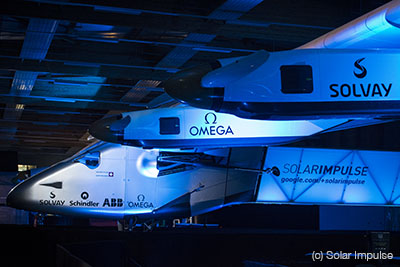 Indeed, the challenge which Solar Impulse faces is to achieve that a manned aircraft remain airborne permanently and unlimited using the Sun as an energy source. No fossil fuels. During the day, energy is obtained directly via photovoltaic cells, while a set of batteries (lithium-ion) are charged, which will be used for flying at night.
The aircraft weighs 2.3 tonnes, is 22 metres long, has a wingspan of 72 metres, and its secret lies in the 17,248 photovoltaic cells which are distributed over its structure. Its cruising speed is around 90 km/h.
At the beginning of March, the latest model of this project, the Solar Impulse 2, departed from Abu Dhabi with the intention of circumnavigate our planet without using fossil fuels On an adventure that will last five months.
 Some sceptics view this project as nothing more than a scientific amusement that will not lead to significant advances for the aeronautical industry. On the contrary, many others are convinced that we still have a lot to to progress in the knowledge of materialsthe Energy optimisationthe engine efficiency and the utilisation of natural energy sources. And Solar Impulse is, without doubt, a brave and determined initiative that has a great deal to contribute in that field.
Here we bring an interesting video which will bring you closer to knowledge of the Solar Impulse project, as well as the recently launched circumnavigation project.
You can visit the official website of this project at www.solarimpulse.com and learn more about the technology used, the project's aims, and about the Solar Impulse 2's round-the-world trip.