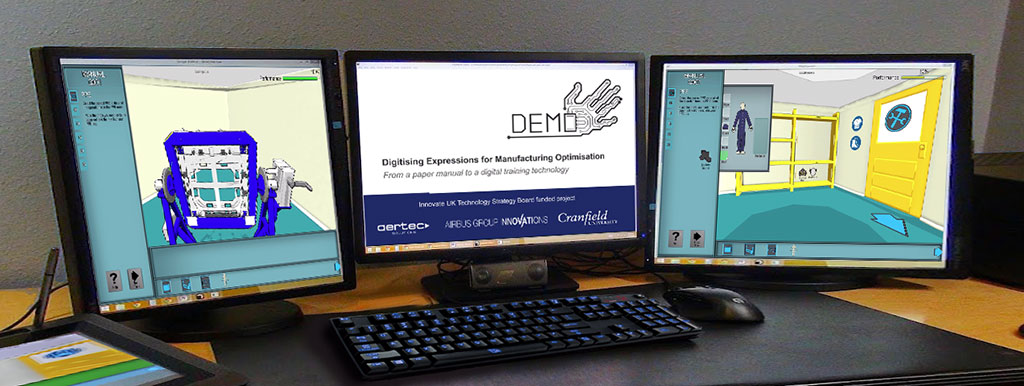
Airbus Group Innovationsthe Cranfield University y AERTEC Solutions, For a little over a year, they have been developing the project known as DEMO (Digitising Expressions for Manufacturing Optimisation), aimed at applying virtual reality to new industrial environments and, especially, to the aeronautical industry.
The project aims to adapt the Virtual reality technology and environments which are currently applied in the field of video games to digitise knowledge and management processes in aircraft manufacturing plants. The initiative seeks to provide a framework for the development of some of the next-generation technologies focused on aerospace sector. Specifically, the main aim is to advance the development of generic technologies that will allow for the optimisation of structural engineering and manufacturing processes in aeronautical plants to be exploited in Airbus's future aircraft development. These technologies will be the foundation for the knowledge that will be used in the future for component design, manufacturing and assembly, from concept validation to final production.
 “The technology used today in the world of video games, with virtual reality environments, allows you to know at all times the Status and situation of objects and people, perform concrete tracking and detect a multitude of parameters. ”The objective is to apply these types of systems to an industrial environment in a way that allows us to understand, for example, how people working in a manufacturing plant behave, obtain all possible information to optimise work, and contribute to decision-making to improve its management and operation," explains Pedro de Melo, director of the British subsidiary of AERTEC Solutions.
The initiative aims to explore technologies in the area of video games, analyse them and Define new practical applications so that they can subsequently be adapted to the aeronautical industrial environment. The project includes the development of technological demonstrators and prototypes that can approve and validate the new technology, the final product of which will subsequently be exploited by AERTEC Solutions on the international market.
“AERTEC Solutions provides its Experience in the aircraft industrial cycle with support services for industrialisation, and for the control and management of aeronautical manufacturing programmes, as well as in the implementation of Information Technology-based solutions for plant control,” points out Pedro de Melo.
The video game sector is one with the greatest technological potential for the coming years in the international market, as its virtual reality applications are being researched and developed for high-tech industries such as aeronautics, automotive, engineering, etc., as well as for applications in the development of professional, educational, or healthcare skills.
In the video accompanying this news, the various project partners explain some interesting details about its development as well as its progress.