In the summer of 2018, we will be able to witness the The first flight of Airbus's new cargo plane, the BelugaXL. Its predecessor, which is currently in service, is already one of the most impressive aircraft in service, but the growth of the aeronautical company Airbus and its need to make the manufacturing process of its aircraft more efficient forces the company to have a new super-freighter.
This state-of-the-art super-transporter aircraft improves on one of the largest aircraft currently in service.
The geographical dispersion of the sites where the different Airbus aircraft components are manufactured requires transport logistics of parts to/from the FAL (Final Assembly Line) and pre-FAL, which involves transport by road, ships, trains, and planes. This necessarily impacts the final price of each aircraft and, consequently, the optimisation of the transfer of parts (especially the larger ones) is one of the company's strategies.
 This is why Airbus considered a few years ago, in 2014, replacing its current fleet of BelugaSTs, based on the A300 model, with more modern and larger ones based on the A330 structure, the BelugaXLs.
The current BelugaST fleet consists of five units, four of which are almost exclusively for Airbus's domestic demand, and another which is also dedicated to transporting large parts for third parties. The new BelugaXL fleet will also consist of five units that will gradually replace the previous ones.
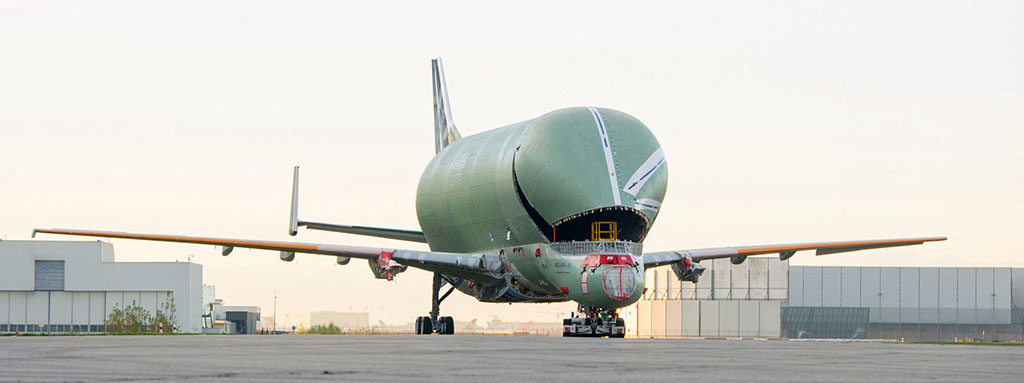
And it's not long now until it becomes a reality.The first structurally complete fuselage The new BelugaXL left its assembly hangar in Toulouse, France, in early 2018. It will make its maiden flight by the summer. Once operational, a fleet of these state-of-the-art aircraft will be used to transport complete sections of Airbus aircraft between the company's European production sites and its final assembly lines in France, Germany, and Spain.
Its origin in an A330-200 can only be recognised in the BelugaXL, to which an enormous hump (with a diameter of 8.8 metres) has been added, and a head-to-tail cargo hold of almost 62 metres in length. Its payload capacity will be 53 tonnes with a range of 4,500 km (4,000 when fully loaded).
 And while the first structurally complete BelugaXL moves into its testing phase, sections of the second A330-200, which will be converted into a BelugaXL, have also arrived in Toulouse to begin their integration process, which is estimated to take a total of about two months less than in the case of the first unit.
Following its departure from the FAL, the BelugaXL requires a little less than 1,000 hours of testing for your certification campaign. The Rolls Royce Trent 700 Turbofan engines, with 316 kN of thrust each, were installed in March and will be followed by landing gear and flight control tests.
With six metres more length, one metre more width, and a payload capacity some six tonnes greater than its predecessor, the new BelugaXL will be able to transport both wings of the A350 XWB aircraft simultaneously, rather than the single wing that can currently be carried.
The extraordinary figures of the Airbus BelugaXL will undoubtedly optimise Airbus's internal logistics and make all its aircraft manufacturing processes more efficient.