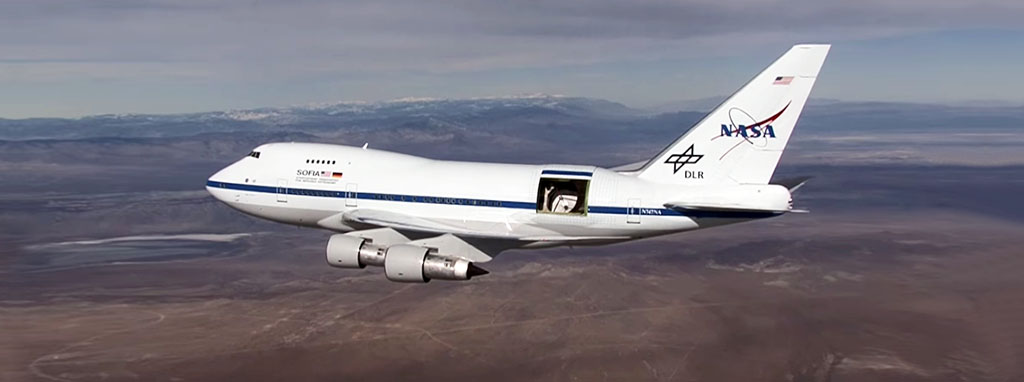
One of the strangest aircraft, The most interesting, and at the same time interesting, aircraft that we can find in the air is the SOFIA. This acronym stands for Stratospheric Observatory For Infrared Astronomy (Stratospheric Observatory for Infrared Astronomy). It is actually a Boeing 747 that was converted a few years ago in order to be able to to house a 2.5-metre telescope inside it as well as a whole range of equipment for astronomical observation and study. Converting a commercial aircraft for such a specific mission implies completely redesigning its Aircraft systems and avionics, from energy management to in-flight telescope stabilisation.
The project is being carried out jointly by NASA and DLR (German Aerospace Centre). Its aim is to provide a telescope that will allow the observations from the stratosphere and thus avoid the filtering of infrared radiation by the atmosphere itself. For this reason, the average flight altitude for observation is 13,000 metres, where avoids 99,8% of water vapour in the atmosphere. The importance of such studies lies in the fact that infrared observations reveal the cold states of matter and allow us to explore the hidden Universe.
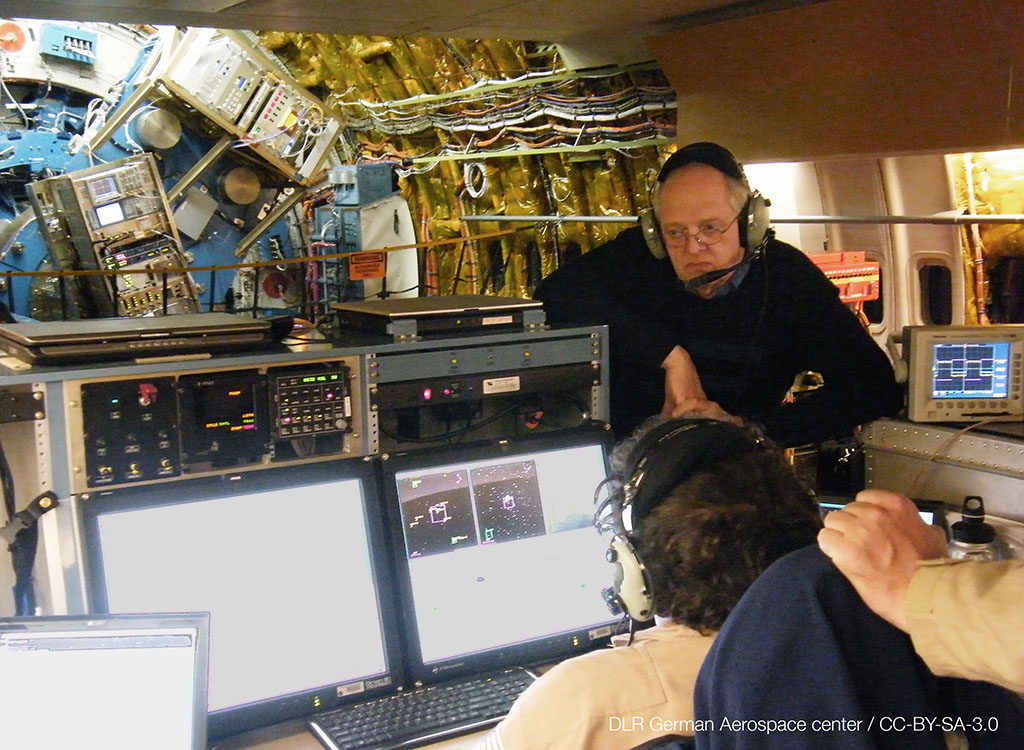 A added advantage to the fact of having a telescope installed on an aircraft is their mobility. SOFIA can carry out observation and study programmes at any point in the Earth's stratosphere and thus look anywhere in the Universe.
Recently, in March 2015, important findings were released from SOFIA regarding the link between supernovae and the formation of planets like Earth.
The aircraft carrying this impressive 2.5-metre telescope is a Boeing 747SP (“Special Performance”adapted. It is a significantly shorter model than conventional jumbo jets, of which only 45 were built. It was built in 1977 and operated as a commercial passenger transport for Pan Am (which christened it Clipper Lindberg) and United Airlines. In 1997 it was acquired by NASA.
To adapt it to its new role, the rear fuselage of the aircraft had to be sectioned and a series of structural modifications made to accommodate the telescope. Integrating highly complex systems into an operational aircraft is an engineering challenge similar to that of Integrated cockpit and mission systems that AERTEC develops for commercial and special mission aircraft. The challenges faced by the engineers who carried out the adaptation were significant:
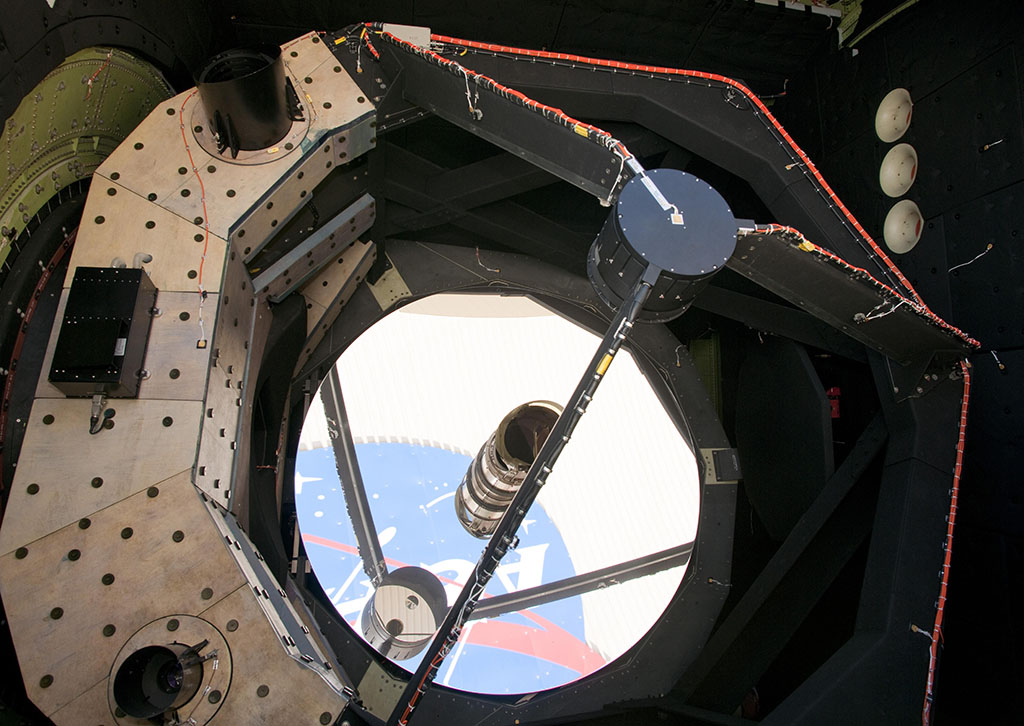 To begin with, it was necessary to create a telescope support structure It had to be both rigid and light, so as not to weigh the aircraft down too much. This also meant adapt the external appearance of the aircraft itself, This gave it a “hunchback” appearance. It was also necessary to create a system to stabilise the movement of the aircraft in such a way that the vibration did not affect the observation. Another no less important issue was eliminate turbulence that would surely be generated by opening the gigantic door protecting the telescope in flight.
This huge door was one of the biggest challenges. Measuring 16 x 23 metres, it had to be opened in mid-flight, at cruising speed, and under extreme pressure and temperature conditions. And can you imagine the impact of the air with the door open?
In practice, all these challenges were successfully met. SOFIA made its maiden flight in April 2007 and made its first - and successful - observations in 2010, opening a new window on astronomical observation. NASA expects it to have a lifetime of 20 years.
In this video what we attach can tell you much more about SOFIA – [Watch video ].