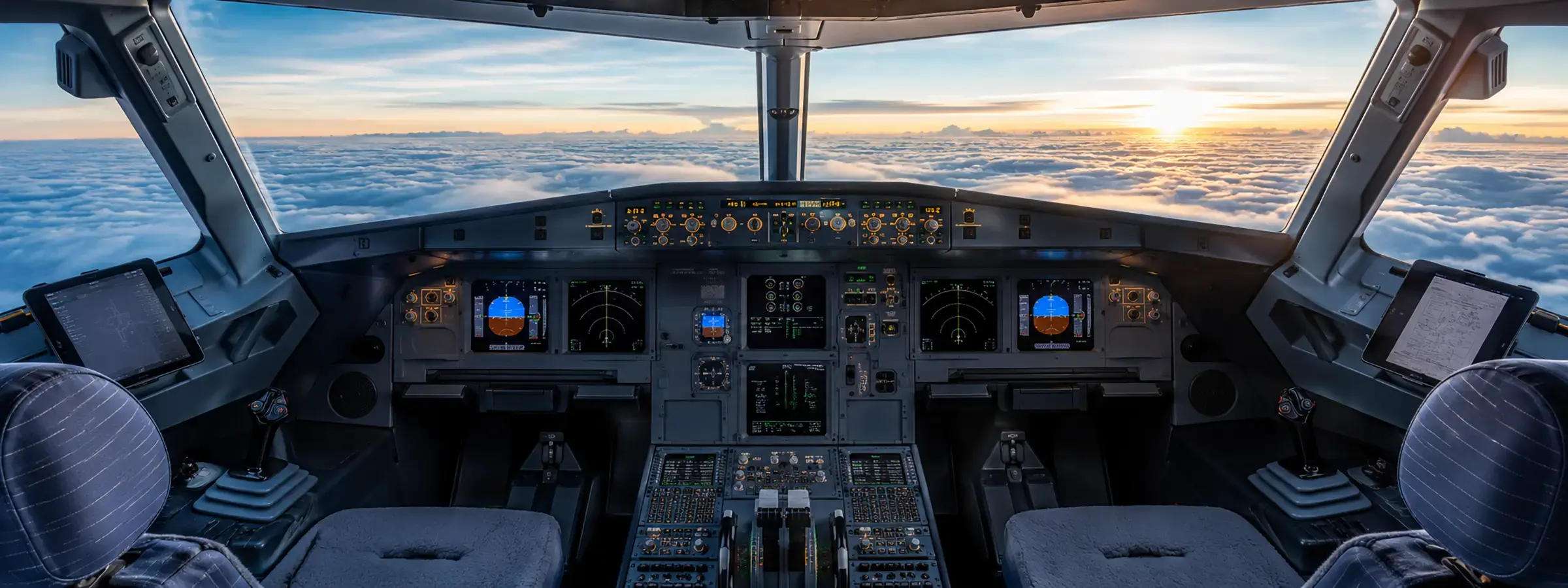
Despite the doubts that some passengers sometimes have about the quality of the air we breathe in the cabin, all issues relating to the quality of the air we breathe in the cabin have been resolved more than satisfactorily.
Those who travel by air are likely to be familiar with the expression “...".“pressurisation”. This is a process whereby compressed air is actively pumped into the airtight aircraft cabin to achieve conditions where any passenger or crew member can breathing normally. Although cabin pressurisation also has other structural connotations for the aircraft, it is an indispensable element for a living being to be able to travel by plane at a certain altitude.
Commercial aircraft typically fly at around 30,000 feet (about 10,000 metres) because at this altitude, engine performance is optimised due to lower atmospheric pressure and cooler air. In these conditions, combustion is improved and fuel savings are evident.. On the other hand, it is conditions that are hostile to human beings. Therefore, it is necessary to proceed to pressurisation, i.e. an artificial atmosphere is created inside the cabin, where there are three key parameters: pressure, temperature and humidity.
With regard to the air pressure, at sea level is 1.033 kgf/cm.2, whereas its average value at an altitude of 7,500 metres is 0.420 kgf/cm2. If we rise to an altitude of about 15,000 metres, it barely reaches 0.140 kgf/cm.2, which would not allow oxygen to reach some of the body's organs, leading to a hypoxaemia (1) (and predictable hypoxia) in a matter of seconds.
In general, the minimum pressure inside the cabin should not be less than that which could be experienced at an altitude of about 1800 metres, i.e. about 0.820 kgf/cm.2 and must be maintained in that environment even when the aircraft is flying at maximum altitude.
By means of controls that measure the differential pressure outside and inside the aircraft and valves called «...", the aircraft can be controlled by the aircraft.«outflow«is maintained, a constant pressure that can be modified by the crew depending on the needs of the moment. One of them is, for example, adapting to the conditions of the airport where the plane is going to land. Landing at Rome-Fiumicino airport, at sea level, is not the same as landing at 4,061 metres above sea level at El Alto airport (La Paz, Bolivia) or in Mexico City, at 2,238 metres above sea level.
As already mentioned, other parameters such as temperature and humidity are also important for passenger comfort.
To achieve the right atmosphere inside the aircraft, part of the air entering through the engines is used, where it is subjected to very high temperatures that ensure the elimination of micro-organisms, while at the same time producing a dewatering of it. It is then cooled and compressed so that the amount of oxygen per unit volume is increased to a level similar to that at the earth's surface. This process takes place in the compressor stages, so that the air has not been part of the combustion and has not been in contact with agents which may be harmful to health.
Before the air reaches the passage zone, it passes through a series of very high efficiency filters called HEPA (High Efficiency Particle Arresting) that can reach remove up to 99.97% of microscopic particles, The air is then discharged, eliminating possible pathogens and allergens, which are always undesirable. It can be said, therefore, that we can breathe calmly despite hearing the odd sneeze or cough in the cabin. The air is certainly healthier than the air we usually breathe in any of our cities.
With regard to the humidity, The average value in an aircraft is 12%, which is very low for what we are used to in general. Cabin humidification is a costly system, since in order to raise the aforementioned levels, it is necessary to act on air that is constantly being renewed. There are also other reasons for not doing it, such as the increase in the weight of the aircraft or the problem of deterioration that it could cause for some of the aircraft's components.
Another aspect of passenger respiratory comfort is the odours. Since the entire passenger cabin air is completely recycled every few minutes, one could say that the odour is necessarily neutral. The standard configuration of air circulation systems contributes to this. In general, fresh air usually enters through ventilation slots at the top of the cabin (apart from the customised ducts over the passengers“ heads) and exits through openings in the floor. This configuration is designed, among other reasons, to reduce the possibility of smells coming from other, more ”humanised" areas of the cabin.
There are many other aspects that can affect the passenger experience during a flight, but there is no doubt that everything to do with the air we breathe in the cabin is more than satisfactorily resolved. Have a good trip.

(1) Hypoxaemia is an abnormal decrease in the level of oxygen in arterial blood, with a pressure below 80 mmHg. Hypoxia, on the other hand, occurs when there is an insufficient amount of oxygen in the tissues.