Coordination and safety are two crucial elements for dispatching aircraft within the scheduled turnaround time at an airport.
When we are preparing to take a plane trip, we carry out a series of activities which are familiar to us: first, we head to the check-in area, where an employee awaits us to provide our boarding pass and check our luggage. After passing through security, we arrive at the boarding gate, where another employee checks our card. Furthermore, if the aircraft is parked remotely, another employee takes us to the aircraft by bus. Meanwhile, other workers have refuelled the plane, other agents have supplied the catering, the luggage has been loaded into the hold…
All this group of people, who possibly go unnoticed by most passengers, belong to what in English is called ‘ground handling’, that is to say, the Ground support.
Ground handling refers to the range of services provided at an airport to facilitate the arrival and departure of aircraft, passengers, and cargo.‘
The concept of ground handling, o ground handling according to the term used by the European Commission, it refers to a wide range of Services that airlines need to be able to operate their flights, from aircraft maintenance, refuelling and handling on the runway to passenger service at boarding, loading of luggage and cargo, and even in-flight catering or transport within the airport itself.
For the State Aviation Safety Agency (AESA), the ground handling Ground handling refers to all those services provided to the user as described in the Royal Decree 1161/199, which is the one regulates the provision of airport ground handling services.
Ground handling services
There are various services ‘handling’ airport-related according to their nature, which, in general terms, would be related to:
Passenger ground handling services
- Billing
- Boarding and loading of luggage and freight
- Passenger attention
Aircraft handling services
- A ramp
- Maintenance service
- Cleaning
- Supply and catering
- Fuel
Coordination services
- Coordination of ground handling with other airport operations
- Communication with authorities and air traffic control
At a more technical level, Annex of RD1161/1999 establishes the full list of ground support services and what each of these areas of ground handling:
- Assistance administrative and ground supervision: liaison with local authorities, control of cargo operations and telecommunications, handling and management of cargo units, and any other flight supervision services.
- Any form of assistance to passengers at the destination, arrival, in transit or in connection, in particular, control of documentation and baggage billing.
- Assistance luggageclassification, preparation for despatch, loading and unloading, transport, and distribution.
- Assistance Load and sendphysical handling of inbound and outbound cargo or mail, processing of corresponding documentation, and adoption of any necessary precautionary measures.
- Assistance runway operationsAircraft guidance, assistance with parking and supply, communications between the aircraft and ground agent, loading and unloading, assistance with starting and necessary movements.
- Assistance Aircraft cleaning and servicing the interior and exterior of the aircraft, air conditioning, cabin conditioning and its equipment.
- Assistance fuel and lubricants: organisation and execution of fuel filling and emptying, loading of lubricants and other liquids.
- Assistance maintenance On-line: regular pre-flight operations, specific operations required by the user, supply of necessary material, booking of a location to carry out maintenance operations.
- Flight operations assistance and administration crewFlight preparation, in-flight assistance, post-flight services, crew administration.
- Assistance Surface transportthe organisation and execution of regular or special transport of passengers, crew, luggage, goods and mail between different terminals.
- Butler assistance (cateringSupplier relations and administrative management, food storage, cleaning, preparation and delivery of materials and food, loading and unloading of food and beverages onto the aircraft.
Quality standards in ground handling services‘
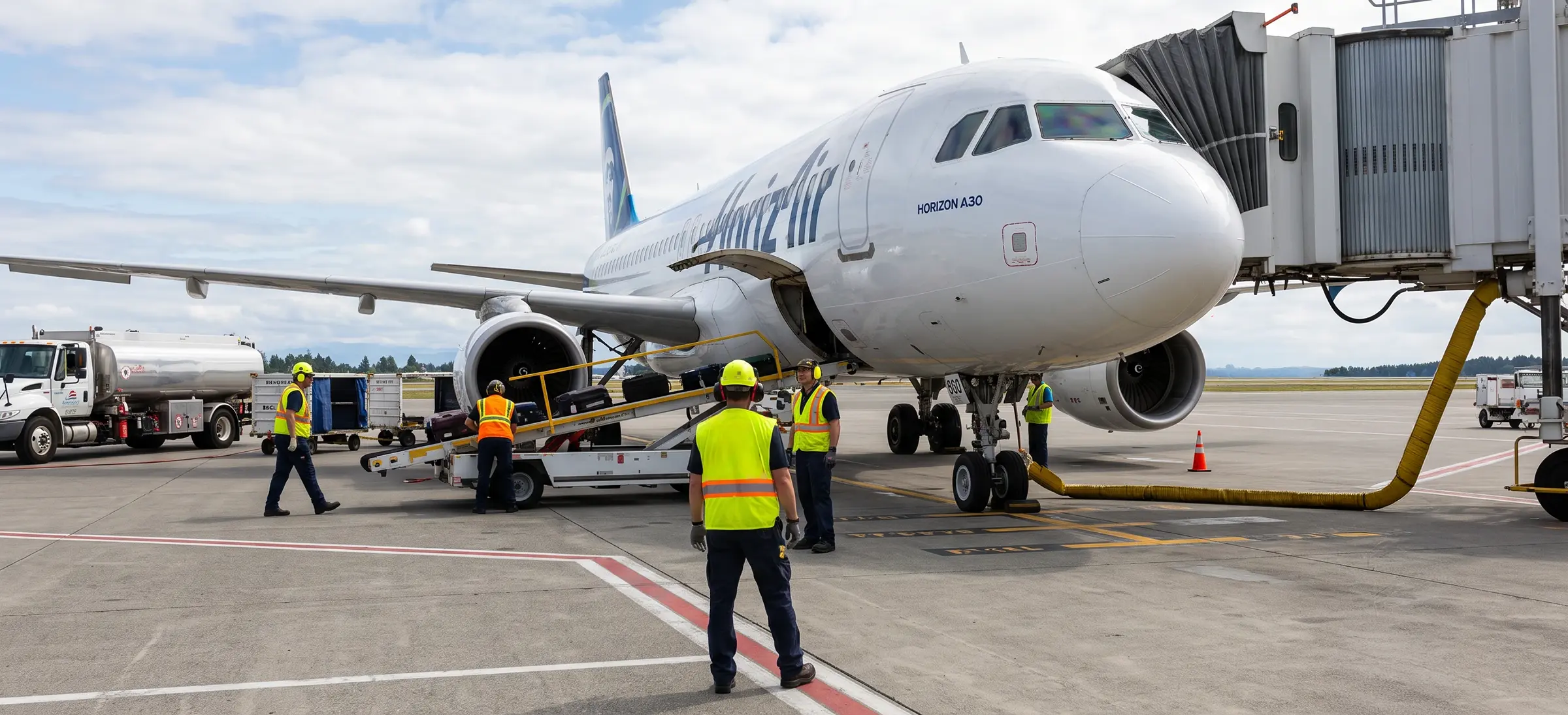
The header image of this post shows a specific moment of ground handling for an aircraft during its stopover. A significant volume of ground personnel and equipment accumulates around the aircraft, so the Coordination and security in the ground handling They are two crucial elements for dispatching the aircraft within the scheduled turnaround time.
The importance of Service Level Agreements (SLAs)
In parallel with punctuality, during the stopover, a level of quality in ground support. For this purpose, a set of SLAs or Service Level Agreement (SLAs), whereby a company or concession provides a service to the airport under certain conditions, in order to guarantee a minimum level of quality and performance.
And who sets a standard in these SLAs? The International Air Transport Association (IATA) establishes, through its Airport Handling Manual (AHM), standards for safe and efficient airport operations. Furthermore, day by day, IATA is responsible for innovating and researching new passenger assistance policies and safety guidelines.
Thanks to these standards, the service provider can size and adjust its own resources to the client's needs. During the provision of the service, the following are carried out SLA tracking to evaluate quality and any possible deviations and, if they exist, the client can demand corrective measures. In some cases, significant deviations may result in financial penalties.
The provision of good ground support contributes to the image projected by users and airlines of the airport, therefore all those involved in the process must ensure that an adequate level of quality is maintained.
AERTEC has a large Experience in performances and projects related to airport operations which helps, among other things, to ensure the establishment and maintenance of a correct ground handling and other operations services.