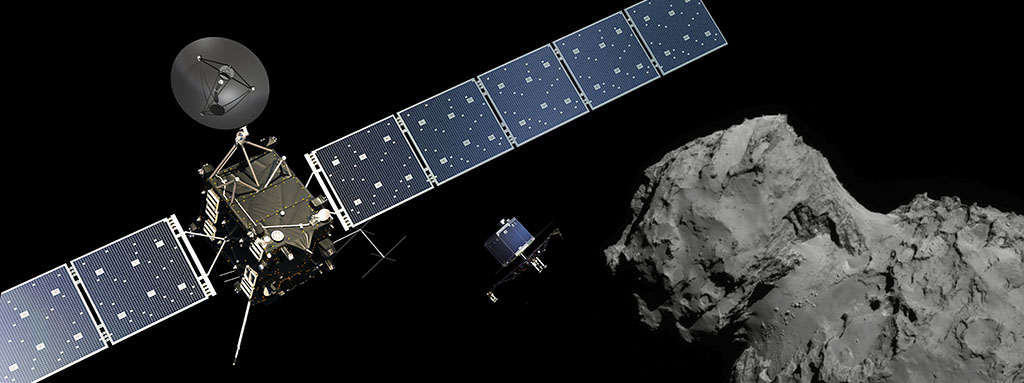
Since December 2014, when we were discussing on this very blog about the technological advancements In the aerospace context that made the Rosetta probe's mission into space possible, much has happened since then. Now, the Rosetta mission has concluded, as planned. It made a progressive descent over several hours, controlling its impact on the surface of comet 67P/Churyumov-Gerasimenko, which it has been studying for over twenty months since waking from its hibernation nearly 10 years after being launched.
The great success of the Rosetta probe's mission lies not only in the immense engineering challenge it posed, but also in the vast amount of data it obtained and provided for study over many years.
There is no doubt that this has been one of the boldest missions ever undertaken in the context of Aerospace engineering. Let's consider for a moment the enormous challenge of launching a small craft into space and, after many years of travel, having it settle into orbit around a comet. We mustn't lose sight of the difficulty involved, given that the speed of these celestial bodies can reach several hundred thousand kilometres per hour. On top of that, there's the ability to take samples and send the data back to Earth. There's no doubt that the success of the mission not only involves all possible knowledge of aerospace engineering, but its development also yields new knowledge that we will use on subsequent missions.
The decision to end the mission as it has, on the same comet, has provided the possibility of studying its entire environment in an exceptional way. Data have been collected concerning Gas, dust and plasma. Thousands of high-resolution photographs have been taken. And we must not forget Philae, the module that Rosetta deployed to land on the comet's surface for a few days, until its batteries ran out, dedicated to collecting data directly on its composition and the effects of its proximity to the sun.
This mission has revolutionised the way we understand and study the Solar System and the comets within it. Some of the most important results are related to the gases expelled from the comet's nucleus, highlighting the molecular oxygen and nitrogen and water. Regarding the information obtained, it is also being investigated whether it could contain ingredients considered key to the origin of life, as it also Glycine was detected, an amino acid which is often found in proteins, and phosphorus, a fundamental element of DNA and cell membranes.
Other results suggest that comets are the trace of the early stages of formation of the Solar System and no collisions between larger bodies as previously believed. Thus, data has been obtained on what the components that gave rise to the planets 4,500 million years ago might have been like.
The Rosetta Mission has gathered so much information that it has prolonged the continued work of technicians for many years. But that's not all. The volume of data obtained is of such magnitude that several generations of scientists will have the common goal of extracting all possible information from this mission for years to come.
Without a doubt, this has not been the end of a mission but the beginning of a great investigation.