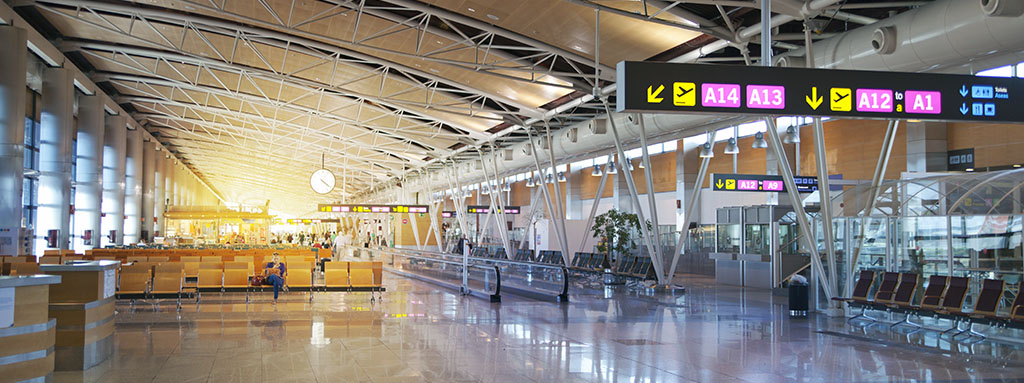
Among the many difficulties that the design of the Airport terminals passengers, perhaps one of the most important and sometimes overlooked, is the design from a fire-fighting perspective.
In Spain, the Technical Building Code, CTE, establishes the legal framework for complying with the basic requirements demanded in fire safety in buildings. It offers a rigid set of rules and procedures that are compiled in the Basic Document of Fire Safety as a recipe book, where parameters such as maximum evacuation route lengths or maximum dimensions of fire compartments are defined, which are to be valid for all types of buildings, but… what happens in a passenger terminal where compartment surfaces often exceed the maximums established in the standard? Or how is the evacuation of occupants reconciled without compromising the airport's operations and security?
 Fortunately, the CTE itself in article 5.1 allows Justify the safety conditions of a building in fire matters through alternative solutions.
Our experience at airports leads us to recommend carrying out a Analysis of the building's fire protection based on effectiveness and performance. This way, a set of specific measures is created with the aim of safeguarding human life without forgetting the operation of the airport itself. For this purpose, the Guide to Performance-Based Fire Protection Engineering, developed by the Society of Fire Protection Engineers, provides a methodology where it defines the sequence of steps to be followed to achieve the established goals as objectives.
For example, to justify the safe evacuation of occupants, the objective proposed is that people have sufficient time to reach exits without being dangerously affected by the effects of a fire. To achieve this, it is necessary to first analyse the type of passenger and their travel speed, the actual occupancy of the building, the fire detection time, and the time it takes for the passenger to start moving on to proceed with the evacuation. Subsequently, they are employed simulation programs to calculate total time How long does it take to evacuate the occupants.
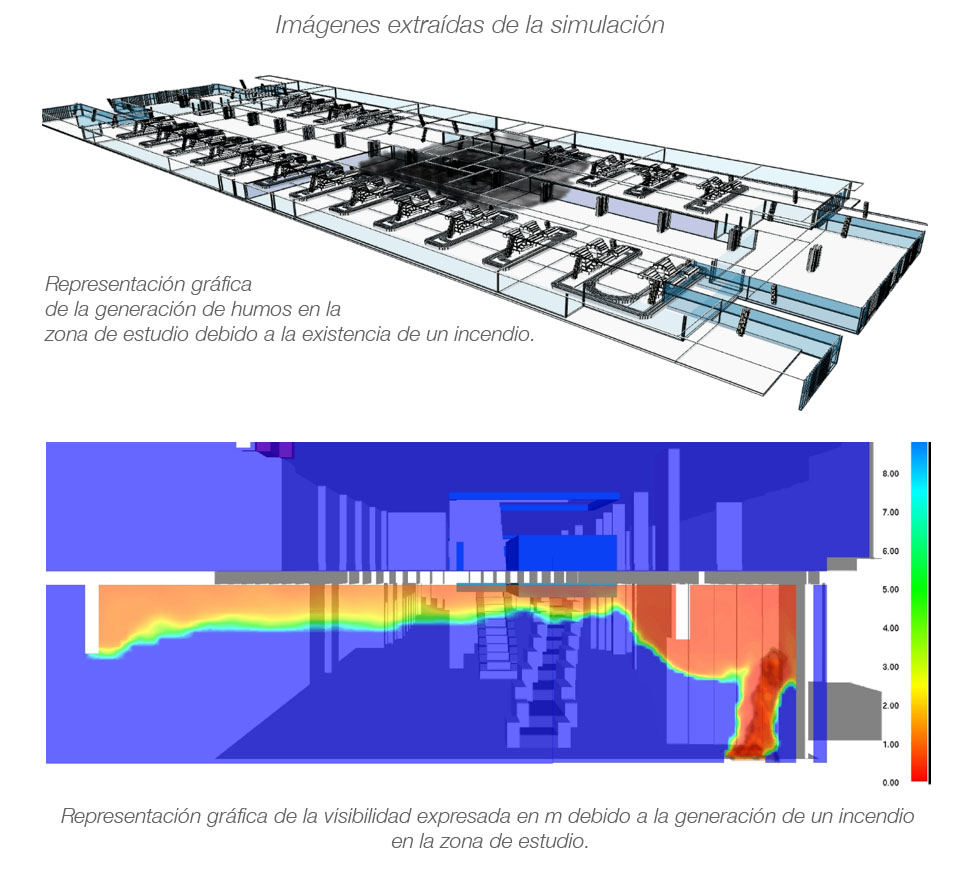
Concurrently, the available time for evacuation is calculated using a Computational fluid dynamics model to simulate fire development. This way, it is possible to estimate the time it takes for the environment to reach temperatures, smoke levels, radiation, CO concentrations, or visibility that are incompatible with people's safety. Finally, both values are compared in order to determine whether evacuation is safe or not. If it is not, solutions are proposed which are then included in a new simulation process until all deficiencies are ultimately corrected.
Recently, we applied this method to a terminal with 80,000 m2 of surface area. Throughout the process, a redefinition of evacuation lengths, the smoke control system was redesigned, sprinkler installation assessed, and a bespoke fire protection solution for the terminal was created. All of this provided a saving of €1.8 million, always guaranteeing the safety of people.