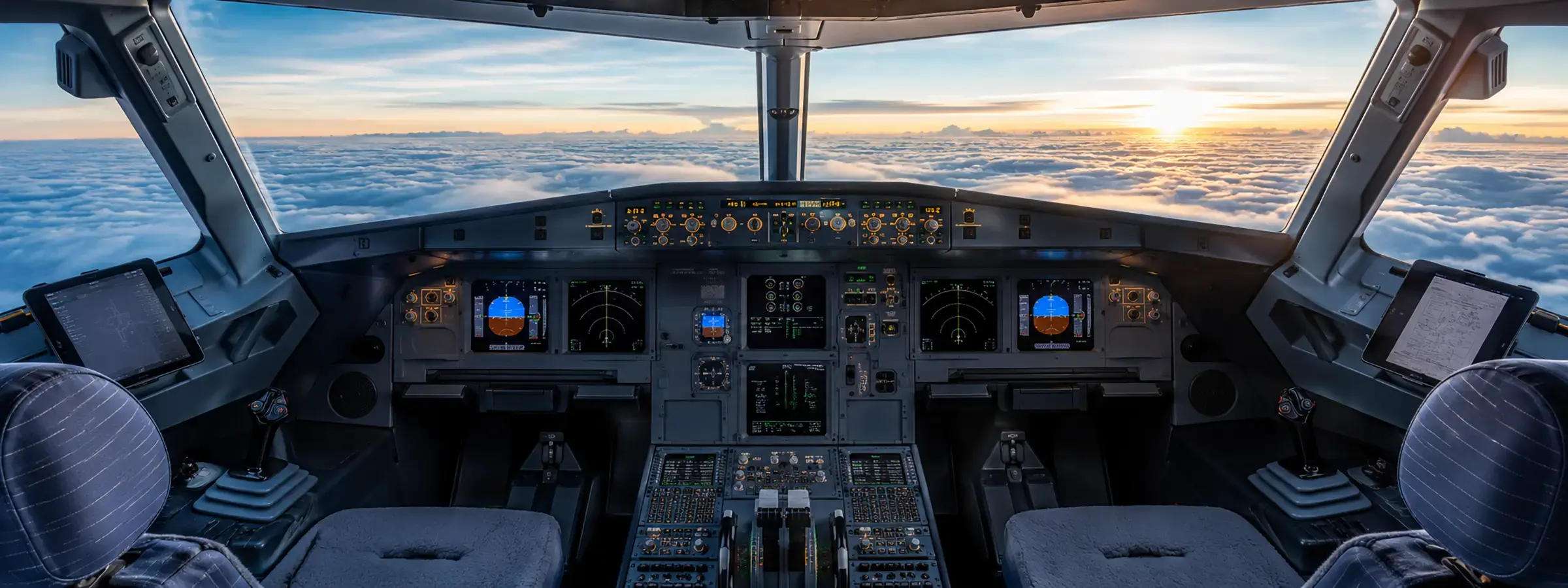
Advanced Air Mobility (AAM) is set to take centre stage in the coming years, and we have the opportunity to leverage prior knowledge to ensure it truly becomes a solution to urban mobility problems.
We are the protagonists of a huge urban transformation which is governed by the prism of people, mobility, the environment and technologies. It really is a paradigm shift.
Driving through the streets of any urban area requires knowing how to drive a vehicle, while also being aware throughout the route of driving regulations, signs, traffic lights, junctions, pedestrians, or unforeseen events that may arise. The rules create a common environment of understanding for all drivers, regardless of the type of vehicle they are driving. All of this mitigate the risks, not only for drivers, but also for the rest of the people and elements that make up the urban ecosystem.
Something similar happens in the air. Far from what some believe, The flight of aeroplanes is regulated by very strict legislation.. Furthermore, they have predefined routes and corridors, much like the streets of a city. All of this ensures that air travel is one of the safest modes of transport available.
In both cases there are two common elements. On the one hand, we have a Circulation structure (routes, corridors, streets, waypoints…) that provide predictability to traffic flows. On the other hand, a regulation of procedures which ensures that all stakeholders have an understanding of the operating rules and that risks are mitigated.
For a few years now, it has been forming a new type of passenger and cargo transport system oriented towards city environments (although not exclusively). This is the Urban Air Mobility (UAM by its English acronym, Urban Air Mobility) or its most recent evolution, the Advanced Air Mobility (AAM). This involves the use of vertical take-off and landing aerial vehicles, with electric propulsion and the capability to move automatically (even autonomously) or be remotely controlled. Generally, this type of aircraft is intended for small loads and no more than two passengers travelling between different areas within the same city, although the concept also includes communication between the city and rural areas, or between the city and intermodal transport hubs located outside its perimeter.
Many companies around the world have, over the past few years, embarked on a race to secure a still nascent market that could be worth around €4.5 billion in the coming years and generate over 90,000 jobs. This not only involves developing the aircraft that will serve this purpose, but also innovating in the technologies necessary for their operation, design, and construction of vertiports (or city skyportsand many other economic activities that will be generated around it.
The AAM will require a structured urban airspace with routes, corridors, and boundaries that will define where aerial vehicles are located and what their movement vectors will be. Development will also be necessary a specific regulation that foresees all the casuistry of this type of transport. And, of course, the existence of a single authority that monitors the system's operation and allows its constant adaptation. Let's not forget, in this regard, that urban airspace will have many operators (companies and individuals) and, therefore, will be a very dynamic environment where the status of vertiports, corridors, and routes will change rapidly in short spaces of time.
There are several premises that need to be addressed in any environment where one intends to implement a Management system for the AAM and which will constitute a challenge prior to their implementation:
- Urban Airspace Design and Procedures. Far from freeing up space for each aircraft to fly as it pleases, an aspect as undesirable as it is inconvenient, there must be a body that is responsible for designing the urban airspace structure (air routes, corridors and their limits) and the specific procedures. The structures will also identify points in space where aircraft will enter or exit adjacent airspace (e.g., controlled airspace near airports). All of this must be coordinated globally so that there are common basic criteria in all places where it is implemented.
- Creation of an information exchange system. It will be a critical service that will allow all stakeholders, both within and outside the regulated space, to interact, share information and make decisions using a coherent dataset. It is an environment where all information about airspace and flights will be dumped and collected in real-time. The information comes from, and is used by, air authorities, air traffic managers, vertiport managers, operators, pilots, etc.
From there, an operational environment will need to be put in place which must include the following services:
- Compliance ManagementPre-flight supervision of flight requests, ensuring the validity of authorisations, and pre-flight assistance if requested.
- Flight authorisationsAuthorisation for registered aircraft and pilots to be able to take flight within urban airspace. Authorisation will also be necessary for an aircraft entering the controlled perimeter.
- Air traffic managementCo-ordination of aircraft movements within urban airspace and separation between them to maintain operational integrity.
- Dynamic Airspace ManagementFlexible real-time management of routes, air corridors and their boundaries.
To all this, a new element needs to be added that enters the scene: carrying out automatic flights, or even freelancers. This implies that some, or all, of the processes involved in initiating, developing, or completing a flight will be managed by an independent system. This should not be a problem given that the aircraft being designed for urban air mobility can truly be considered flying computers.
It is foreseeable that each city, region or country has a different approach for the creation of urban space regulation and control bodies based on regulations, policies, strategies and resources. But, as has already been commented, There should be a series of common principles which must be respected by all stakeholders, as is already the case with air traffic control regulation.
The environmental impact This will also be one of the issues to be addressed, particularly everything relating to the noise generated by aerial vehicles. Although combustion engines will be phased out in this type of aircraft, the friction from the rotors generates a noise about which 38% of the population have expressed reservations, according to a recent study carried out by the European Aviation Safety Agency, EASA (See full study here).
Given the configuration of this new transport system, as well as its high technological dependence, it will be necessary to A strong commitment to cybersecurity much further than has ever been possible with any other transport system.
It is also worth mentioning an aspect that will be key both in the implementation and development of the AAM: the confidence and acceptance by the citizen. At present, according to the study mentioned, 83% of those surveyed were in favour of introducing AAM in their cities. As many as 49% would even be willing to take a ride in an air taxi.
There is still a long way to go before all these steps, and some more, are completed and we can see the dream of personal and autonomous air transport in our metropolitan environments become a reality. In an industry like aviation, where we rightly pride ourselves on extensive and detailed regulations that allow for a very high standard of safety, we must also be aware that the implementation of AAM requires adequate regulation and, above all, to take each step with the solvency that such an important change, as the one before us, requires.