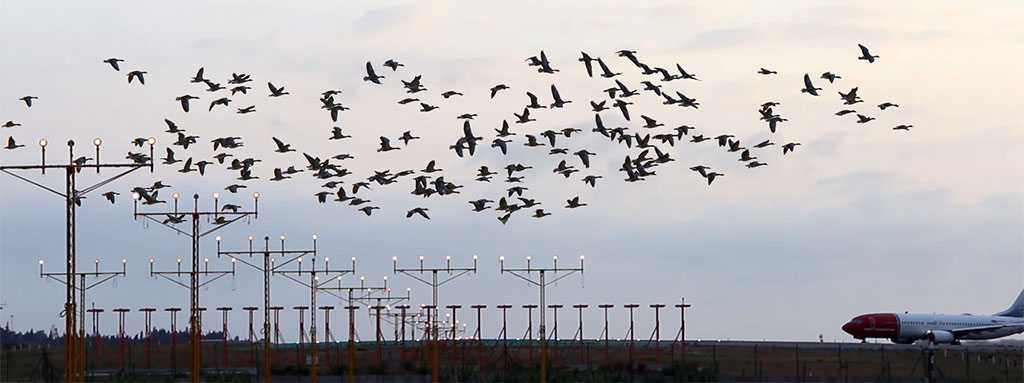
The presence of birds at take-off and landing manoeuvres of aircraft can lead to unforeseeable situations. A bird strike can cause serious damage to aircraft engines or glass, putting passengers and crew at risk.
For this reason, it is essential to application of techniques to avoid the presence of birds at airports around the world.
Falconry, which is becoming more and more widespread, is an effective and nature-friendly measure.
The first and most necessary is to ensure that there are no hot spots in the airport environment, such as:
- Nesting sites
- Trees that can attract them.
- Presence of food.
- Ponds or areas where puddles form.
In addition to these preventive actions, there are different methods to scare away invasive birds and that the chances of collision are reduced as much as possible.
It is curious to note that there are airports where we can find scarecrows, such as those in agricultural fields. Evidently this measure is rather poor and if it is not accompanied by other dissuasive tools, it is not very effective.
A widely used method is the emission of sounds to scare them away. This is done by using blanks, launching flares, reproducing the squawks of predatory birds, etc. This technique is effective when it is first used, but after a while, the birds become accustomed to these sounds, consider them as part of the habitat and stop responding to them.
The most effective measure today is the use of the falconry. Expert raptor trainers work at airports to keep birds of prey away from other birds. In this case, this is not the case as with other types of measures already mentioned, since animals never get used to the presence of their natural predators. and are kept away from them on a permanent basis. Even so, there is no repetition of locations and times of action, to prevent the invasive birds from becoming accustomed to a pattern of behaviour and trying to avoid it.
Falconers sometimes use trained dogs to detect and scare away invasive birds that may be hiding and not spotted by the raptors.
This measure is respectful of nature, The main focus is on preventive and dissuasive flights, in order to keep the birds away. In the event that the bird of prey intervenes directly and hunts a specimen, it will always target the weakest, applying the principle of natural selection.
Numerous airports have breeding centres for falcons and eagles, among other species, participating in programmes for the preservation of these species.
Once again, it is nature that gives us the best response to a problem, in this case, of area security.