EUROSATORY has established itself as the leading global gathering for the defence and security industry in an international landscape characterised by armed conflicts, hybrid threats and a growing need for technological sovereignty
In June 2026, Paris will once again become one of the major hubs of the international defence and security industry with the staging of EUROSATORY, the world’s leading trade fair in the sector. The event will take place from 15 to 19 June at the Paris-Nord Villepinte exhibition centre and will bring together thousands of companies, government delegations, armed forces, technology centres and procurement officials from dozens of countries.
The history of EUROSATORY is, to a large extent, the story of the transformation of European defence over the last six decades. Its origins date back to 1967, when the French Directorate-General for Armaments organised a small technical exhibition at the Satory military camp, featuring just thirty or so exhibitors. That event focused almost exclusively on French and European land-based equipment. However, the growth of the industry and the new geopolitical balance following the Cold War drove a profound evolution of the event. In 1992, it officially adopted the name EUROSATORY and began its truly European phase; in 1996, it became fully international with the inclusion of manufacturers from Russia and other global markets.
The thematic evolution of EUROSATORY accurately reflects the transformation of the contemporary concept of security. For years, the exhibition was dominated by armoured vehicles, artillery and traditional land combat systems. However, from the 2010s onwards, areas such as cyber defence, unmanned systems, artificial intelligence, electronic warfare, advanced simulation and the protection of critical infrastructure began to take centre stage.
EUROSATORY has also been the scene of events that illustrate the ongoing tension between industry, politics and international diplomacy. The 2022 edition took place just a few months after Russia’s invasion of Ukraine, against a backdrop marked by the return of conventional warfare to Europe. That edition was regarded as one of the most significant in its recent history and even featured an official opening by the French President, something that had never happened before.
Two years later, the exhibition once again made international headlines due to the controversy surrounding the participation of Israeli companies in the midst of the Gaza conflict. The restrictions initially imposed by the French authorities led to legal challenges and conflicting rulings, ultimately turning the event into a direct reflection of global geopolitical tensions. This political dimension confirms that EUROSATORY is no longer merely a trade fair: it is also a forum where alliances, strategic priorities and shifts in the international balance of power are played out.
The 2026 edition will take place against a particularly complex international backdrop. The war in Ukraine continues to reshape European military doctrines; the Middle East remains a constant source of instability; tensions in the Indo-Pacific are mounting around Taiwan and the South China Sea; and hybrid threats—cyberattacks, sabotage of critical infrastructure, information warfare and threats to supply chains—are now a structural part of the Western security agenda. At the same time, numerous European governments have significantly increased their defence budgets and accelerated industrial and technological modernisation programmes.
In this context, the presence of innovative companies at EUROSATORY takes on clear strategic importance. The exhibition serves not only as a commercial showcase, but also as a forum where institutional relationships are forged, industrial alliances are strengthened, and technological capabilities are identified that can be integrated into international defence and security programmes. For many companies, being present means gaining direct access to military procurement officers, government bodies, international integrators and leading technology partners.
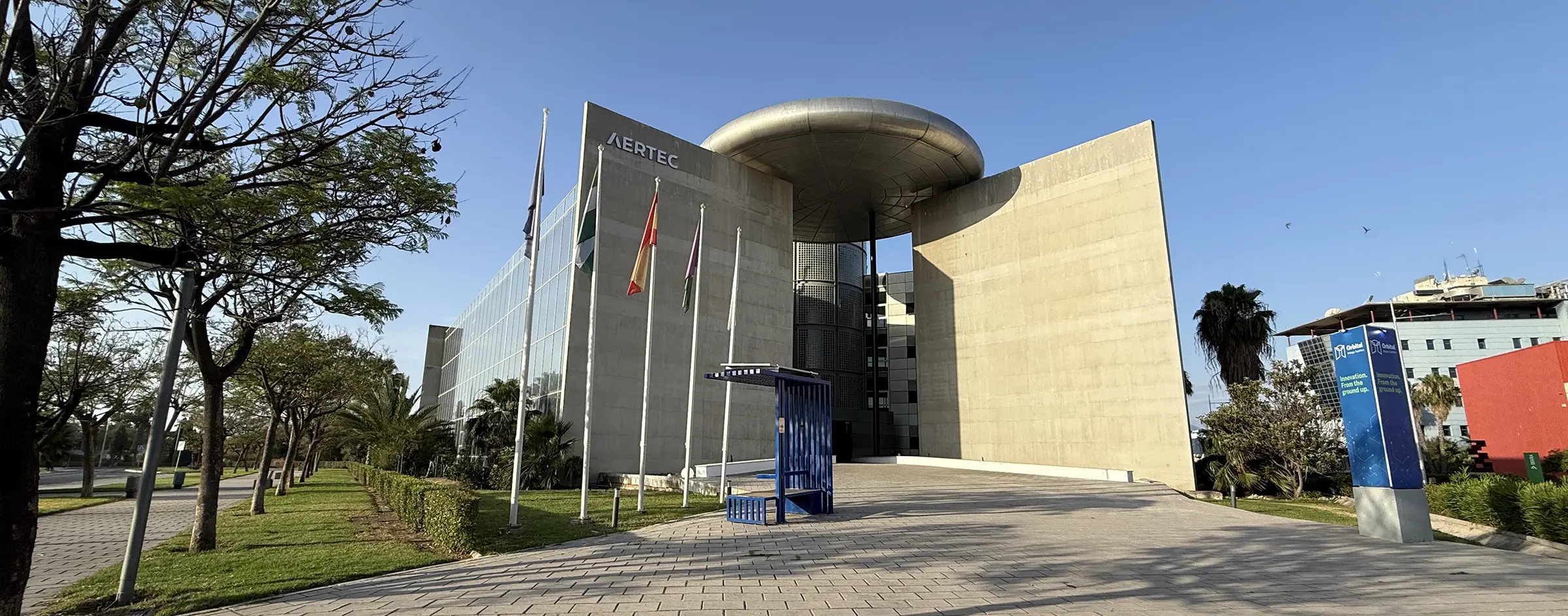
For AERTEC, participating in an event such as EUROSATORY is also consistent with its development as a technology and industrial company linked to the aerospace and defence sectors. The exhibition represents an opportunity to showcase its own developments in a highly competitive international market where European technological sovereignty has become a political and industrial priority.
The importance of showcasing in-house developed products is particularly significant in the current climate. The European defence industry is increasingly seeking to reduce external dependencies and strengthen national and continental capabilities in areas such as intelligent systems, surveillance solutions, operational digitalisation and dual-use technologies. In this context, a company’s ability to design, integrate and develop its own solutions provides a competitive advantage far superior to that of acting solely as an integration or distribution provider.
Furthermore, exhibiting at EUROSATORY allows us to project an image of technological and industrial strength to international clients and partners. In a sector where trust, innovation and technical credibility are key factors, participating in the world’s leading land defence and security exhibition also serves as a statement of our strategic positioning.
More than half a century after that small exhibition held at the Satory camp, EUROSATORY has established itself as one of the key barometers of international security. Its growth has mirrored the transformations in the global geopolitical landscape and today reflects, with remarkable precision, the technological, industrial and strategic priorities of an era marked by considerable uncertainty. For companies in the sector, not being there means being left out of a global conversation that is already shaping the future of international defence and security.
Related topics: Eurosatory