The chronological simultaneity of the triumph of 20th-century avant-gardes with the most spectacular development of commercial aviation in the inter-war period, meant more than a historical coincidence for architecture. The relationship that was established between the prevailing school of thought at that time, with its main figure Le Corbusier at the forefront, and the increasingly technological and emerging aeronautical universe, was practically immediate. Not in vain modern times dictated that cutting-edge architecture had to be identified with technological progress and indeed, flying had become a symbol of that progress.
Mid-last century saw rationalisation, industrialisation and prefabrication make their mark on airport design, and these concepts have remained present in their design ever since.
So it's no wonder that the very Le Corbusier, whose ideal of housing was the living machine –dwelling machine he would show all his enthusiasm for aeronautics and all that it represented. Some authors even dub this enthusiasm a true obsession,[1] above all for the most representative element of that universe: the aeroplane, the flying machine. But beyond the evident rationalist connection and the common complicity in achieving the ideal of “modern life”, this obsession of the Swiss architect had another fundamental facet, which we can extract from his own writings.[2]
Revolutionise the world and achieve a bird's-eye view..This is how, in addition to changing our perception of the world (and why not, its size), these fantastic devices represented a new tool for practising the profession: aerial photography. The changes brought about by the awareness of this new point of view are what lead to the sentencing of Le Corbusier In 1935, a more than significant “the aeroplane accuses”.[3]
somehow this duality meant that the modern movement found in the airport design a ram of his principles buildings that were eminently functional, with attractive aeronautical shapes and which could also be seen in their entirety as soon as one took off or approached to land. Despite all of this, the examples that have survived to our day are not very numerous and none of them, with some exceptions, are identified with the legacy left by the modern movement and the eclectic situation that followed it in the second half of the 20th century.
Furthermore, for some reason, the results seen in the first half of the century seemed to have “capitulated” to the more austere “international style”, finding themselves confined within cold, rectilinear, and unyielding volumes.
This void is very possibly caused in part by the strange nature that accompanies passenger terminals: ephemeral, changing buildings, but constructed with enormous technological, economic, and planning effort. Always additive, never subtractive.
The dwelling machine made way for the rationalisation, industrialisation and prefabrication. It had to be a useful object, manufactured by assembling industrialised components taken from the «building element box”.” [4] promulgated by Le Corbusier. Exactly the same as a plane. Even more so at an airport.
However, as was noted earlier, few proposals of interest have emerged to date regarding this new programmatic typology. Perhaps the most striking is the one outlined Erich Mendelsohn in 1914,[5] a sort of large hangar with shapes evoking aeronautical aesthetics.
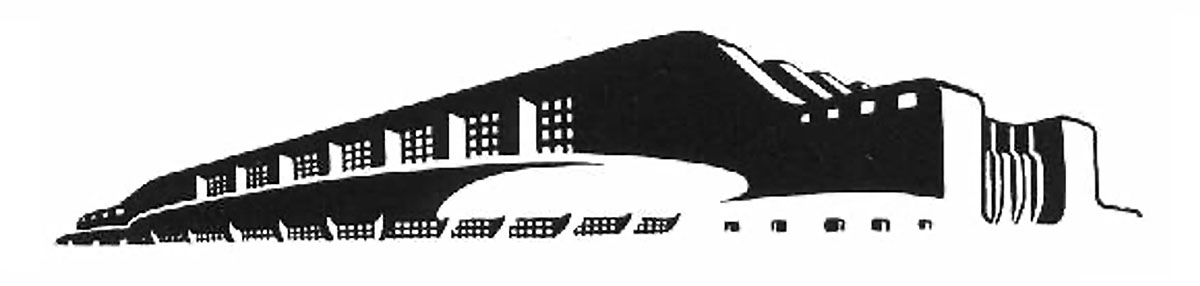
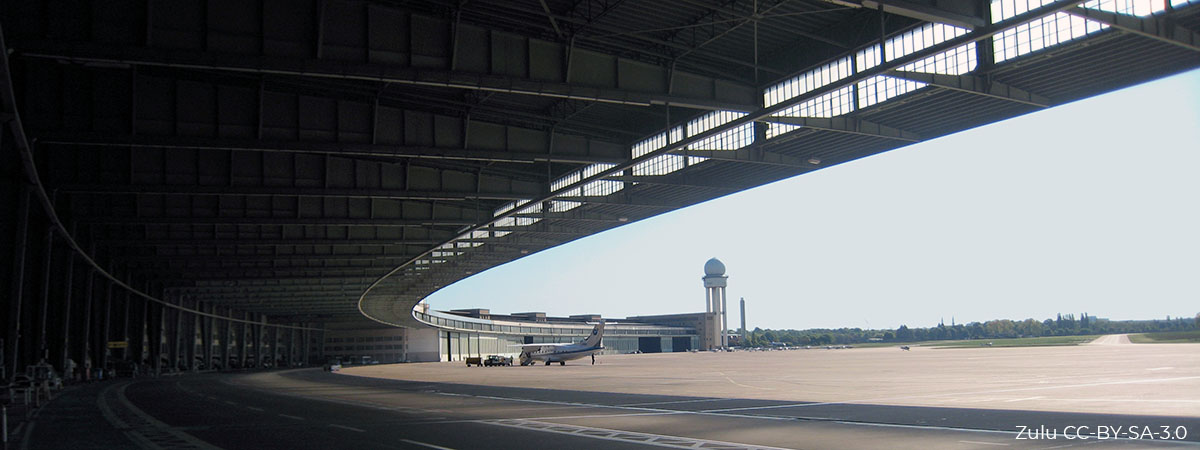
This building is a true reflection of the Expressionism that the architect of the so-called “first generation” would use just 3 years later in his Tower Einstein, in Potsdam. His way of composing the elements seems to anticipate current terminals more than those that chronologically came after. In fact, years later, a disciple of Mendelsohn, Ernst Sagebiel, ; it would sign the one that has practically been the only airport terminal to reach the present day in operational condition (it ceased activity in 2008): Tempelhof, in Berlin, a dream of Hitler, christened the mother of all airports for Foster .[6]
It is clear that architects saw the use of technical advancements, such as reinforced concrete, as the solution to many of the challenges posed by their new architecture. It was through the use of this material that Le Corbusier put forward the five points of this new architecture.[7] Above those five points, two of them would be fundamental for organising future terminals: The open-plan layout – load-bearing walls no longer define the floor plan and, therefore, the different levels of the building already have the same layout – and the large openings in the facade.
But the impact of aviation on architects' thinking was not solely focused on terminal buildings. It obviously was – and remains – the most representative building of an aerodrome. However, it is the airfield itself, as well as all the elements that will gradually proliferate around it, that truly represent – and will represent – an immense impact, not only on its immediate surroundings but on the complicated and unstable balance of realities that our cities are today. In terms of energy, resources, mobility, and, of course, morphology.
[1] Bibián Diaz, Concepción, (2014). Airport Architecture. Notebook 15. p. 19
[2] Le Corbusier, (1938). The airway.
[3] Le Corbusier, (1938). The airway. “We knew that our cities were undignified, despised by most of those who inhabited them and who would remain indifferent to reason, to society, to family and to all sentient beings. We knew this, but we did not suspect the extent of this filth and dishonesty of the city towards its inhabitants. The plane observed, informed us and accused.”.
[4] Le Corbusier (1923). Towards an Architecture. The house, understood as a machine, must be a useful object, manufactured by assembling industrialised parts, just like a car, an aeroplane, or a ship. For this reason, we need to create the “Box of Building Elements» which will make the industrialisation of architecture possible.
[5] In 1914, Mendelsohn had designed a spectacular airfield of enormous dimensions. With a curved line, a large central hall extended into a low horizontal body to accommodate up to six aircraft, also housing hangars for planes and workshops on each side. http://vaumm.com/tempelhof-el-aeropuerto-de-hitler/
[6] Until the creation of Pentagon, Tempelhof Airport terminal was the largest building in the world. Norman Foster described it as «the mother of all airports».review)
[7] Le Corbusier and P. Jeanneret (1926) The five points of a new architecture. Document in which some ideas, finalised in previous years, are presented systematically.