By definition, wind is a current of air produced by natural causes such as changes in pressure or temperature. However, there is another method of generating wind that was identified in the 1920s and developed in the 1960s: ionic wind. Also known as electro-aerodynamic thrust The French word "un" translates to "one" or "a/an" in English. It's a numeral and an indefinite article. wind or thrust that can be produced when an electric current passes between a thin electrode and a thick one. If enough voltage is applied, the electrodes can produce energy to power a small aircraft. However, it was limited to experiments without much prospect of finding feasible practical applications.
In the search for new aircraft propulsion systems, ionic wind has re-emerged as an alternative to study; it's still a little way off, but promising.
Over the years, numerous researchers have supported the hypothesis that in the specific case of using ion thrusters for jet propulsion (a procedure used to move a vehicle forward by expelling a stream of gases produced at high pressure by the engine in the opposite direction of travel), they will always be tremendously inefficient no matter how many improvements are made to the design, since require enormous amounts of electricity to produce enough thrust to propel a vehicle.
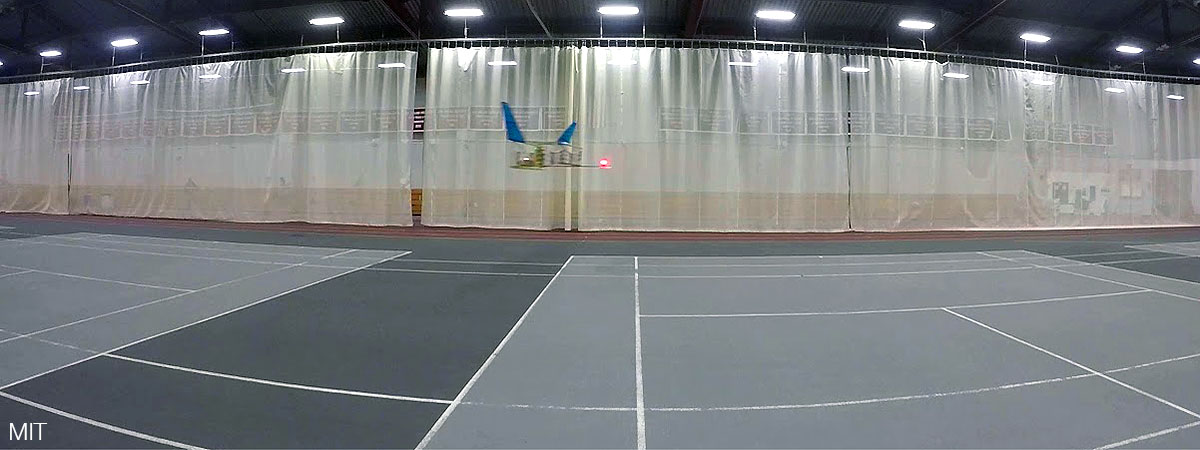
Recently, engineers at MIT (Massachusetts Institute of Technology) have built and successfully flown the first aircraft based on this concept, without turbine engines or propellers and which also does not rely on fossil fuels. They have managed to achieve sustained flight, demonstrating that this technology is possible. Instead of a traditional engine This aircraft is propelled by ionising the air and generating sufficient thrust to sustain it in constant flight..
The aircraft has a wingspan of 5 metres and weighs 2.45 kg, which, as an interesting comparison, is about one-tenth of the luggage allowance for a single passenger on a typical commercial flight. It has thin electrodes extending across its wings; at the front of these are thin wires, and at the rear is a curved aerofoil to produce lift. With its 500-watt lithium polymer battery, the thin wires at the front are charged to +20,000 volts and the aerofoil at the rear is charged to -20,000 volts., what creates a strong electric field. On the front, electrons are stripped from nitrogen molecules in the air to produce ions, and as these are accelerated backwards, they produce an ion wind which gives the aircraft thrust.
During the 10 test flights, the aircraft successfully flew approximately 60 metres in about 12 seconds with a thrust efficiency of approximately 2.6 %, but, As the speed increases, the system efficiency increases. Theoretically, at 1,080 km/h – faster than a passenger aeroplane – it achieves an efficiency of 50 %. The technology is similar to that used by ion engines on some spacecraft for space travel, although in their case they rely on the ionisation of a fuel such as xenon gas to produce thrust.
The key element of this ionic flight is the use of very lightweight batteries capable of producing a high-capacity discharge for a long time. The problem of electro-aerodynamics is how to generate enormous potential differences at very low cost, with very low weight and high durability. The major advancements expected in batteries over the coming years will be essential, as the electrical power source is the most significant restriction in the prototype's design.
Furthermore, it should be taken into account that the prospects for building an aircraft with wings reaching 15 or 20 metres are good, but manufacturing wings of 30 or 40 metres, like those on large passenger aircraft, involves development and design work that could take over 10 years. Another question is whether this new ionic wind motor is scalable. The most similar experience in design is solar-powered aircraft, which use photovoltaic solar energy to power electric motors, which are also very quiet compared to traditional fuel engines.
Perhaps it is more reasonable to think of a Hybrid propulsion technology which would allow us to have more efficient, quieter, mechanically simpler aircraft that do not emit so much pollution, according to a statement from MIT, as well as the idea from its engineers that, in the short term, this ionic wind propulsion system could be used to manufacture quieter drones.
A challenge that any ion-wind-powered aircraft will have to face is that, by the nature of the system, the engine components cannot be concentrated in a single area, but rather occupy points all over the vehicle. This is because ion thrusters depend on the wind produced between the electrodes; the larger the gap between the electrodes, the stronger the thrust produced. For an aircraft, that gap will obviously be the one from one end of the vehicle to the other.
There are many other challenges to overcome for the use of this technology. One of them, important, though not insurmountable, is the enormous voltage needed for the aircraft to take off.
It's possible that all these investigations and tests lead nowhere, but what's beyond doubt is that they are trendsetting innovations in the search for More environmentally friendly solutions.
In any of these cases and having reached an appropriate level of efficiency, This could be the birth of a new way of flying.