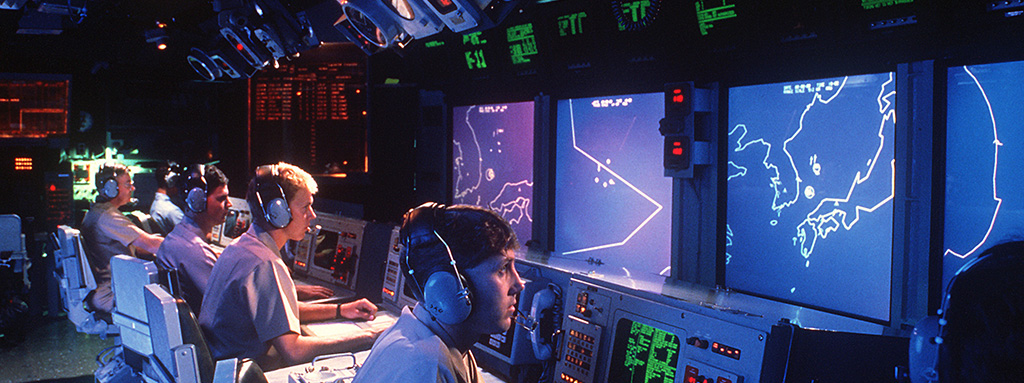
The air forces are trying to reduce the vulnerability of their aircraft attempting to make them less visible to the enemy. Before the Second World War, the mimetic painting to bypass the enemy's visual detection means, but since then, radar has become the principal method of aircraft detection, locating them miles away.
The effectiveness of air power in any war conflict depends, among other capabilities, on avoiding detection. Conversely, the enemy will work on appropriate countermeasures.
Low observability technology attempts to camouflage aircraft from radar by sending a focused beam of electromagnetic radiation. Part of it is reflected by the aircraft back to the radar antenna. This reflected energy determines what the radar can and cannot see.
During the Second World War, bombers would drop thin strips of aluminium foil strips called chaff, which, carried by the wind, formed enormous clouds on enemy radar screens. This made it impossible to ascertain the precise position of the attacking bombers.
In the 50s, advances in radar technology made it possible to see through these clouds, so they resorted to electronic interference. Electronic countermeasures were fitted to aircraft that could emit false signals that blinded radars by obscuring reflected signals with stronger ones. Every new technology has always led to the emergence of a countermeasure.
The Quail decoy missile in the 1960s proposed another system. It took advantage of the fact that an aircraft's visibility to radar was determined more for its shape than its size. This is how right angles concentrate radar signals and reflect them intensely. In this way, the Quail appeared on enemy operators' screens with the same size as a B-52 bomber. These aircraft would launch several Quails on false headings to confuse the enemy about the number and location of the attackers.
And if the Quail could appear larger on radar than it actually was, perhaps a plane could be configured so its image would practically disappear. This idea led to low-observability technology, popularly known as stealth.
There is currently talk that stealth aircraft such as the Northrop Grumman B-2 Spirit or the Lockheed F-117 fighter can be detected by the new Russian Rezonans NE radar. The Chinese KJ-600 aircraft, a turboprop fitted with an Active Electronically Scanned Array (ASEA) radar that emits radio waves of different frequencies alternated rapidly, is also capable of doing so.
Undoubtedly, once detection technology has been accounted for, engineers will design new systems to try and circumvent it. The objective will always be the same: for some to see and for others to remain unseen.