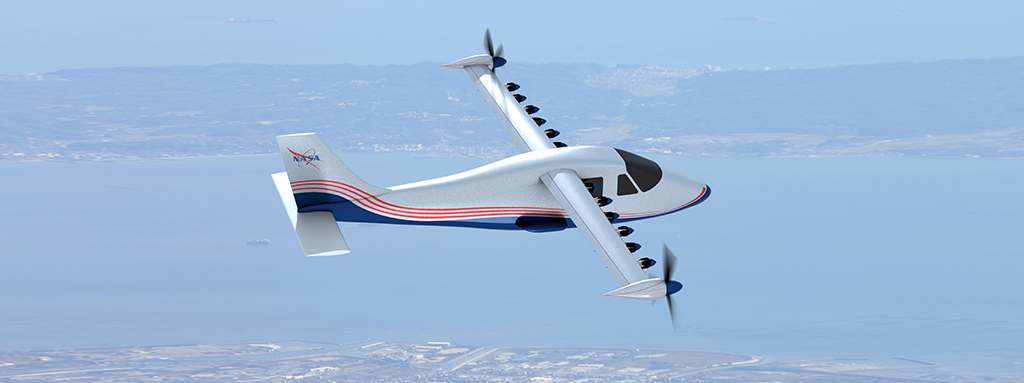
The Electric motors, which burst onto a sector of constant innovation like aviation several years ago, have managed to be the subject of attention in recent months. The aeronautical world is studying the possibility of offering an interesting alternative for short flights with the use of electric motors in aeroplanes, a matter that would lead to them being more economical and efficient than conventional models.
There may be more or less time left, but what is beyond doubt is that the journey has already begun and electric propulsion for aircraft will soon be part of our lives.
Today there is a real race to be the first to offer their solutions in this field. The company Zunum Aero, a startup founded in 2013 and already known as the “Tesla of aviation”, aims to launch its first line of electric aircraft in 2020. Its intention is to make short flights with a capacity of between 10 and 50 people and around 1000 km in distance, expecting to increase performance with the passage of years and technological improvements. For the moment, this company intends to use hybrid aircraft, that is to say, will use combustion engines together with electric ones to extend the range on journeys. It's something similar to the prototype Siemens 330LE, which, in cooperation with Airbus, also makes use of hybrid engines in a similar way to what we are already experiencing in the automotive sector.
Statistical studies carried out indicate that 95%: journeys of less than 700 km are made by car. For journeys between 800 and 1,200 km, the rate falls to 61%, and between 1,200 and 1,600 km it reaches 50%. Consequently, it seems logical to assume that a proportion of these figures could be met by electric-powered aircraft, provided their price is competitive. The main drawback is the same as ever – one of engineering’s greatest unresolved challenges, batteries, which do not yet meet the capacities that would allow offering performance comparable to commercial aeroplanes today. Despite these difficulties, Boeing and JetBlue have already invested in Zunum’s programmes, aiming to keep a close eye on the development of these engines. Another company with a similar project is Wright Electric, which, together with the collaboration of Easyjet, aims to launch commercial flights with electric aircraft in the next 10 years and attempt to compete in the segment of Boeing's 737 and Airbus's A320, the best-selling commercial aircraft.
The aeronautical world was already surprised by the Solar Impulse II, which managed to circumnavigate the globe without emissions by using the 17,000 solar A new aeronautical trend. Furthermore, AIRBUS It also intends to market its first electric aircraft this year, the E-Fan 2.0, an electric two-seater that will, in principle, be used for pilot training. The prototype of this model successfully crossed the English Channel, although the company decided not to continue developing it commercially.
Electric propulsion has also arrived in US experimental aircraft series, some designed by the NASA, such as X-57 Maxwell, and others projected by DARPA (Defence Advanced Research Projects Agency, or DARPA) with programmes such as the creation of the XV-24A Lightning Strike.
What is clear is that we are immersed in a new aeronautical era where the use of electric motors seems to be the fundamental pillar of a specific line of developments. The most obvious case is drones. Companies such as XTI Aircraft Company are interested in the launch of projects on the creation of electric aircraft with vertical take-off and landing (VTOL) capability for passenger transport. In fact, the German company E-Volo already has its tested prototype, the Volocopter VC200, considered an electric multi-rotor helicopter or “multicopter”. In the air, the 18 rotors of the Volocopter VC200 ensure great stability, even if it is not capable of flying at high speed, for the moment. Everything points to the fact that from 2018 they will be in service in Dubai for urban mobility. But there are more projects aimed at similar objectives. Also from Germany, commercialisation is sought by 2018 of the Lilium Jet in collaboration with the European Space Agency. And even from Switzerland, an experimental project called H55 has been proposed, which has developed the aEro1 aircraft, which also uses electric propulsion technology for movement.
Certainly, the ideal situation would undoubtedly be that we could enjoy this type of transport in our daily lives, if price.
There may be more or less time left, but what is beyond doubt is that the journey has already begun and electric propulsion for aircraft will soon be part of our lives.