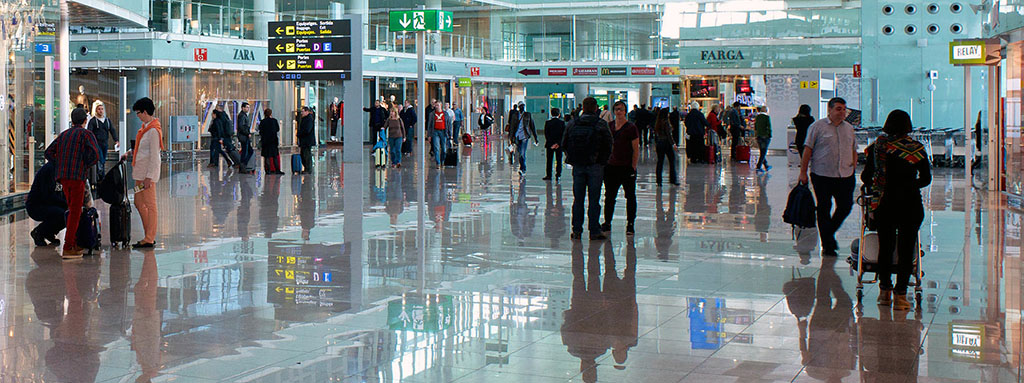
The airport terminal is a complex building. Unlike other buildings, the dimensions of the different spaces and rooms of which it is composed are generally unknown. Therefore, before starting the architectural design, a series of parameters describing and quantifying the needs to be met by the terminal.
One of the most complex tasks in the design of an airport terminal is to adapt it to the movement of passengers that it will have in the future.
For a passenger terminal, the most important parameter is the Peak Passenger Time (PHP). The definition of this concept is critical. Peak Hour Passenger refers to the number of passengers that are processed by the terminal in a given hour. It is a measure of terminal capacity. There are many definitions for this concept, but they all have one thing in common: at specific times, the actual passenger flow exceeds the PHP used for the design. If the terminal design were to use the maximum passenger flow for the entire year, the processes would be oversized for most of the time and the airport's resources would be wasted. This value seeks to meet demand with an adequate level of service for most of the time.. Therefore, it is expected that, at certain times, the terminal will exceed the design PHP and experience minor congestion. At such times, the quality of service perceived by the passenger decreases. This results, for example, in an increase in the length of queues. Correct analysis of passenger flow throughout the year is important to ensure that these occasional congestions are within an acceptable range.
The value of the PHP depends on how this concept is defined and on the method of calculation to be used. Most of these methods are based on a list of the number of passengers passing through the terminal hour by hour for at least one year. To obtain this information, it is usually based on the flight history, which is no more than the commercial flights that have taken place at an airport during the study period. The information in this table is processed until the desired information is obtained. Once obtained, one of the methods described below is used to obtain the PHP.
IATA proposes obtain the typical rush hour from Busy Day. The Busy Day is the second busiest passenger traffic day of the average week of the peak month. First, we look for the month with the highest passenger traffic. Then, we look for the calendar week whose number of passengers is closest to that of the average week of that month. Next, the days of that week are ordered from highest to lowest, according to their number of daily passengers. The second day in this list is the Busy Day. Finally, the passenger traffic during that day is analysed. The 60-minute period during which the highest passenger traffic is detected is the design hour, and its number of passengers is the Peak Hour Passenger, according to the method proposed by IATA.
In the United Kingdom, the British Airport Authority used the Standard Busy Rate (SBR), which corresponds to the thirtieth busiest hour of the study year. A similar variant, using the 40th hour, is used at Paris airports. This method requires knowledge of the number of passengers per hour processed by the airport, during all hours of the year. From this point, they are ordered from highest to lowest and the value at position 30 and 40 respectively is chosen.
A variant of the Standard Busy Rate (SBR) is the Busy Hour Rate (BHR). In this method, the design PHP is sought to correspond to the 95th percentile of the PHP for all hours of the year.
The FAA (Federal Aviation Administration The United States) proposes a simpler method. It establishes a ratio of typical peak hour to annual ridership. In other words, the typical peak hour can be estimated from annual passengers and vice versa.
This process is then repeated until the input PHP of each of the terminal's processes is obtained. It is usually necessary to calculate the PHP of departures and arrivals, segregated by type of traffic (domestic, international), and even by airlines or alliances.
The PHP obtained correspond to the flow of passengers that have occurred in the past. The next step is to obtain the PHP that the terminal will demand in the future. Prognosis is used for this purpose. Prognosis is a forecast that uses historical airport information, as well as information from airlines and economic indicators to predict the evolution of demand at the airport. It is a very interesting concept that deserves its own blog article.
Combining the current PHP with the prognosis, we obtain the PHP for each of the processes of the terminal in the future. With this data it is possible to start sizing each of the halls, queuing area, as well as the number of equipment that will be needed in the terminal.