We have previously addressed the challenges of the different phases of the RPAS life cycle, specifically with regard to the design and manufacturing phases. Now, in conclusion, we will address the most relevant aspects, from our point of view, on operations.
It is necessary to start with the assumption that RPAS flight is considered to be an exceptional air activity, and therefore:
- It must be explicitly authorised.
- The operator is responsible of the aircraft and its performance, and must be supported by a liability policy.
- The platform should fly duly identifiedThe following information shall be provided: registration number, serial number and operating company.
- And only the operation is allowed within the approved flight envelope.
The main challenge is to solve the safe integration of RPAS into complex operations by working collaboratively with other systems.
Therefore, and depending on this exceptionality, there are several precautions to be taken whenever operating an RPAS. Of course, having all the documentation in order is fundamental, as well as being in contact with the competent authority which will provide the necessary support for any doubts that may arise regarding the operating limits set by the regulations.
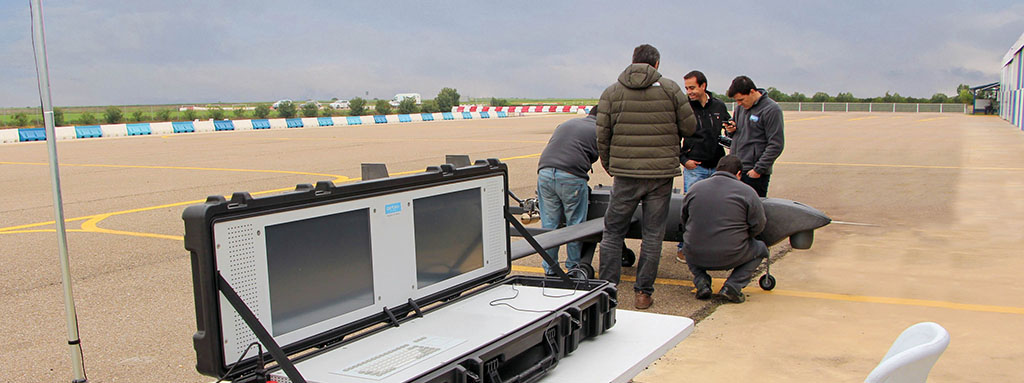
Before launching the operation it is more than necessary to carry out a comprehensive series of checks pre-flight to verify on shore that all systems are working properly. An incident detected in time on the ground saves a lot of problems later.
The control and guidance system which governs the navigation of the platform must be very robust and prepared for the maximum number of different failure scenarios and to execute the appropriate mitigating actions in each case. Furthermore, it is essential that the remote pilot operating the platform is expert and have the appropriate training with the corresponding certification. In some compromising situations that may occur during operation, the pilot's expertise may be essential to safeguard the integrity of the platform, other property and, of course, people.
There are quite a number of applications that justify the use of RPAS in civilian operations, for example:
- Environmental monitoring tasks such as forest inventories or precision agriculture (optimisation of water resources and fertilisers, identification and control of pests, improvement in crop quality and production). One of the main challenges in this regard lies in the possibility of improving the efficiency of electric motors to cover large areas of land while leaving the smallest possible footprint on the environment.
- Topographical works for mining and civil engineering. Thanks to the use of high-resolution COTS cameras, precision in-flight and post-processing techniques with stereo triangulation imagery, terrain surveys and orthophotos can be carried out without the need for expensive equipment and services such as manned LIDAR flight (Laser Imaging Detection and Ranging) and large-format photogrammetric cameras.
- The automation of cartographic information (e.g. for cadastral services) and identification and documentation of cultural heritage elements.
- Or, related to the current concept of Smart Cities, the real-time assessment of pollution air pollution in controlled situations (urban city centre) or in emergencies (fire, nuclear disaster, etc.)
In the field of defence, In addition to the technical difficulties encountered in the civil scenarios described above, it is required to much greater precision in operations of RPAS, as the margin of error is practically zero for obvious reasons. In this context of use, there is normally integration of operations with ground teams and other aerial assets, The scenario is further complicated by manned and unmanned aircraft, which further complicate the scenario.
So, these are just a few examples of the hundreds of applications that we can all think of in which the use of RPAS can efficiently help to improve actions that are currently implemented by other means. But, without a doubt, the main challenge is to resolve the safe integration of RPAS in complex operations, working collaboratively with other systems.