For several years, some companies in the aeronautical sector have been consolidating their Technological capability in aircraft design unmanned or UAS. That knowledge has primarily been acquired through participation in research and development programmes or in the launch of industrial projects such that each company has evolved its own know-how to develop fixed-wing or rotary-wing platforms for various types of applications.
The mission, that is to say, the operation that is desired to be performed with the platform, is the ultimate purpose of the UAS. This is what should dictate all design.
With complete certainty, on that path we have had the opportunity to apply lessons learned that have strengthened every achievement gained. Each challenge overcome has allowed for the improvement of general UAS development processes, particularly in what affects the design phase, which is where the following reflections will focus.
Perhaps the first thing to emphasise is that the aircraft itself is merely a “means”. The ultimate purpose of the RPAS is the mission, that is, the operation that is desired to be carried out with the platform, and this is what should dictate the entire design. According to the type of mission, the desired specifications for the aircraft should be developed, and the main design parameters could begin to be narrowed down:
- General characteristicsfixed/rotary wing, payment load sensors, launch and recovery system, etc.
- PerformanceCruise speed, ceiling, required range, sea-level or altitude operation, etc.
- Manufacturing processPrototypes needed, materials, number of different versions to implement, etc.
- Type of propulsion plant: electric, explosion, hydrogen pile, hybrid, etc.
In the field of UAS The design freedom is quite large and there are few references or standardised patterns that allow engineers to base their designs on previous developments, especially in Class I aircraft and to a lesser extent in Class II aircraft. It is therefore recommended to have a multidisciplinary team of specialists, each focusing on a particular area such as aerodynamics, propulsion, control systems, or communications, so that they can complement each other's skills and abilities.
Of course, the Knowledge of national regulation In each case, and from international standards, it is fundamental to include restrictions in the system specification. Obvious examples include MTOW and the permitted communication bands depending on the geographical area where the aircraft will operate.
It is always recommended to approach the development of a new UAS project with a flexible approach Regarding the design point, understood as the power-to-weight ratio (for sizing the aircraft's propulsion plant) and wing loading (for determining the necessary wing surface area for the aircraft). This flexibility is especially critical if we move close to the boundaries where weight can change the aircraft's class or category according to regulations. Calculations are always performed theoretically, although they will subsequently have to be validated through ground and flight tests, for which it will be necessary to maintain adequate compliance margins and make well-founded considerations regarding the sub or about design sizing and its impact on specification compliance. Therefore, it is fundamental that the design is approached as a iterative process that it corrects errors and proposes alternative solutions.
These technical assumptions from the design phase will be tested in various trials, both structural and functional, on the ground and in flight. These trials will be carried out using more or less complete prototypes with the aim of verifying compliance with specifications by validating the aircraft's performance and capabilities with regards to take-off and landing runs in its different configurations, flight envelopes, weights, angles of attack, and range, among others.
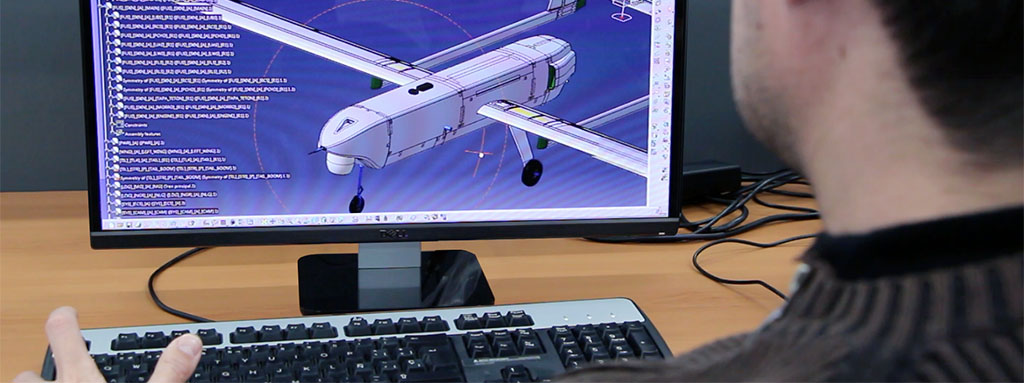
Finally, it is very useful to build a digital model 3D completion of the aircraft to optimise and resolve encounters and interferences between different subsystems, as well as to facilitate information for the manufacturing and assembly process. These well-utilised tools allow for concurrent engineering from the early stages of conceptual design, facilitating piece configuration control, providing theoretical weight estimates, and greatly simplifying the generation of documentation for manufacturing.