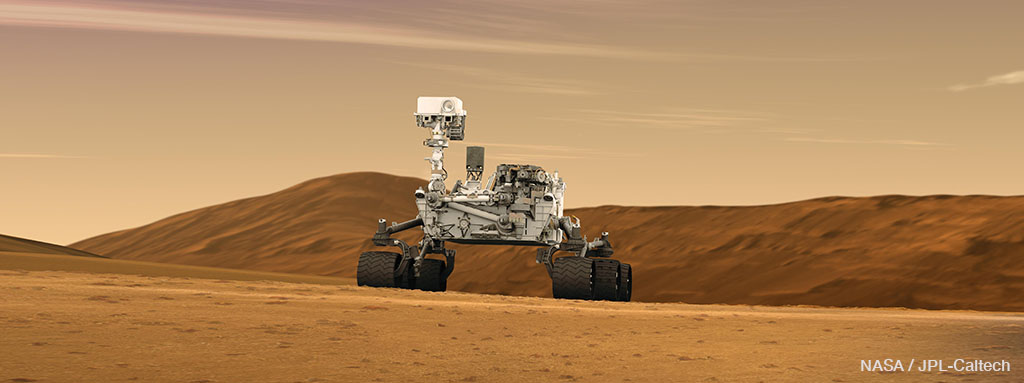
Mars is the only planet known to be inhabited exclusively by robots. It may sound like a joke, but it is strictly true. It is also a relevant fact to demonstrate that there is water on Mars.
Confirm existence of liquid water on other celestial bodies it is very Astrobiology. And it is for that reason that Mars is populated by robots, all of them programmed for sampling and analysis in search of signs of life or conditions for life, among other things.
The odds are quite against finding any life on Mars due to the planet's known surface conditions.
These inhabitants of Mars have confirmed, based on the geomorphological structures found, that in the past there definitely was liquid water flowing across its surface. Attempts to find it have been in vain because, among other things, Mars's thin atmosphere does not allow for exposed liquid water on the surface, as it either evaporates immediately if on the sunlit side, or freezes immediately if in shaded areas. In short, the inhabitants of Mars have been detecting the presence of traces of water in gaseous and solid states, but the liquid phase has been extremely elusive... until now.
It has just been confirmed that our red neighbour has persistent liquid water. The finding was made using radar MARSIS (Most Advanced Radar for Surface and Ionosphere Sounding instrument), which was specifically designed and operated to carry out this discovery from the European Space Agency's (ESA) Mars Orbiter.
It works by transmitting low-frequency electromagnetic pulses. The emitted waves interact with the elements on and beneath the surface, and their reflection is captured and used to generate a geological composition model of the planet.
As the water molecule in its liquid state reflects these waves more than any other component of the Martian subsurface, and given the similarity between the readings obtained and those taken from glaciers, it has finally been concluded that it is indeed liquid water that lies at the bottom of that lake.
The liquid water detected consists of a mass approximately 20 km in diameter located at the planet’s South Pole. The liquid phase lies beneath a 1 km-thick layer of a dense mantle of dust, minerals and ice of varying compositions. The exact depth of this underground lake is not yet known, but it is at least one metre deep. Its temperature is estimated to be between -10 and -30 °C, but it remains liquid due to a high concentration of dissolved magnesium salts.
There is likely more liquid water to be detected, but this lake is large enough to be identified from Martian orbit.
The discovery is particularly important for several reasons. For one thing, it indicates that there are environments on Mars that possess sufficient conditions to harbour life. For another, it gives an idea of where to continue searching. Furthermore, in the case of Mars, the location of this precious molecule is important for it to be used as a supply source in future human settlements.
However, the odds are heavily stacked against finding any life on Mars due to the known Surface conditions of the planet, which suggest that, however much water we may have found, it is almost impossible that it could have formed, let alone persisted until now.
In any case, in order to definitively state that it is water that has been found, it is required further studies repetitive. That's how science works... nothing is certain until it's conclusively confirmed.
A new phase of research is now set to begin, with the aim of collecting further samples. The number of missions to our red neighbour is expected to increase, with new robotic exploration equipment designed to retrieve samples. So… it is also expected that the population of Mars will grow in the near future.