Jose Manuel Hesse Martin is a Senior Aeronautical Engineer and is currently Director of Operations at ISDEFE.
«The best airport model is one that allows for the best service to be provided at the lowest possible cost, ensuring that the airport business is sustainable.»

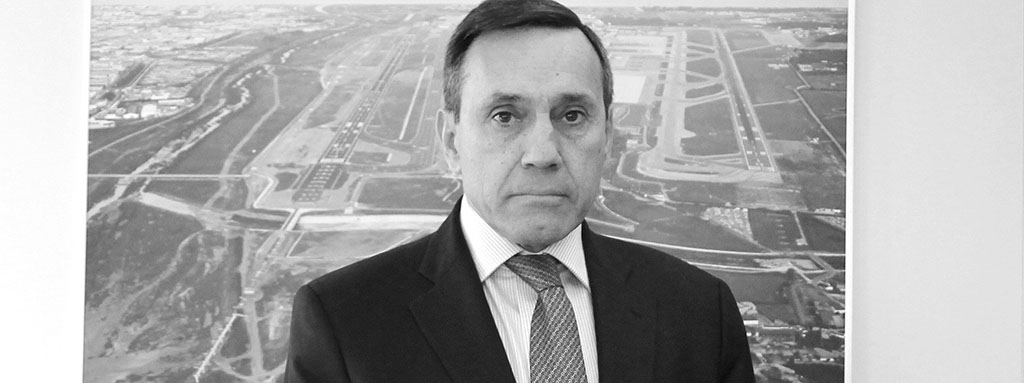
His background as an aeronautical engineer and his professional experience of several decades in airport planning and management are the best endorsement for him to give us a brief retrospective on how airport infrastructure has evolved…
Airport infrastructure, and particularly terminal buildings, have undoubtedly undergone a profound transformation in recent years that could be graphically summarised by the idea that concrete has ceased to be the defining feature of airports, being replaced by systems.
Conceptually, considering the terminals, it can be said that they have shifted from being “unique buildings” to being “containers for processes”.
Airport infrastructure has always been the necessary element for the provision of services, but while in the past infrastructure was designed and services were adapted to it, nowadays processes are defined to be as efficient as possible and the infrastructure (concrete and systems) becomes a facilitating element and never the main element of the design, as it was in the past.
What is your concept of the “airport of the future”?
One of many possible definitions of an airport is “a city you pass through”, the airport is a city in which one does not live, but only passes through, yet it has all the complications of a city. In this vein, the airport of the future could be defined as a “Smart city that one goes through.
The airport of the future will certainly be an airport where airport processes are designed with facilitation in mind, and thanks to digitalisation and intensive use of technologies such as Big Data, the blockchain, the IoT and the machine learning, the processes will be almost transparent to the passenger, while also allowing for the design of new business models by creating new products and services.
The automation of processes and the application of the latest technologies aim to reduce waiting times at airports. However, new airport infrastructures are virtually becoming cities for passengers to enjoy new experiences while their plane takes off. Isn't there a contradiction?
Apparently so. It is clear that the large commercial spaces designed into terminal buildings are at odds with the idea of an airport that prioritises minimising the journey from the building's entrance to the departure gate.
The solution, as is usual in other commercial activities, lies in segmenting passengers and understanding that each passenger segment has different priorities.
Terminals should offer “fast lanes” that allow regular passengers to reduce the time it takes to board their flight, and “slow life” spaces where passengers can enjoy leisure experiences or areas to continue working while they wait.
In summary, the airport must be able to guarantee, in some cases, that the time taken to reach the departure gate is as short as possible, whilst offering the most desirable space in the city to relax or continue working while waiting to board.
Regarding airport management, what do you think is the best model for achieving efficiency in the airport business?
From my point of view, the best model is one that allows for the best service at the lowest possible cost, ensuring that the airport business is sustainable. It's not a question of choosing between public or private; it's a question of the model guaranteeing efficiency and the quality of service.
Airports are monopolies (real competition can only be said to exist at the level of the large hubs, so reducing costs, in order to ensure the lowest possible prices for its services, must be one of the model’s top priorities. The other must be ensuring the quality of the services provided and minimising their environmental impact, all while guaranteeing sufficient revenue for business sustainability, but without expecting high returns on investment, at least from “aviation” revenues.
As an expert with a deep understanding of the aviation sector, what is the difference between investing in infrastructure in established markets like Europe and the US, versus investing in new airports in the Asia Pacific or Middle Eastern regions?
Both Europe and the US are mature and highly regulated markets, where investing in airports that do not require infrastructure expansion is, in the long term, a safe investment and, in principle, free from unforeseen risks.
Conversely, if airport expansion is required, the expansion may necessitate a long and sometimes almost impossible process, which complicates the valuation of the concession due to the temporal uncertainty of when the necessary infrastructure will be available to guarantee demand growth and, consequently, the revenue that will make the concession viable.
The Asia-Pacific or Middle East markets are much more dynamically growing markets where strong activity growth can be expected in the short term, so investing in new airports requires strong initial investment in a context of lower political stability in the medium and long term, which increases the risk.
We recently participated in an event called “Aerospace Architecture and Engineering”, where the increasingly intense and collaborative relationship between these two professions was discussed, giving rise to a new term: “Archi-engineers”. How has this collaborative symbiosis evolved in recent years, from your point of view?
Throughout my years of experience, I have always observed this lack of understanding between the engineer and the architect, with the former focusing more on processes and the latter on the overall conception of the building from a spatial and aesthetic viewpoint.
I must say that during the construction of Terminal T4 at Madrid Airport, it wasn't like that; there was magnificent coordination between the engineering team and the architects' team, and numerous decisions were made jointly, which led to valid solutions, both from a functional and aesthetic point of view.
The future must head in this direction; terminals must be the result of teamwork, a team that integrates the various professionals who guarantee that all aspects defining a modern and efficient terminal will be taken into account, and these include not only architects and engineers.