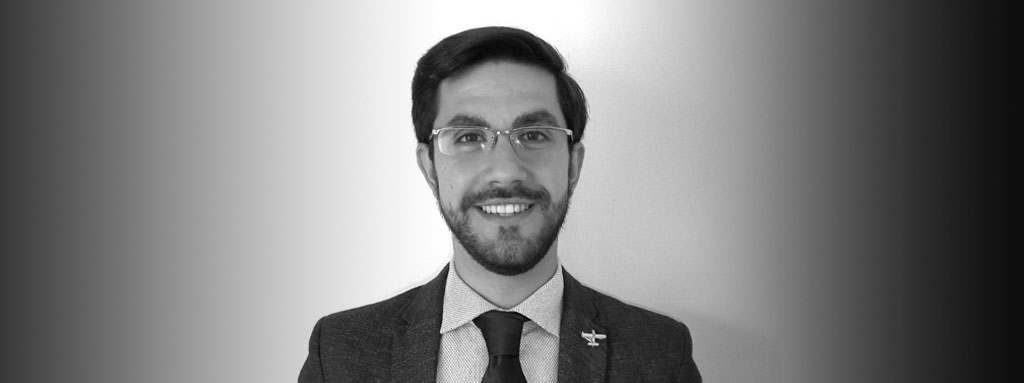
Mr Daniele Vangone is President of the International Council of EUROAVIA (European Association of Aerospace Students).
«Over the years, the importance of the aerospace sector has grown exponentially, becoming part of daily life.»

Before long, EUROAVIA will be celebrating its 60th anniversary. How has the relationship between the aerospace sector and universities evolved in recent decades?
Firstly, we must recognise the evolution of the sector itself, which has moved from an eminently military environment to a more commercial one. It is also true that, at first, it was very difficult for students to participate in such a restricted world, especially when the European project was in its earliest stages. However, over the years, the importance of the aerospace sector has grown exponentially, becoming part of daily life. The fear of flying has disappeared and curiosity about what might lie beyond the moon has been widely awakened.
Fortunately, the sector's proximity to academic life is greater today than ever before. As a result, there has been an increase in the number of young people who dream not only of being astronauts but also engineers and technicians. The driver of this change in trend must be sought primarily in the interaction between universities and the sector. However, we should ask ourselves who plays the leading role in this. Many universities still lack the resources to bring the sector closer to their students, and it is this lack of opportunities, among other factors, that gives meaning to student initiatives such as EUROAVIA. In this regard, the Association aims to prepare its members for the future working environment by developing and improving their skills through high-profile technical and academic activities. Its main achievements are the breaking down of barriers between countries, allowing students to learn about the sector and the culture of an entire continent, and consequently, the improvement of mobility and the promotion of the European spirit. This is the aspect that the future relationship between the university and the sector acquires: solid, close, and student-led.
What is EUROAVIA's contribution to the needs of the future aerospace sector?
EUROAVIA's potential lies in its extensive network based on innovation, cultural awareness, and international working relations. Therefore, the development of this community must be considered essential, in the long term, for the training of highly qualified professionals and to foster their preparation in a global environment, so that EUROAVIA becomes the bridge between universities and companies. Through special and personalised attention to the standards required by the European sector, EUROAVIA members have the opportunity to develop their potential as leaders and improve their technical knowledge to become capable and competent professionals. Currently, we also highlight the importance of developing social and management skills through specific learning sessions. It is widely known that the key to success in a dynamic and multicultural environment is none other than great leadership competence. These skills are not yet widely integrated into the educational system. However, our students are focused on achieving a high degree of personal development that will allow them to easily improve their performance and effectiveness in their future professional careers.
Which are the most active working groups and where is their research directed?
Working groups are teams of enthusiastic and motivated EUROAVIA members who share their time and knowledge and dedicate them to specific tasks according to the Association’s needs. The majority of their work and achievements are within the international sphere. Currently, nine working groups are acting as real driving forces in making EUROAVIA's International Council's vision and objectives a reality. As an articulated association built upon the expression and research of its members and external parties, it is of utmost importance that our teams ensure dynamism and continuity of operations. Without diminishing the scope of the operations and tasks, it is interesting to highlight the commitment undertaken by the public relations, corporate, and affiliated societies working groups.
The working group of affiliated societies provides a stable communication point between the main agents of the Association: the International Board and the affiliated society in each country. Three internal departments focus on the maintenance and interconnection of EUROAVIA's local branches: the Presidential Committee and the Search and Rescue and Expansions Units. The former is the backbone of internal communication between representatives of each affiliated society who have access to information on local and international events and can request and provide advice and help, if necessary. The second focuses on local branches that may need assistance in resolving incidents, problems, or communication breakdowns. And the third fosters the expansion of EUROAVIA, to reach new countries and universities.
The Business Relations Working Group coordinates contacts between EUROAVIA's international sphere and the aerospace sector, academic institutions, research facilities, and governments. It aims to actively seek professional opportunities and interesting partnerships of a diverse nature: financial assistance, career opportunities, or mutually beneficial ventures.
The public relations working group is the team that works on EUROAVIA's image to ensure it is created, developed, and disseminated in the best possible way by creating the necessary material and finding the most suitable methods for sharing it internally and externally.
How do you run an association made up of over 2,000 students from more than 20 countries?
Given its non-political, non-profit status, EUROAVIA is exclusively run by volunteer students, with its various activities and projects entirely financed by membership fees and sponsors. Thus, it is crucial to ensure a perfectly structured framework that allows for the Association's social mission to be carried out and for its members' day-to-day experience to be enhanced. The EUROAVIA International Board constitutes one of the most important and decisive bodies within the Association. It is responsible for leading, assisting, and bringing together each independent part of EUROAVIA, both at a local and international level. The members of the International Board assume the primary and privileged responsibility of building and laying the foundations upon which sustained growth can be supported and opportunities to increase EUROAVIA's development prospects can be created.
During the current business year, five members from four different countries have worked side-by-side to keep the constructed bridge operational. They have met, collaborated, shared their tasks, and delegated the functions and achievements of the objective to working groups led by a single coordinator.
Communication and cooperation between the 45 local branches are guaranteed by the Presidential Committee. Given the heterogeneity and scope of the EUROAVIA network, affiliated societies are typically grouped into 5 distinct regions: East, West, South, German, and Central.
Above all, the EUROAVIA Congress represents the lifeblood of the Association and is where mid-cycle and annual performance is assessed. Our members have the opportunity to be part of the decision-making process, discuss current and future policies, and give their input on the next steps and procedures to be implemented. Representatives from each local branch convene to participate in a process that will define the Association's roadmap and strategy throughout the entire business year.
Do you think the aerospace sector is truly applying the latest advances from universities, or are there still obstacles to their implementation? How can the partnership between the aerospace sector and universities be improved?
The visibility of the aerospace sector has notably increased among students in recent decades. Within the academic environment, international competitions, innovation research, and scholarship and training programmes are increasingly being promoted. The key to the matter lies in broadly exploring the range of possibilities through which universities can progressively increase the reach of these valuable opportunities. The expected outcome would be that students with the most innovative and creative minds could benefit from them and become involved in the idea-generation processes and challenges of the sector. We believe that competition enhances creativity. Therefore, in order to reinforce this aspect, it is essential to promote the various initiatives that students undertake at university, both through direct support for the associations to which they belong and for the projects on which they work.
What will be the main challenges EUROAVIA faces in the immediate future?
As the outgoing president, my priority right now is to ensure a smooth transition of leadership for the association. The members of the International Council are changing, and for the handover of power to the new generation not to mean a loss of time in re-establishing an efficient working environment, it is necessary to prepare the more experienced members. Therefore, my colleagues and I will remain focused on fully completing the process of knowledge transfer and the acquisition of experience and know-how from the appointed International Council.
The ever-accelerating global landscape and the continued demand from the sector and external parties make changes to EUROAVIA's organisation inevitable. Therefore, an open approach, combined with the conservative experience of the Association's founders, represents the key to maintaining a prominent and healthy position within the European aerospace community.
In order to consolidate EUROAVIA's position within the global aerospace sector network, a consistent framework is necessary. Therefore, we must consider both the interest the association sparks and its relevance, in order to optimise relations with its operating environment and react to new challenges with decisiveness and proactivity.
In addition to the above, it is essential:
– Strategically and operationally manage EUROAVIA among its current and future members, as well as in all countries where it is currently and will be established in the future.
To understand the expectations placed upon the Association, in order to achieve a strong and consolidated position within the sector.
– Create and define an added value to increase overall satisfaction.
– Build a communication network with entities, institutions, and companies to optimise your own work environment.