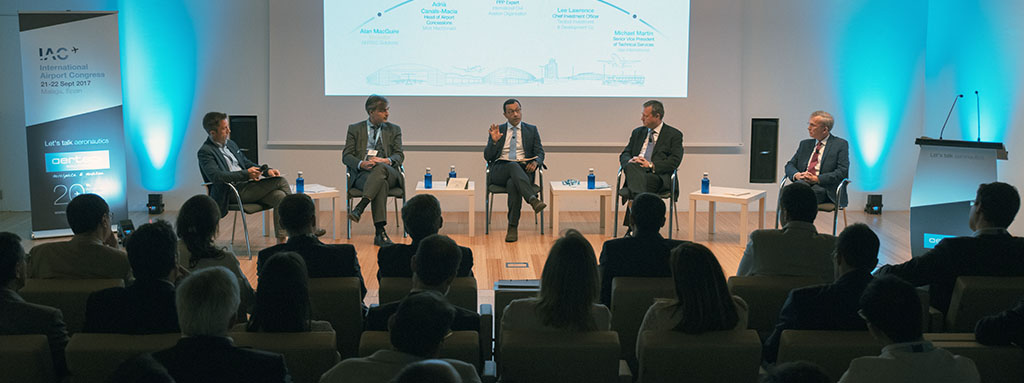
Speakers
- Adria Canals-Macia – Mott MacDonald – Director of Airport Concessions
- Lee Lawrence – Tarabot Investment & Development – Investment Director
- Michael Martin – daa International – Senior Technical Vice President
- Dr. Fethi Chebil – Expert in public-private airport partnerships
- Moderator: Alan MacGuire from AERTEC Solutions
Moderator Questions:
What do you think are the main challenges that large PPP initiatives (both in the public and private sectors) must face?
Adria Canals: The coordination of the various shareholders involved in an airport project is of paramount importance. The main stumbling block is defining a business scenario that is both workable and clear. It must take into account the interests of investors, governments, and all shareholders.
Dr Fethi Chebil Discuss the major differences between the public and private sectors, as well as their respective objectives and perspectives in relation to a project. The public sector tends to focus more on expectations, as opposed to actual statistics. These expectations are, at times, somewhat utopian in terms of actual traffic figures.
The private sector, for its part, always focuses on risk and reward. In other words, on the cost to investors, the risks, and the volume of benefits. PPP projects are very complex, and the major challenge is finding the balance between these two very different sectors in all aspects of the project, including the legal framework.
Lee Lawrence Highlight another issue that hasn't been mentioned, which is the source of the funding. Investment firms have multiple options in terms of infrastructure projects, so why opt for airports? The main hurdle for investors is defining an attractive business case to present to the banks. Every project has a debt and an equity element, however, sometimes it seems that government agencies forget about the debt element. They must understand that the risk of a project cannot fall solely on the investors. In some regions, banks face liquidity problems, a point that is not always properly taken into account.
Michael Martin: According to the previous comments, the main challenge is to find common ground for the interests of shareholders from both sectors, public and private.
Considering the main risks and challenges, what are, in your opinion, the main drivers and triggers (2-3 max.) that should be taken into account to maximise the chances of success of a PPP initiative?
Lee Lawrence It's all about ensuring the project is a win-win for everyone. The aim is not just to build an infrastructure that supports a country and its economic development, but also to provide a portal that guarantees passengers a pleasant experience. There are many stakeholders involved, and the key is to understand how they will interact with each other. We must remember that passengers have a choice, so when developing airports, it's necessary to recognise the existence of a risk/reward relationship that allows us to understand airlines while trying to transfer confidence in aeronautical benefits to other revenue streams. We must be creative in how we provide enjoyment to passengers so that they are willing to spend money.
Adria CanalsThe government must allow sufficient flexibility in its regulatory framework so that airports can be properly developed. A mechanism should be established in the contract that allows the project to move forward on a reasonable path for both parties. For example, at a less profitable airport, a method should be foreseen that helps the concessionaire to generate traffic in the early stages.
Which regions or markets are leading the way in terms of successful PPP project execution? Can they be taken as examples of optimal environments for PPP project development or do they have their flaws?
Lee LawrenceSaudi Arabia has implemented an extensive privatisation programme. One of the most encouraging factors with this programme is that they are looking at other benchmarks to find best practice. I was the CEO for Jordan International Airports Group and had the opportunity to be involved in the whole privatisation process, from 2001 to 2010. The interaction with the government and their flexibility during the problematic times in the project were very positive. They understood that we were intending to build an asset for the benefit of national interests and that otherwise the project would never indeed have been so successful. Clearly, in the Middle East there is a lot of ground to cover, it’s not all about 100 million passengers per year terminals, there are other sectors within the region that rely on PPP projects, not just aviation.
Michael MartinSaudi Arabia boasts some genuine success stories thanks to the flexibility of the approach and a focus on the project's objective rather than the process itself. And this is precisely why we've seen some failures in other regions, such as the US, where the process became more important than the objective. When that happens, the project ends up ruined.
Adria CanalsIn Europe, we're seeing an increase in transactions involving 'veteran' or remodelled airports. These are different transactions. They are more to do with business management than infrastructure.
We have identified the most opportunities for future PPP project development in the following markets and regions: * **North America:** This region presents strong opportunities due to its stable legal and regulatory frameworks, well-established financial markets, and a consistent demand for infrastructure upgrades and new developments across sectors like transportation, energy, and social infrastructure. Government initiatives supporting PPPs and a mature private sector actively seeking such projects also contribute to its attractiveness. * **Europe:** Similar to North America, Europe benefits from robust governance, sophisticated financial institutions, and a clear need for modernisation of existing infrastructure and investment in new areas, particularly in green energy, digital infrastructure, and sustainable transport. The strong commitment to climate goals and the European Green Deal are driving significant PPP opportunities in these sectors. * **Asia-Pacific:** This region, particularly countries like India, Australia, and parts of Southeast Asia, offers substantial growth potential. Rapid urbanisation, increasing populations, and a growing middle class are fuelling demand for new and upgraded infrastructure in transport, utilities, healthcare, and education. While regulatory frameworks can vary, many governments are actively promoting PPPs to attract private investment and expertise to meet these needs. * **Latin America:** Despite some political and economic volatility in certain countries, Latin America holds significant PPP opportunities, especially in sectors like renewable energy, telecommunications, and transportation (particularly roads and ports). Governments are increasingly turning to PPPs to bridge infrastructure gaps and leverage private sector efficiency, with a growing focus on sustainable development projects. The reasons for these opportunities are multifaceted and generally include: 1. **Infrastructure Gaps and Modernisation Needs:** Many regions have significant deficits in existing infrastructure or require substantial upgrades to meet the demands of growing populations and economies. PPPs provide a mechanism to finance and deliver these projects efficiently. 2. **Fiscal Constraints:** Governments in many countries are facing budget limitations, making it challenging to fund large-scale infrastructure projects solely with public funds. PPPs allow for the transfer of financial risk and leverage private sector capital. 3. **Demand for Efficiency and Innovation:** The private sector often brings greater efficiency, technical expertise, and innovative solutions to project design, construction, and operation, leading to better value for money and improved service delivery. 4. **Shift Towards Sustainability and Green Projects:** There is a global drive towards sustainable development and the decarbonisation of economies. PPPs are increasingly being used to fund and deliver renewable energy projects, energy efficiency initiatives, sustainable transport solutions, and climate adaptation measures. 5. **Government Support and Policy Frameworks:** Many governments are actively creating or strengthening their PPP frameworks, streamlining procurement processes, and providing incentives to encourage private sector participation. 6. **Attractiveness for Private Investors:** Well-structured PPP projects offer predictable revenue streams and acceptable risk profiles, making them attractive to a wide range of private investors seeking long-term returns.
Dr Fethi Chebil The US market makes for a convenient prospect for those seeking a safe investment. And, at the moment, the Saudi Arabian market does too.
Adria Canals: Significant developments are underway in Asia and Southeast Asia. Japan has broadly succeeded in its first phase, attracting international operators, and is now preparing for the second. They seem clear about what they want. The challenge in many of these places is that the legal framework remains insufficient and does not allow for the speed needed to facilitate PPP projects.
Lee Lawrence One area that has particularly caught my eye is Indonesia, in Southeast Asia. They are about to recognise that the PPP model is their only alternative. Curiously enough, what has sparked my interest in Indonesia has been an airline, not so much the government. Air Asia started acting as an investor with the aim of expanding the airport's own infrastructure so as to satisfy its growing passenger demand. The company came to the conclusion that waiting for government intervention would take too long. Opportunities for consultants might be opening up there in the future.
Public Questions:
Carlos Berenguer from AERTEC Solutions asks why Brazil has not been mentioned as a region with latent opportunities.
Michael Martin: Dublin Airport has been studying the previous generation of privatisations in Brazil. It appears the process was simply an auction. In other words, the contract went to the highest bidder. There was no pre-qualification process, so anyone could participate. The situation seemed to improve slightly in the second phase of transactions but it is still not our time. Comment on a particular political issue between Ireland and Brazil related to the sale of tickets for the Olympic Games which significantly hinders possible participation in the process.
Dr Fethi: The tendering process itself seemed to kill the market.
Adria Canals: They seem to have learned from the first round, as in the second, they required experience and management capacity, not just the money, which was apparently the only thing needed in the first round. In recent transactions, big names of airport operators such as Fraport, Zurich and Vinci have entered the fray. It is very positive that they have changed the rules.
Ghazi Al-Oufi of the Royal Commission for Jubail and Yanbu asks for opinions regarding the non-financial risks of a PPP transaction, for both the public and private parties.
Dr Fethi: He points out that, in his opinion, the non-financial risks of a PPP project stem from changes in regulations and laws applied by the government and whether they adapt and modify them sufficiently to favour the project.
Alejandro Martín, from AERTEC Solutions, asks whether PPP projects give sufficient importance to environmental and sustainability matters related to airports..
Lee LawrenceIt states that environmental practices are absolutely mandatory. A good example is the fourth runway at London Heathrow. One of the most technologically advanced countries on the planet has taken 40 years to make a decision on the new runway.
Michael Martin: It is imperatively necessary to have the environmental aspects resolved before a project can be launched onto the market.
Adria Canals: Sustainability is the most general term in this sense. It covers all social and environmental aspects. It is essential for large and smaller airports in countries where they do not necessarily have sufficient funds, such as Madagascar, for example. The IFC and multilateral banks are involved in scenarios where proper airport development is critical to the economic growth of the region. This is, for example, the case in small countries where the tourism industry is the main element underpinning economic development in these countries. Banks financing such projects apply very strict environmental methodologies that must be respected. Sometimes, as part of the environmental study, a sociological analysis is also required. In developing countries, in fact, some of these aspects are becoming more important than issues such as the length of the runways themselves. Coming back to Heathrow, in the end, everything will depend on the air quality study. If the result is negative, the project will never go ahead.