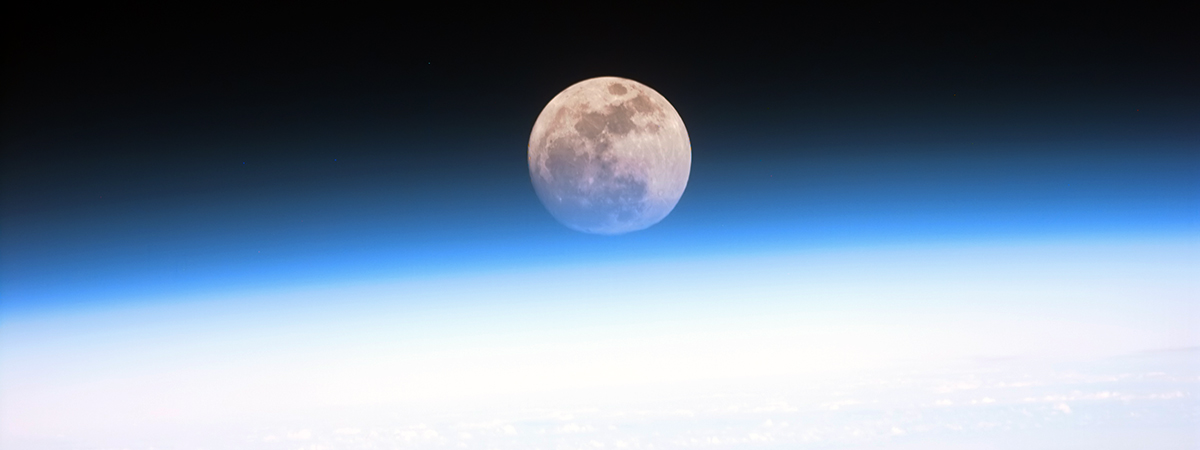
In 2019, we celebrated the 50th anniversary of man's landing on the Moon. It was in July 1969 that Commander Neil Armstrong, the first man to set foot on the Moon, said: “One small step for a man, one giant leap for mankind”.
And here we are, nowadays, contemplating the possibility of living off our planet. One of the first options in this current of searching for a new location is always that of living on our satellite, the Moon.
Many of the children of today are part of a generation with a real possibility of living stably off-world.
But is it really possible to live there?
Many scientists, particularly from space agencies like NASA (United States), ESA (European Space Agency), JAXA (Japan), Roscosmos (Russia) or the China National Space Administration, are convinced that this will soon be a reality, although they know very well that a number of hurdles must first be overcome. Many questions arise here, but we have few answers as things stand today.
What are the main obstacles to overcome to inhabit the Moon? How to make it viable from an economic standpoint? Would it be a project suitable for tourism, or would the Moon only be for scientific use? Could there be tourism? How would one get there with certified and approved vehicles for tourist transit?
As a starting point, and just as happens on our planet, for life itself we would need such basic aspects as energy, carbon, liquid water and a suitable atmosphere that allows the development of life. But not only that, but also one would have to foresee Protection against ambient temperatures and its abrupt changes, nor the dangers from radiation. Nor should we dismiss meteorites falling as a risk factor that would need to be faced.
Currently There are already investors. and companies who are considering life beyond Earth as a not-too-distant reality. For example, there is a revolutionary lunar housing project already underway. This project is led by the prestigious UK architecture firm Foster and Partners in collaboration with the ESA, who since 2012 have been conducting the necessary studies to create the first homes beyond Earth.
One of the fields of study is the use of advances made with 3D printers, which have already been employee in the construction of housing here on Earth. This company is exploring the possibility of using such means to construct habitats where humans can live, which would be located in the south of the Moon, where sunlight is permanent. The main prototype dwelling is designed for four people, who would have everything necessary for life and would be protected from external threats originating from temperature changes, meteorites, or gamma rays, as a consequence of the absence of an atmosphere.
The Moon is about 384,000 kilometres from Earth and, as transporting resources and materials is long and expensive nowadays, scientists are studying the possibility of using the regolith as a source of necessary raw materials. Regolith is the layer of unconsolidated, weathered material occurring as rock fragments or mineral grains (not constituting true soil) and resting upon the original, unaltered solid rock of the Moon. The idea would be using regolith as a construction material for 3D printers.
According to some scientists, the water problem could be solved, as in craters near the lunar poles there are areas that never receive sunlight, where we will find water ice at temperatures of around -220 degrees Celsius.
And, regarding food, previous experiences on Earth demonstrate the feasibility of having closed systems that would allow the cultivation of certain types of garden plants in greenhouses.
Lastly, but by no means least, we are left to discuss the Aerospace transport, as without it we would never be able to truly inhabit the Moon.
Is a direct transport network to outer space imaginable, to which all people could have access for tourism transport?
In addition to the plans by the European (ESA) and United States (NASA) space agencies, there are other aerospace agencies such as the aforementioned JAXA (Japan Aerospace Exploration Agency), CNSA (China National Space Administration), and Roscosmos (Russian Federal Space Agency), with very interesting projects to send satellites and robots to the Moon, as well as to periodically resupply the ISS (International Space Station) in the future.
The real solution could also be in the hands private, as is the case with SpaceX, which currently has one of the most technologically advanced rockets, known as the Falcon 9. The concept of scalability has been one of the constants of this company in its space race, which it already demonstrated with the super rocket Falcon Heavy. A short time ago, they revealed that the best is yet to come, as is the case with the BFR (Big Falcon Rocket): a 106-metre-high rocket with 100%% reusable technology and capable of carrying 150 tonnes of cargo.
They also have an aerospace craft planned which is called Project “Moon Base Alpha", What is the key for us to fully engage in the ambitious lunar base project, as, in addition to being able to take supplies to the ISS, it is also designed to transport materials and people to the Moon and even to Mars.
When NASA was tasked with considering a leap forward in the space race, and specifically regarding travelling back to the Moon with manned missions, it called upon aerospace companies to create projects and ensure that by 2024 the stated objective would be achievable.
For its part, the European Space Agency, with its “Moon Village” project, aims to establish a stable population on the Moon, with a tentative date for this leap in space conquest to occur in the year 2030. However, it goes further by considering that Moon Village would not only allow work on the Moon, but also the birth of the first human outside our planet, expected by the year 2040, as quoted by Bernard Foing, director of the ESA's lunar interstellar group.
In this era of entrepreneurship, it's not out of the question that in the coming years we'll be surprised by small, yet very ambitious, projects related to the development of different specific aircraft for tourist transport to the Moon. It would be a round trip that wouldn't take more than 3 days to reach the chosen destination for living or enjoying a holiday.
And you, would you like to be a real lunatic?