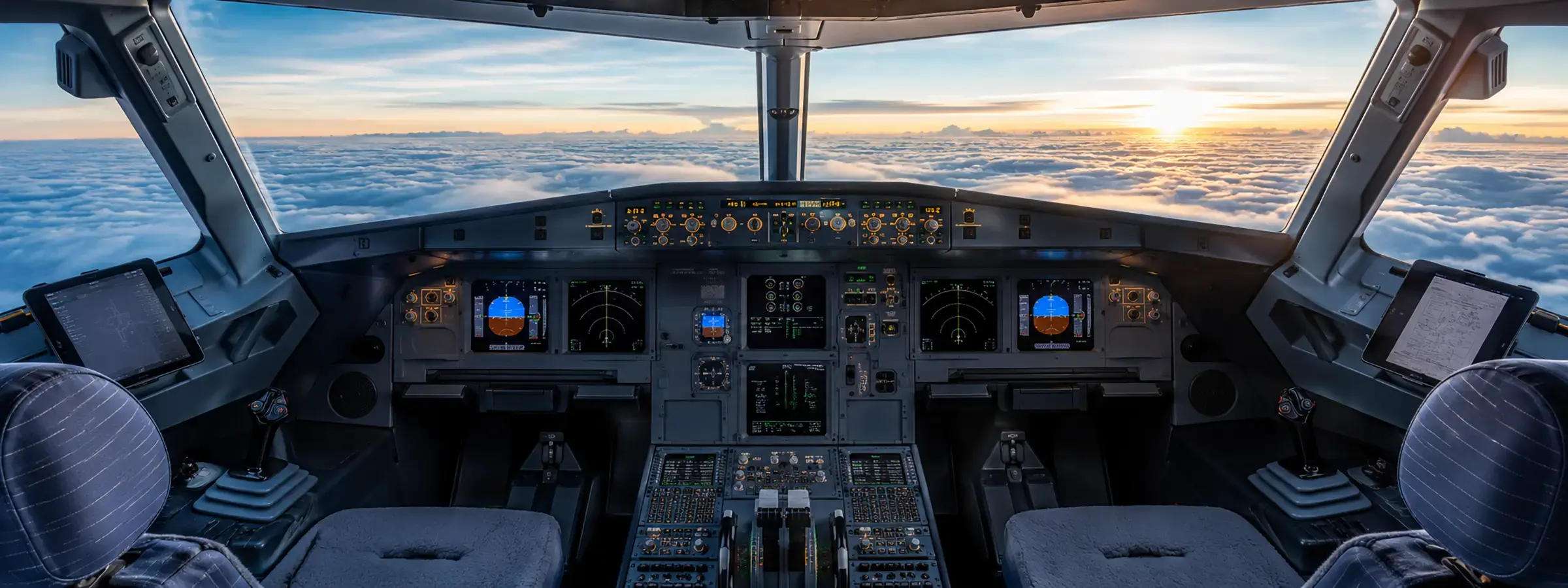
The HUD is a system that facilitates access to flight information and improves the pilot's situational awareness, increasing the efficiency and safety of missions.
Carlos Antúnez Is A400M and C295 Flight Test Engineer He works for Airbus and is currently at the company's plant in San Pablo Sur, Seville (Spain). He qualified as an aerospace engineer between Madrid and Missouri at Saint Louis University in 2000. He then completed studies to obtain an Airline Transport Pilot (ATP) licence shortly before starting his professional career at AERTEC back in 2004, practically from the company's beginnings as an aerospace technology firm in Seville.
He spent four years working hard in the Center of Competence of GST (Ground System Tests) for proprietary products: C212, C235 and C295, alongside the current director of AERTEC's Aerospace Systems division, Pedro Becerra, when the company was carrying out Functional system testing in these aircraft, and initiating the first contacts with tests for the A400M design, which was due to be launched at that time. Subsequently, he joined Airbus in the same department, where he continued his work for a further seven years.
In 2015,.
This pilot from Malaga has almost 20 years of extensive experience in the aviation sector and has an in-depth knowledge of the different aircraft he has worked with. Without a doubt, of all of them, the most technologically advanced is the A400M. This aircraft is packed with systems, sensors, and technological advancements that Carlos has worked with very closely.
According to accounts, one of the most impressive aspects upon entering the cockpit of an A400M is a more than evident digitalisation of controls and information panels existing, monitors, switches, etc.
But if there is anything that is especially surprising, it is the Head-Up Display, which gives a very futuristic image of the cabin. It is a transparent interactive screen in front of the pilots' view where navigation data and flight information (flight mode, altitude, vertical speed, airspeed, heading, reference signals, etc.), all superimposed on the real-world view, are displayed. It is a most interesting piece of equipment belonging to the ATA31 system, which provides pilots with greater situational awareness in conditions of low visibility or special conditions where specific vision is required, such as for taking off or landing on unprepared runways, air-to-air refuelling, low-level flight, or paratrooper operations. In the case of the A400M, there are two HUDs, which are used by the pilot and co-pilot.
The name of this system comes from the fact that the pilot or user can view the information on a screen with their head up and looking straight ahead, without needing to move their head to check the instruments.
The A400M's HUD can provide pilots with information from other systems, thanks to its interface with the FCGS (Flight Control and Guidance System), FMS (Flight Navigation System), and EVS (Enhanced Vision System), among a few others.
The complexity of these aircraft, combined with the number of systems and subsystems in an aircraft like the A400M, necessitates a minimum of two pilots with demanding training to operate it. The valuable training and experience of Carlos Antúnez give us an insight into the broad field of theoretical, technical, and practical knowledge involved in his daily work, of which he is very aware and feels fortunate.
According to Carlos, The first real HUD was used in 1942 in a RAF De Havilland DH.98 Mosquito. On that occasion, it only showed the information radar and an artificial horizon. Subsequently, indicators for airspeed, altitude, heading, turn/slip, yaw/skid, and other information of interest for the control of the aircraft, its payload and situational awareness were gradually incorporated. By the 1970s, this technology was incorporated into commercial aviation.
There are two types of HUDs, the most common being the fixed one, which forces the pilot to look through the screen attached to the fuselage. The system determines the information that needs to be displayed at any given time based on the aircraft's position and orientation. The other type of HUD is the HDM (helmet-mounted display), mounted on the pilot's own helmet whose main virtue is that information moves according to head movements. In this case, information is presented based on the position and orientation of the aircraft, as well as the orientation (on three axes) of the user's line of sight.
In Carlos Antúnez's opinion, the great virtue of this type of device is that provide adequate situational information to the pilot, which accesses data in a more accessible, intuitive and efficient way, making their work easier and significantly increasing security.
Our interesting protagonist has a special memory of his time at AERTEC and cherishes many great moments lived with his colleagues during those years. From here, we would like to thank Carlos immensely for his help in making the writing of this article possible and for bringing us a little closer to his world.