As early as the first decade of the 20th century, during the First Great War, the RC system for aircraft guidance, The first time a flying bomb was used was during the Second World War. Later, during the Second World War (1944), the first use was made of a self-guided system so that there was no human being in charge of piloting the aircraft. After the end of the war, interest in these autonomous guidance systems was abandoned, only to be revived years later when they were again used for tactical purposes during the Yom Kippur War in 1973. Although the first uses of self-guided systems were military in nature, the great civilian support they can provide for aerial surveillance, firefighting, geographic studies, etc., has now been taken on board.
In the first guidance systems, the whole process and calculation of the machine was done mechanically.
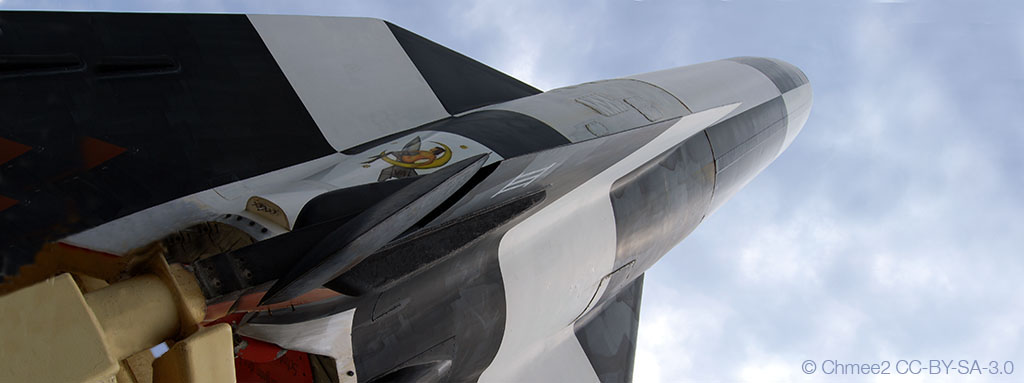
But let us return to the origins. The V1 and V2 flying bombs produced by Germany during the Second World War are well known, and it is worth mentioning them in relation to their guidance system. This consisted of a mechanical system, with no electronic control electronics, whose operation was based on the maintenance of horizontality by pendulums, gyroscopes, accelerometers and chronometers.
The general system of horizontality was provided by a pendulum with a calculated weight at its end, so that it acted on four switches that marked the inclination on the bow, stern, starboard and port sides, giving the signal on which side the aircraft's movement had to be corrected. It acted on the ailerons on the wings for roll and on the steering ailerons on the tail for pitch.
The V1s were launched by catapults that launched the aircraft at an initial speed necessary to begin operation. The V2s had their own engine for launch; when they were launched, the gyroscope was in charge of maintaining the desired angle by means of mechanical systems commanded by the chronometer, which counted the time in which the bomb had to be climbing. After that time, the stopwatch would again command the gyroscope and its system to create the horizontality, which was maintained by the pendulum system. The accelerometer calculated how fast it was going and monitored, together with the stopwatch, the moment when it was over the target. At that point, it cut off the fuel supply to the engine, which stopped and fell to earth in a parabolic fashion.
A simple system at first glance, but complex from the mechanical and scientific point of view of the time.
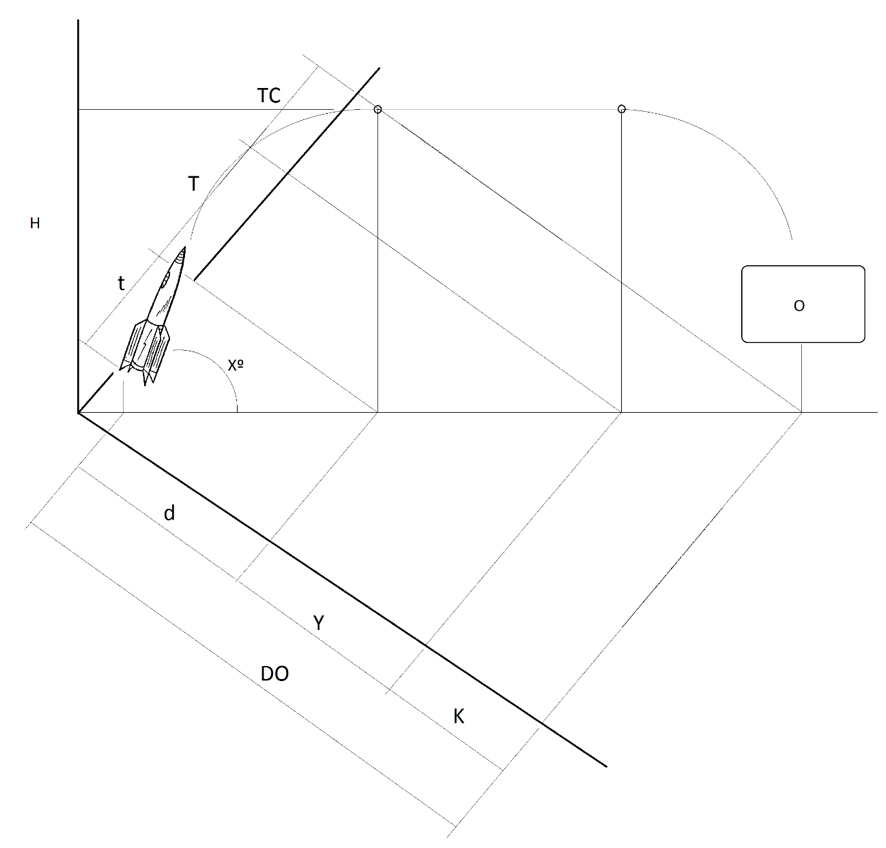 Prior to the launch, some calculations used to determine the distance from the target O (DO) from the launch point, which was on the horizontal of the launch point. These calculations were made by measuring from aircraft, by aerial bombardment of targets, and by aeronautical measurement and photography. Knowing approximately the speed at which the vehicle will travel (V) and the height to which we want it to fly (H), with a departure angle (Xº), it will need a time (t) to reach that height.
In this, it should be noted that the V2 can be considered a stratospheric rocket, as it sub-orbital flights are possible and are powered by liquid-fuelled ethanol and oxygen engines, capable of a maximum speed of 5760 km/h (17,760 mph). The V2s were launched vertically by moving platforms (90°). V1s had pulse engines (pulse jets), which reached a maximum speed of 630 km/h, and were launched from catapults; the launch angle of V1s was between 45° and 30°, although some were known to be launched from bombers to aid their performance (0°).
From the moment it reaches the altitude, the vehicle will have travelled (d) km and, taking into account that the target is (DO) km away, the remaining space will be (Y) km, which will be the time (T) it takes to reach it at its speed. But since it will have travelled (K) km from the time the engine cuts out until it touches the ground with its parabolic fall, this travel time must be subtracted from the total (TC).
The whole process and the calculation of the machine was done mechanically.; The errors were corrected by adjusting springs and gears, which had to be modified after different launches to check the error margin obtained as programmed.
It is common knowledge that during the course of the World War, Germany had spies and double agents in the British ranks. Their work was also important in the effectiveness of these guidance systems, After the first drops, they had to send information about where the bombs were falling so that they could rectify the direction by adjusting the tensioners in the guidance systems. It is also known that many of these flying bombs did not reach their target because some officers were more sympathetic to the British troops and chose to indicate the range several kilometres ahead, which meant that, after adjustment, many of the bombs fell long before reaching their target.
The range of the V1 was 250 km. The range of the V2 was 320 km.
Undoubtedly, all the scientists, engineers and technicians involved in the development of these missiles could not have imagined the precision, effectiveness and versatility that the guidance systems they themselves began to use would have some seventy years later.