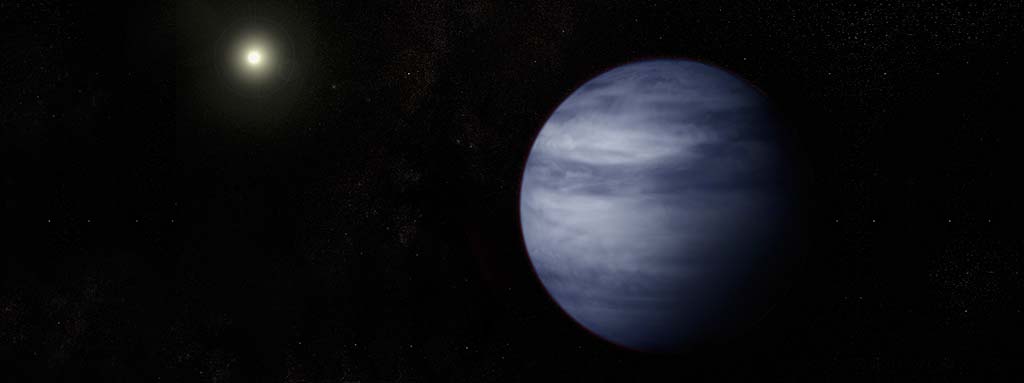
Michael Brown, an American astronomer, dispelled our belief a few years ago that we were in a solar system composed of nine planets. It denied Pluto the definition of a planet due to its “small dimension.” Following a vote among the most distinguished astronomers in the world, it came to be considered a “dwarf planet”However now, a decade later, Brown believes in the existence of the true ninth planet in our solar system.
We have the necessary telescopes and technology to be able to see it, but until now we didn't know where to look.
After many studies and observations alongside his colleague Konstantin Batygin, they recently declared in the journal The Astronomical Journal, that we could be facing the Discovery of the ninth planet of our solar system.
This would be found much further away than Pluto (about twenty times), with an elliptical orbit that would have its closest point to the Sun at a distance of approximately 600 AU (astronomical units) and its furthest at about 1200 AU (Pluto is at 40 AU). It is estimated that it would take between 10,000 and 20,000 years to complete one full orbit of the Sun, and it would be composed of a giant icy mass, 5,000 times larger than Pluto's own.
There have already been several theories presented to the scientific community regarding discoveries of new planets. They have almost always been based on the presence of enormous masses. that would affect the orbit of some space objects. Most have subsequently been refuted.
Even after so many observations and mathematical calculations, No one has ever seen the “ninth planet”, but we have the precedents of Neptune and Pluto, whose existence was declared before they were first seen. Although, according to Michael Brown, we already have the necessary telescopes and technology to be able to see it, until now “we didn't know where to look”. On the other hand, such a distant planet barely reflects sunlight, making it very difficult to observe. This is even more the case considering that it appears to be located in an area of our galaxy where there is a light funnel.
For those more curious or interested in continuing with this study, the initial results have been published in the journal The Astronomical Journal. The research was encouraged by the idea of refuting the hypothesis of two scientists, Scott Sheppard and Chad Trujillo in 2014, who found themselves facing the possibility of studying an unknown part of the solar system, where giant masses could be found that could be considered within the current definition of a planet. In light of this situation, Brown has had to confirm that we could indeed be facing this new discovery.
For now There are many studies remaining and long observations. to declare the true discovery of this new planet, so for now it is only in our hands to believe or not believe that it can really exist.