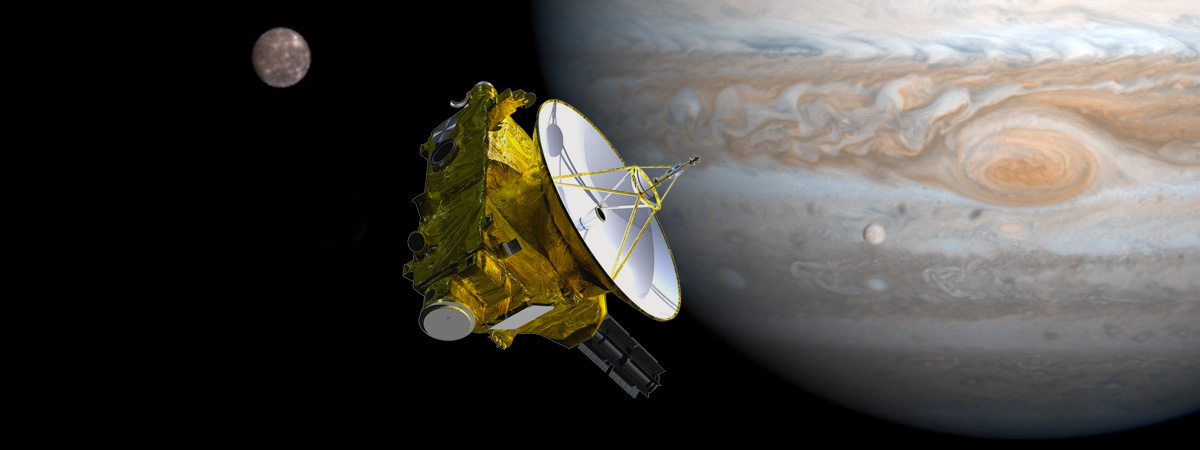
New Horizons is a spacecraft, designed by NASA, intended to be the first reconnaissance mission to our best-known dwarf planetPluto), its five moons (Charon, Hydra, Nix, Cerberus, and Styx) and objects from the Kuiper Belt.
The mission's objective is to study how the Pluto system, the Kuiper Belt, and the transformation of the primitive solar system. The spacecraft has already collected data on the atmospheres, surfaces, interiors and environments of Pluto and its moons. It will also study other Kuiper Belt Objects. Its specific missions include characterising the geology and morphology of Pluto and Charon, mapping their surface compositions and temperatures, characterising Pluto's neutral atmosphere and escape rate, determining if Charon has an atmosphere, obtaining high-resolution images, and conducting similar investigations on Kuiper Belt Objects.
New Horizons is discovering previously unknown objects, which are giving us information about the primordial solar system and its evolution to the present day.
The probe was launched from Cape Canaveral (United States) on 19 January 2006 and is currently in the Kuiper Belt, 44 astronomical units (6.6 billion kilometres) away, or in other words, 44 times further from the Sun than the Earth is.
The spacecraft has a total launch mass of 478.4 kilograms and measures 0.7 x 2.1 x 2.7 metres (similar to the frame of a grand piano), with a triangular shape. Due to the vastness of space and the limited sunlight it will encounter, the New Horizons probe is powered by a radioisotope thermoelectric generator (RTG), which generate electrical energy through the In space, heat is only transmitted by radiation. (there is no convection or conduction as it is almost a vacuum), it was wrapped in a lightweight, gold-coloured multi-layer blanket to prevent the heat generated by the equipment from being lost into space. This is sufficient to keep all systems within their operating temperature range.
Regarding the payment load, you have seven different systems for capturing different aspects of Pluto’s system: ALICE, weighing 4.5 kg, captures images in the ultraviolet spectrum. It determines the atmospheric composition and internal structure of celestial bodies. RALPH, weighing 10.3 kg, captures images in the visible and infrared spectrum. It determines the surface composition and maps temperatures. REX, with 0.1 kg, captures radio waves. It determines atmospheric temperature and pressure. Lorrie, weighing 8.8 kg, consists of a high-definition camera installed in a telescope. It obtains high-definition images of the bodies to be studied. Swap, 1.1 kg, it is a solar wind detector. It determines Pluto’s interactions with the solar wind. PEPSSI, at 1.5 kg, it is an energetic particle spectrometer. It searches for neutral atoms escaping Pluto's gravity and becoming charged due to their interaction with the solar wind. And, finally, VB-SCD, weighing 1.9 kg, detects microscopic dust grains produced by collisions between asteroids and comets.
New Horizons travelled for just over a year to reach Jupiter (February 2007), gather data on the various celestial bodies that make up the Jovian system, and obtain sufficient gravitational assist to travel through space towards Pluto. In March 2015, it began reconnaissance manoeuvres of the planet for almost six months, until July 2015. During that period, New Horizons successfully mapped Pluto and its five moons. Having successfully completed its primary mission, the space probe set a course for the Kuiper Belt asteroid 2014 MU69 (now known as Ultima Thule), which it reached on 1 January 2019 and is considered the furthest object from Earth ever visited by a human-made object. The New Horizons is currently venturing into the unknown Kuiper Belt, awaiting the opportunity to detail more objects in this region of the solar system.
The New Horizons probe has made numerous discoveries about Pluto and its system of moons. Thanks to the data that is still being received, researchers are continuing to draw new and incredible conclusions even today. But, in addition, further details are emerging Kuiper Belt objects, previously unknown, who are giving us information about the The primary solar system and its evolution to the present day. This is vital if we are to understand how our planetary environment can evolve and, one day, expand our frontiers beyond planet Earth.
The disagreement of Pluto
In August 2006, months after launching the New Horizons probe into space, the International Astronomical Union (IAU) demoted Pluto from planet to dwarf planet. This is because it does not comply with the three requirements To be considered a planet within the Solar System, an object must meet three criteria: 1. It must orbit the Sun. 2. It must be massive enough for its own gravity to pull it into a roughly spherical shape. 3. It must have cleared the neighbourhood around its orbit, meaning it is the dominant gravitational body in its orbital path.
- To.
- To be massive enough for its own gravity to round the celestial body's shape to a hydrostatic equilibrium (essentially spherical).
- That it has cleared its neighbourhood of orbit of a majority of smaller objects.
Of course, Pluto orbits the Sun and is spherical, so the requirement it doesn't meet is that it hasn't cleared its neighbourhood of smaller objects. And this is why there is such controversy. Pluto's orbit is very distant and within the Kuiper Belt. The number of objects it must attract with its gravity and the neighbourhood it needs to sweep are much larger than those of the rocky planets (Venus, Earth, and Mars). In fact, if any of them had been in Pluto's orbit, they could have had serious problems clearing their entire neighbourhood. This leads us to think that, logically, Venus, Mars, or even Earth wouldn't have been discarded as planets if they had been located in Pluto's orbit, and this is what many researchers defend to the IAU in order for Pluto to have its planet status reinstated.