They are rarely spoken of, but jet streams are an atmospheric phenomenon that significantly affects important aspects such as the climate, or, within the aviation sphere, the duration or stability of certain flights, and even the economy of some airline companies.
It is about enormous airflows circulating at high speeds in our atmosphere. Generally, when someone mentions “the jet stream,” they are usually referring to two in particular: the polar-front jet stream or the subtropical jet stream, two important phenomena that are an essential part of climate patterns worldwide.
Huge flows of air that move in the atmosphere at high speed and significantly affect the climate and, specifically, air navigation.
According to the World Meteorological Organization, a jet stream is “a strong, narrow current of air concentrated along an almost horizontal axis in the upper troposphere or stratosphere, characterised by strong vertical and horizontal wind shear. It typically flows for several thousand kilometres, in a band several hundred kilometres wide and a few kilometres thick”. In reality, it is not a phenomenon that occurs only on Earth, but it has been detected in the atmosphere of other planets in our Solar System.
There are various jet streams in our atmosphere that are found around the tropopause, the transition zone between the troposphere and the stratosphere. The tropopause is found at a variable altitude that ranges from 9,000 metres at the poles to 17,000 at the Earth's equator, being a very relevant zone in air navigation as it is the main environment in which commercial flights take place during their cruise phase. In the troposphere, the ambient temperature decreases with altitude until it reaches values around -60ºC, while from the tropopause, rising into the stratosphere, the temperature increases until it reaches around 0ºC.
 Regardless of the hemisphere we find ourselves in, In the jet streams, winds travel from west to east, with speeds ranging between 125 and 225 kilometres per hour, although they can exceed 400 kilometres per hour. Their physiognomy is highly variable, although the prevailing form is that of long, meandering flows that constantly evolve and occasionally move to higher or lower altitudes. They split and rejoin, create eddies and modify their flow, depending on various factors. They are mainly caused by A combination of the effects of the planet's rotation on its axis and atmospheric warming due to solar radiation..
In both the northern and southern hemispheres, there exists a polar jet stream and another subtropical. In the Northern Hemisphere, the polar jet stream travels over middle and high latitudes, around 60º (over Asia, Europe, and North America, as well as the North Pacific and North Atlantic). In the Southern Hemisphere, however, the polar jet stream is confined to almost its entire course to the Antarctic continent. During winter, jet streams tend to follow the sun's elevation and move towards the equator, while in spring they return towards the poles. They are located at an altitude ranging between 8 and 12 kilometres above sea level.
The subtropical jet streams, meanwhile, develop in the mid-latitudes (around 30°) of both hemispheres and at a higher altitude, between 10 and 16 kilometres, being weaker than the polar ones.
As jet streams evolve vertically or split and rejoin elsewhere, they move immense masses of air, creating shifts in global weather patterns.
In the field of air navigation, these phenomena are essential to understand the turbulences that affect flights or the fact that flight times for the same route can be much shorter or longer depending on whether we fly east or west.
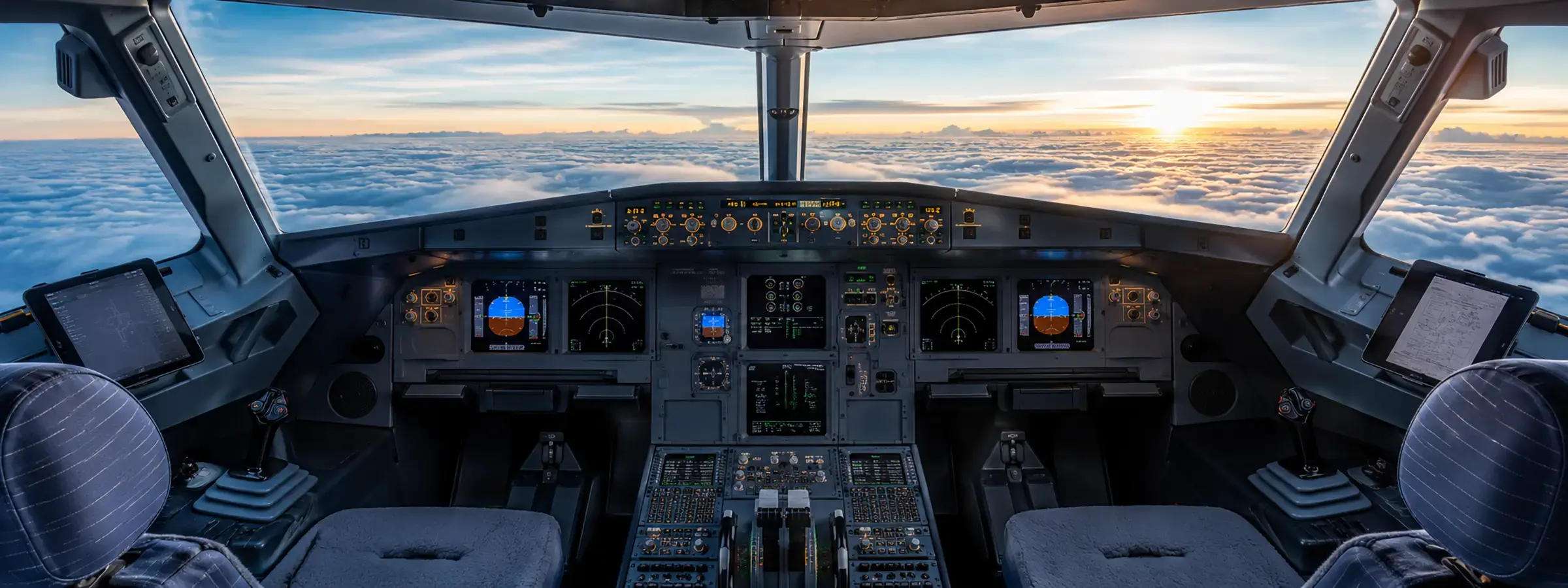
 Commercial flight cruising altitudes are usually around the tropopause, just where the jet streams flow. They do this to take advantage of the low air density, which allows them to achieve higher speeds while using less fuel. Furthermore, at that altitude they will not encounter intense weather phenomena, nor birds, which could affect the flight.
When airline pilots plan a flight, one of the elements they usually take into account is the location of jet streams and their intensity along the route they are going to fly. For a flight that runs in the same direction as a jet stream, joining that mass of moving air could provide an additional “push” which will significantly reduce the time to complete the journey while reduces fuel consumption. On the contrary, encountering strong headwinds would have the opposite effect, which is why they are avoided by altering the course.
A very clear example of this phenomenon can be observed in flights between the United States or Canada and Europe, crossing the Atlantic Ocean. Under conventional circumstances, a flight between New York and London should last approximately 6 hours and 15 minutes. Recently, a Norwegian aircraft completed the shortest subsonic journey between these two cities in 5 hours and 13 minutes, thanks to tailwinds of up to 300 km/h, which propelled the aircraft to a maximum speed of 1249 km/h. A short time later, a British Airways Boeing 747 shattered that record by completing the same journey in 4 hours and 56 minutes, at a speed of 1287 km/h, and alongside it, a Virgin Airbus A350 did likewise, taking just one minute longer. In both these cases, the record was made possible by the superstorm Ciara (2020), which originated in the polar jet stream.
Generally, using these currents to cross the Atlantic saves airlines an average of 30 to 45 minutes, which translates to a very significant reduction in fuel consumption which, in turn, means a reduction in greenhouse gas emissions. If, on the other hand, the flights are in the opposite direction, the consequences would be the opposite.
While there are many parameters to consider, and therefore setting a concrete figure can be misleading, as an indication, the overall reduction in flight times thanks to jet streams will likely generate savings of more than 55,000 tonnes of aviation fuel per year, which means approximately 175,000 fewer tonnes of CO2 emissions annually.
Another aspect where jet streams play a starring role is in turbulence which we usually experience on flights. These types of currents are what are usually at the origin of so-called “clear air turbulence”invisible, unpredictable and more common during the early hours of the day, which result in small jolts in the plane. You can find more detailed information about turbulence at this post.

There are various theories and studies that address The way global warming is affecting the jet streams, in such a way that it is possible to predict, to some extent, what the variation in climate patterns or their effect on air navigation will be in the future. However, it can be said that the main conclusion is that there are no clear conclusions.
Reliable and trustworthy expert groups conclude that global warming is gradually pushing the jet streams towards the poles, confirming that the Northern Hemisphere jet stream shifted northward at an average rate of 2.01 kilometres per year between 1979 and 2001, with a very similar trend in the Southern Hemisphere jet stream. They have also raised the possibility that the jet stream may also be gradually weakening. However, other scientific studies have revealed that between 2002 and 2020 the North Atlantic jet stream had strengthened without any clear displacement.
A 2021 study at the University of Arizona, using ice cores extracted in Greenland, was able to reconstruct jet stream patterns over the last 1,250 years, revealing that all recently observed changes remain within the range of natural variability.
Jet streams are undoubtedly (and will continue to be) an essential part of some aspects of our lives, especially in our interaction with the atmosphere, even though the vast majority of the population remain unaware of their existence.