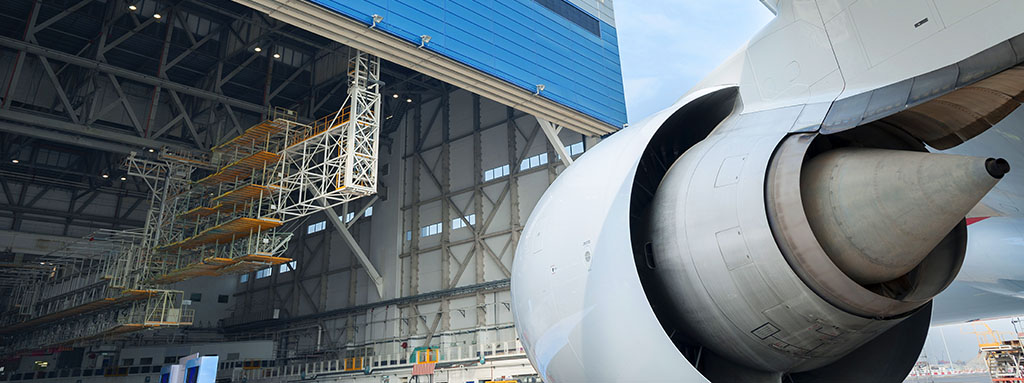
The application of the international standard NFPA 409 In fire protection for hangars, it's quite a common practice, not only in Spain but internationally, given that it is the most comprehensive specific standard for hangars.
The standard stipulates specific design criteria for the building and its installations, with differentiations based on the maximum fire sector area and the size of the aircraft it houses.
Fire protection in hangars based on NFPA 409 is a standard de facto with little room for the designer, but the correct choice of extinguishing systems is key to a safe hangar.
These design criteria leave designers with no leeway in their application, except with regard to fire-fighting installations, where three alternatives are proposed:
- Water-foam deluge system.
- Automatic low-level, low-expansion sprinklers.
- Automatic sprinklers with a low-level, high-expansion system.
A priori, the choice of one system or another may seem like a minor issue, but nothing could be further from the truth.
The water-foam deluge system, especially if the wing surface of parked aircraft does not require a support system underneath them (low or high expansion systems), it is usually the appropriate option as it requires only one system, thereby reducing costs.
The problem arises when maintenance work is carried out that leaves parts of the aircraft's electrical and electronic systems exposed. The AFFF type concentrate, which is the most widely used, can cause damage to these components, as no technical prescriber from the manufacturers of these products has confirmed and validated this fact in writing.
This issue is reinforced by reviewing the specific regulations of the United States Department of Defense for hangars, where this option is not provided for.
So, if the deluge water-foam system is ruled out due to aircraft maintenance work, which of the two low-level systems is more suitable? Each system presents advantages and disadvantages that the designer will need to weigh.
In the Low-level, low-expansion systems, the foam is supplied either by means of flickering monitors or by means of Floor nozzles.
The former present the drawback of obstacles in the discharge pattern, especially in the immediate vicinity of the monitors, making it very important to raise awareness among workers not to obstruct their operation. In any case, when one has hangars of a certain size that house a large number of small aircraft, the aircraft themselves become obstacles, so they are not the most suitable equipment. In this case, floor nozzles should be used.
The drawback of floor nozzles is their high cost. They are patented equipment supplied by a single manufacturer on the market; furthermore, the entire hangar floor must be covered with a grid of these elements, and the branches must be left accessible for maintenance. This makes the hangar floor slab or raft (depending on the aircraft) much more expensive, in addition to the covers for the access hatches. This cost increases as the size of the aircraft increases.
As a reference, there is UFC 4-211-01N of the United States Department of Defense, which specifies the use of a solution formed by automatic sprinklers with a low-level, low-expansion system using ground nozzles, for hangars with small-sized aircraft.
In the High-expansion low-level systems, the foam is supplied by foam generators located at ground level on the building's walls, as they must be supplied with outside air for generation.
The drawback of this system relates to the operation of the hangar itself, as its doors must remain closed, otherwise the foam generated will escape outside without fulfilling its purpose.
One solution consists of the automatic closing of hangar doors in the event of a fire, to ensure they remain closed while the high-expansion low-level system is active, which will require an adequate emergency electrical supply for them.
As a reference, there is ETL 02-15 from the United States Department of Defense, specifying the above solution for Air Force hangars.
As can be seen, The most appropriate fire protection system depends on each specific case., so The designer shall assess the solution that best suits their needs..