On 30 July 2020, the Perseverance mission was launched with its destination being Mars. The launch date was chosen to take advantage of a very limited temporal window of just a couple of weeks, which only occurs every 26 months when Earth and Mars are on the same side relative to the Sun, thus allowing for unobstructed communications during the craft's 7-month transit time. The mission's arrival on Mars is scheduled for 18 February 2021.
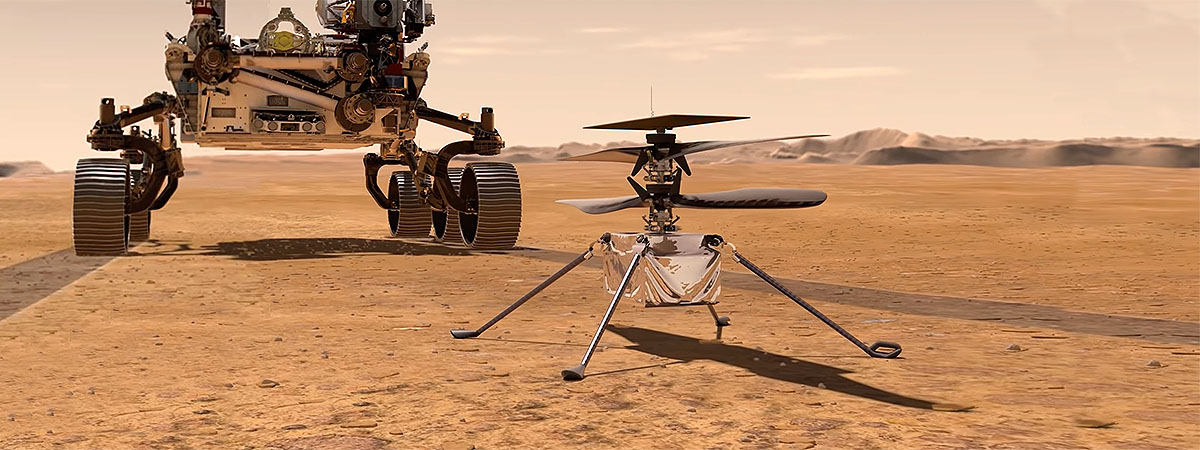
The Perseverance Mission represents a qualitative leap in the exploration of Mars, which for the first time includes the incorporation of a drone called Ingenuity.
This mission is the continuation of NASA's Mars exploration programme, carried out through missions particularly known for the probes sent to its surface such as Viking 1 and Viking 2, Pathfinder, Polar Lander, Opportunity, Curiosity, and many other lesser-known missions simply because they did not land on Mars, but remained in its orbit carrying out remote explorations of its surface and atmosphere.
The Perseverance mission will place a new rover (a remotely controlled surface vehicle with a high capacity for autonomous decision-making) on the Martian surface, representing a true quantum leap in Mars exploration as well as the practical application of many lessons learned from previous missions.
Such is the number of improvements and new capabilities incorporated and grouped into a single mission that this article can only cover some of them.
One of the first pieces of data that can be considered to assess the scale of this mission compared to previous ones is that the Perseverance rover weighs 1,025 kg, which is almost 6 times more than the Opportunity rover sent in 2012 (180 kg). This difference means that the (relatively simple) airbag landing system cannot be used. This time, a system called the Skycrane will be employed, consisting of an initial braking parachute that detaches when the descent vehicle, supported by retro-rockets, is activated, and from which the rover hangs by tethers with small detonating charges at their ends. When the descent vehicle reaches a sufficient height for the rover to land gently on the ground, the tethers are released from their fastenings, and the descent vehicle increases its power for a few seconds to elevate obliquely and finally fall away from the rover.
The media star of the Perseverance mission (at least from an aeronautical perspective) It's the Ingenuity drone.
Ingenuity is a 2 kg drone with a central prismatic body the size of a soda can and contra-rotating blades almost a metre in diameter.. The rover carries it in its belly and deposits it on the ground. Then it moves several tens of metres away to clear the area. As communications from Earth have a delay of about 20 minutes due to the distance to Mars, direct control of the drone is not feasible, and therefore the rover itself is responsible for controlling it. Additionally, Ingenuity has its own stabilisation and flight envelope maintenance system with gyroscopes, accelerometers, altimeters, inclinometers, and a terrain-comparison camera that allows it to distinguish its movement over the terrain plane.
Ingenuity's mission is to conduct far-reaching explorations in support of the rover and it will become the first aircraft to fly on another planet.
The challenges for designing Ingenuity are astonishing. To begin with, the Martian atmosphere is incredibly thin compared to Earth's. It has just one-hundredth the density of our atmosphere, making aerodynamic flight (flight supported by aerodynamic surfaces) almost impossible. For reference, the Martian atmosphere has approximately the same density as Earth's atmosphere at an altitude of 35 km, where no aircraft can reach via aerodynamic lift (the maximum altitude ever reached by an aircraft is 25 km with the SR-71 Blackbird).
On the plus side, Martian gravity is only 30% of Earth's gravity.% Combining all factors, it has been calculated that, with an extremely lightweight configuration of the drone, with contra-rotating blades (with the advantage that the lower blade works on air already compressed by the upper blade) and with blade speeds of up to 3,000 rpm (about 10 times the speed of helicopter blades), it will be able to make controlled flights of up to 90 seconds (more than enough time to complete the mission assigned to it).
With its solar panels, it needs a full Martian day to recharge its battery, equivalent to 3 mobile phone batteries (of which only 30% is used for flight, while the remaining 70 % is used to keep the system warm), allowing for a daily flight of between 3 and 10 metres in altitude and approximately 300 metres in distance.
The Ingenuity sub-mission is considered high-risk, but also high-reward. This means that if the mission fails, it will not affect the outcome of the main mission, and if it is completed, it will lay important technical foundations for future exploration vehicles in areas that have so far been unreachable by rovers.
This mission primarily seeks current or past conditions conducive to the generation and sustentation of life.
Another of the great contributions of The Perseverance mission is fundamentally astrobiological, meaning its aim is to search for current or past conditions that could support life forms. For more details See the post “Water on Mars.
The landing point is located inside Jezero Crater. The reason for choosing this area (which goes against the immediate logic of landing in a flat, extensive area rather than a depression surrounded by walls that will limit the rover's future movement) is because it was formed by a large impact that brought heavy minerals to the surface from its depth. The crater subsequently filled with water and it is highly probable that underwater fumaroles formed. This connects directly with the probable origin of life on our planet, which began precisely at submarine hydrothermal vents, where the combination of a continuous input of thermal energy, complex organic elements, and agitation of the medium over millions of years gave rise to the first self-replicating molecules that, over time, would evolve into proto-cellular forms..
In areas of maximum interest, Perseverance will drill into the ground, obtaining samples that will be analysed for traces of life as in previous missions, but as a new development in this case, they will also be stored in capsules to be collected and sent to Earth by means of subsequent missions.
This set of studies will be of the highest quality in the study of possible evidence of life on Mars that will also allow us to nail down the characteristics of future candidates for habitable planets.
It is worth highlighting the Mars Oxygen In-Situ Resource Utilization Experiment (MOXIE) subsystem for producing oxygen from the majority gaseous carbon dioxide in the Martian atmosphere (90%). If this equipment functions correctly and with the expected efficiency, it will validate an unprecedented capability that is absolutely necessary for preparing crewed missions to Mars. On the one hand, will allow the manufacture of the necessary oxygen for the return trip to Earth for future Martian crews and bases and on the other hand it will also allow the production of the necessary oxidiser for the engines on that same return journey with the corresponding saving of resources which will translate into greater crew capabilities and greater operational safety overall.
Perseverance also includes a Spanish-origin sub-system developed by INTA called MEDA (Mars Environmental Dynamics Analyzer)see hereconsisting of around ten radiation, humidity, temperature, pressure, wind, etc. sensors, with which the quality of the Martian air and its atmospheric conditions will be characterised in great detail, to the point of performing a daily profile of suspended particle granulometry, which, combined with the above, has of special relevance for determining the conditions of future human settlements.
The list of experiences, sensors, tests, and results expected from this mission, in addition to those already mentioned, is almost endless. From testing different textile fabrics for future spacesuits to using a pulsed laser to vaporise the terrain and analyse the chemical composition of the expelled gases, all of it well-equipped with multiple video cameras at every possible angle to record all movements both outside and inside the rover. Microphones have even been incorporated to record the sound of Mars and the rover's actions, as, from the moment there is an atmosphere, there is also airborne transmission of sounds. The recording of sounds is at the very least a scientifically curious activity whose relevance can be assessed on this occasion.
Ultimately, Perseverance and Ingenuity will probably be the “trending topic” of February. So remember to keep an eye out around that time for the historic first aircraft to fly on another planet (…and use this article to impress your acquaintances when they start talking about it, given the flood of news that will be published in all the media in February.)