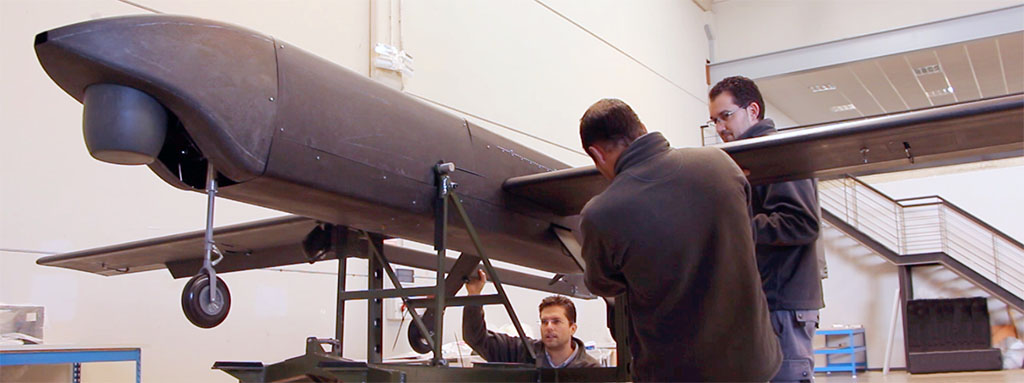
As we read a few weeks ago in this blog, RPAS design has many peculiarities that need to be taken into account. Today, we continue with the challenges posed by the production phase.
The first particular fact that companies in this industry face has to do with the number of RPAS units that the customer usually demands of them.
Each RPAS size segment faces a number of challenges that condition its manufacturing process.
In this respect, it is perhaps the mid-range production segment that is the most complicated. For small multi-rotor drones, it is feasible to mount industrialised production chains due to the number of units distributed. In this niche, the Chinese company DJI is probably the one that has best understood the leisure-oriented market. In just a few years, it has grown from a small company based in Shenzhen to a multinational with more than 6,000 employees and offices in the United States, Japan and half of Europe. The larger RPAS market, on the other hand, is clearly oriented towards military applications and has to be considered on a different scale, as geopolitical considerations and large budgets of companies such as Northrop Grumman, Lockheed Martin, General Atomics or Boeing come into play.
If we focus this question on the Medium RPAS, The first challenge to be faced relates to bridging the gap between what can be proposed in a theoretical design on a CAD tool and how to implement those proposals in a real manufacturing plant. Once in the factory, the manufacturing techniques for such aerial platforms are eminently manual and it is not always easy to make moulds or to have tools to support the assembly of structures.
At this point is where the engineer has to resort more to the etymology of the word that names his profession and, without losing the philosophy of industrialised product and therefore having well defined and implemented manufacturing processes, configuration control and product traceability, he must propose creative solutions to minimise the number of moulds necessary to manufacture various configurations of the same product with materials that are both robust and cost-effective. In terms of tooling, it may be advisable to use a combination of catalogue industrial elements with other elements to configure a complete solution.
Another fundamental problem is the shortage of specialised suppliers. Although there are already some manufacturers that are specifically oriented towards RPAS (with all their peculiarities), a large number of them come from the world of aeromodelling or general aviation. This has the disadvantages of under- or over-compliance with design requirements that have a direct influence on the performances (performance) of the final product, as well as posing problems in terms of possible shortages of spare parts, high prices for small quantities or the need for almost tailor-made parts, which the supplier is not always willing to supply for a few units.
It is at this point that the democratisation of additive manufacturing and the adjustment of their costs can be a medium-term solution to make short runs of tailor-made solutions available on the market at a reasonable price.