When on 1 September 1919 the Compagnie de Lignes Aériennes Latécoère began its air services between Toulouse, Barcelona, Alicante, Malaga and Casablanca, the unease of the Spanish government and of King Alfonso XIII himself was more than evident, as it was a French company.
Spurred on by this situation, the Spanish administration initiated a process for the creation of national airlines, This initiative was not hesitated to be taken advantage of by the Directorate General of the Post Office to give new impetus to the deficient land communications that were hampering postal distribution in Spain.
A historical review of the difficult beginning of commercial aviation in Spain, a sector that today moves tens of millions of passengers annually.
With this aim in mind, the proposal for three air-postal lines of which only the Seville-Larache line The project succeeded, more because of military interests in the Moroccan Protectorate than because of the need for air transport between the two cities.
Of the seven bidders who applied for the Seville-Larache line, a first selection left this group reduced to just two companies; Talleres Hereter and the Compañía Española de Transportes Aéreos, the latter officially led by Manuel Aznar, director of the Francophile newspaper The Sun, in partnership with Pierre Latécoère and Beppo Massimi, Latécoère's partner, who was a managing director of the new company.
On 23 January 1921, the competition evaluation commission ruled that the concession of the line should go to Manuel Aznar's company. However, the protests promoted by the representative of Talleres Hereter, the Malaga engineer Jorge Loring in Madrid's political circles, taking advantage of his good relations with high-ranking government officials, were not long in coming, since, knowing Latécoère's participation in the project, this circumstance could undermine the company's Spanish status, a patriotic position that was encouraged from all areas of the government, the administration and even the crown.
 Thus, at the end of 1920, the contract was awarded to the Barcelona company Talleres Hereter in a precarious financial situation that led it to bankruptcy a few months later. Its technical director Jorge Loring tried to save the concession of the Seville-Larache postal line, for which he contacted Fernando Sartorius, Count of San Luis, a naval officer, military pilot and one of the most influential men in the Royal Aero Club of Spain. The idea of joining the project did not displease Sartorius who, together with Loring, began to set up a new company that could replace Talleres Hereter by means of a legal device that would allow the transfer of the rights of the postal airline competition to the new company.
This new company called Spanish Air Traffic Company, CETA, In addition to Loring and Sartorius, its partners included Felipe Comabella, Álvaro Muñoz, and Bernardino Melgar Abreu, Marquis of San Juan de Piedras Albas, who provided the main part of the capital needed to set up the company.
CETA was established on 25 June 1921 The object of the company was the operation of airlines, the construction of aviation and aerospace equipment, and the import and export of aviation-related equipment. The company's share capital was set at one million pesetas, divided into two thousand shares of five hundred pesetas, with its registered office at Calle de la Reina 39 in Madrid.
With the start-up of CETA, the next step was its operational organisation. Jorge Loring, as CEO, also took over the management of the company and sought the collaboration of Eduardo Barrón Sotomayor as Technical Director and Juan Viniegra Aréjula as Head of Services.
For the procurement of the flying equipment CETA opted for the famous DH-4 and DH-9 bombers, whose devices bore the name of their designer Geoffrey De Havilland, owner of the company De Havilland Aircraft Ltd.
De Havilland undertook to carry out the modification of the DH-9s requested by CETA for airline service, which had previously been carried out for AT&T, by removing the Scarff mounting for the observer's machine guns and placing a seat for a second passenger in front of the pilot. De Havilland subsequently enlarged the observer's seat to make room for a third passenger, naming this new model DH-9C.
The De Havilland DH-9C had a wingspan of 12.92 m and a length of 9.30 m and was powered by a Puma engine with 6 vertical cylinders and 240 HP, sufficient for a payload of 350 kg.
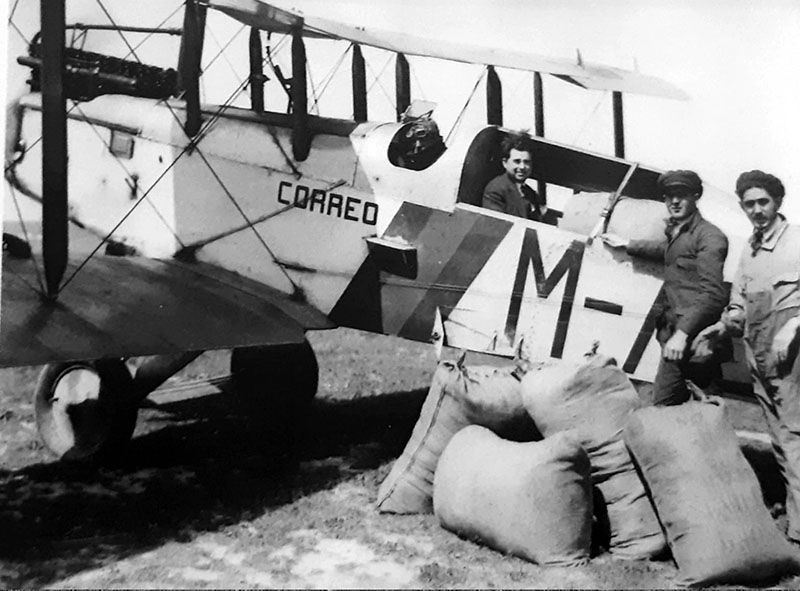
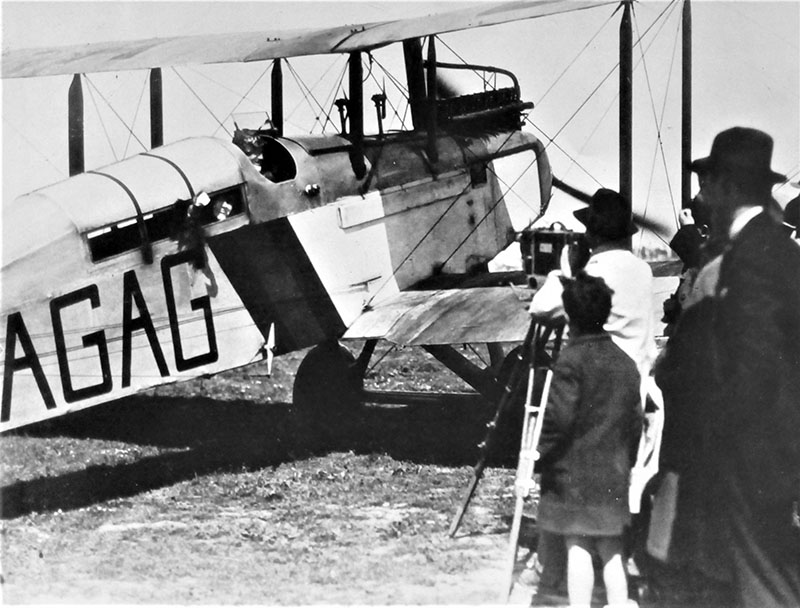
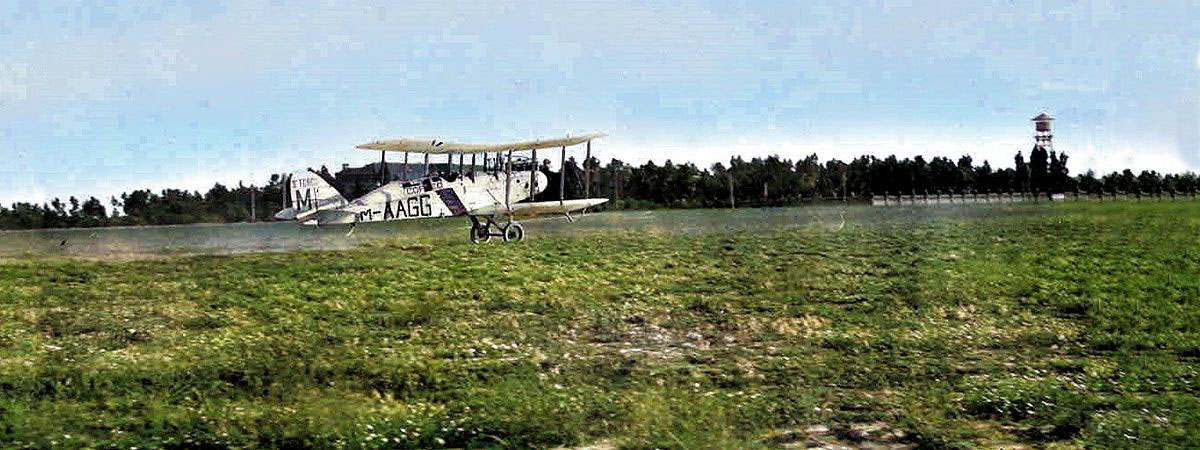
On 19 September 1921 the first two DH-9Cs were ready for delivery to CETA, which took place at London's Croydon Airport with the factory numbers 11 and 12, and were assigned the registration numbers M-AAAG and M-AAGA. From London, the aircraft flew to San Sebastian, piloted by Englishmen Alan Cobham and F.J. Ortweiler. The third aircraft, M-AGAA, did not arrive in San Sebastian until a few days later, on 7 October, flown by Charles Barnard.
It was in this Basque city where the import customs formalities were carried out, after which the aircraft continued on to Madrid once the customs duties of 1,000 pesetas per aircraft, six euros, had been paid.
On the flight from San Sebastian to Madrid, the plane piloted by Cobham and Hatchett was forced to make a precautionary landing next to one of the villages along the way due to bad weather.
The plane was the object of the curiosity of the neighbours who kept handling all the elements of the plane. Only the intervention of the local parish priest managed to keep the onlookers away from the aircraft before they could cause any damage.
After spending the night at the parish priest's home, Cobham tried to repay his kindness by offering him a 50-franc ticket, which the parish priest flatly refused, and the pilots continued their journey to Seville.
The haste in the inauguration of the line, motivated by the high political tension existing in the Moroccan Protectorate as a consequence of the events of that summer in Annual, allowed CETA to obtain a provisional permission to fly, and later in the month of December in Seville, the tests were carried out for the approval of the aircraft, which were mandatory requirements for the issuance of the registration certificate.
Spanish commercial aviation is born
In mid-September 1921 the Dirección General de Correos issued instructions for the new airmail services, setting the surcharge for such correspondence at 50 cents for every 20 grams or fraction thereof of weight, up to a limit of 500 grams. In addition to the «Correo Aéreo» surcharge, all items circulating on the airmail line were to be marked «Sevilla-Avión».
On 10 October, the Deputy Director General of the Post Office, Mr. Meruendano, published the first timetable for the airline, according to which the first of the planes would leave Seville at eleven o'clock and was scheduled to arrive in Larache at twelve forty-five. The second plane would leave Larache at 3 p.m. and was scheduled to arrive in Seville at 4.45 p.m. The second plane would leave Larache at 3 p.m. and was scheduled to arrive in Seville at 4.45 p.m. One hour and forty-five minutes to cover the slightly less than three hundred kilometres between Seville and Larache. The first Spanish airline was to begin its services on 13 October 1921.
CETA's initial staff in Seville consisted of one clerk, three drivers, three pilots and some mechanics and carpenters, making a total of just twenty people. In order to locate the airline's service facilities, the Seville City Council gave CETA a 700 x 300 metre plot of land to the south of the Dehesa de Tablada, sharing the airfield with the military air base. CETA initially fitted out two large wooden crates, of the type used for transporting aircraft, which were fitted with doors and windows. One of them would be used as an engine and spare parts store, and the other would be used as a waiting room, pilot's changing room and a small workshop bench. The company's offices were located at 30 Juan Rabadán Street in the Andalusian capital. The first CETA pilots were the Englishmen Jack Hatchett, Sidney, ST. Barbe and C.F. Wolley Dod.
The line was inaugurated on 15 October 1921. and for the occasion the Director General of Post and Telegraphs, Count de Colombi and his wife, the head of Military Aviation, General Francisco Echagüe, the head of the Air Postal Service, Federico Leal, the true architect of the project, and other civil and military authorities, accompanied by the Archbishop of Seville, Monsignor Ilundain, arrived in Seville and were received first thing in the morning at the Tablada camp on behalf of CETA by Jorge Loring.
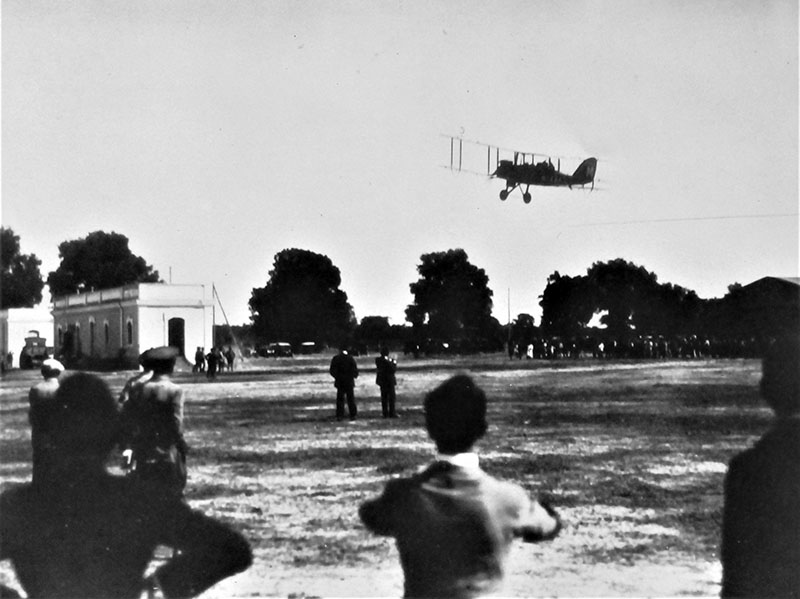
At around half past ten in the morning the Infantes Carlos and Luisa arrived at the aerodrome, awaited by an expectant crowd. Minutes before eleven o'clock, one of the CETA planes appeared over the aerodrome from Cuatro Vientos, Madrid, from where it had taken off around eight o'clock in the morning. In the plane, piloted by Hereward De Havilland, brother of the constructor, were Fernando Sartorius, CETA's advisor, José Muñoz, the company's engineer, and photographer Leopoldo Alonso. They brought with them, in addition to the Madrid newspapers of the day The Sun, ABC, y The Debate, a letter from H.M. the King addressed to General Barrera, Commander General of Larache.
 After the customary greetings to the authorities present, the other two brand new DH-9Cs were taken out to the airfield, which were stored in one of the hangars of the air base. The CETA DH-9Cs wore a beautiful dark green livery with a band with the colours of the national flag on the side of the fuselage and the word "correo", next to the names of Seville, Algeciras and Larache with which they were baptised by Archbishop Ilundain, being sponsored by the Infanta Luisa, the Countess of Colombi and the wife of the civil governor of Seville respectively.
After the speeches by the President of CETA, the Marquis of San Juan de Piedras Albas, and the Director General of Correos, Count de Colombi, the press brought from Madrid, plus a package from El Liberal, together with a postal bag containing some thirty postal items, were placed in the front seat of the plane that was to inaugurate the service. The two remaining seats were occupied by Fernando Sartorius and the journalist Mr. Galarza.
The prince Don Carlos also gave Fernando Sartorius a letter for his son Don Alfonso, an airline pilot who was taking part in the African conflict at the time.
Once everything is in place, the M-AAAG, Seville, took off from Tablada, now under the command of pilot Jack Hatchett, at 11:50 a.m. on its way to Larache. All those present followed the silhouette of the aircraft until it was out of sight on the horizon and then went to one of the hangars of the air base where CETA offered them a lunch, as well as some baptism flights in the DH-9C. Algeciras.
Meanwhile the DH-9, Seville, continued on its southerly course without incident. On the plane's arrival at the Auimara aerodrome in Larache, General Barrera entertained the protagonists of this first flight, who were invited to a meal organised in their honour. At around four o'clock in the afternoon, the CETA plane took off for Seville, where it arrived after barely two hours of flight. The first commercial airline of a Spanish company had been successfully completed; a success that CETA's services maintained in the following weeks and months with commendable regularity.
The chronicle of that first flight, written for the newspaper El Sol by the journalist Galarza, described the trip to Larache as follows. «...At five minutes to twelve we set out on our journey. The Viscount of Priego occupies the cabin with me. We go face to face. The plane starts to fly over the ground, heads into the wind and we rise to a low altitude. Once we pass over the sheds, we climb up to 1,000 metres, and we fly between the Jerez road and the Guadalquivir. We pass over villages that look like patches of snow in the sun-flooded countryside. The aeroplane gives a sense of security.
We look out to sea, and cross the Strait in about ten minutes. We enter Africa to the right of Tangier. We march at 1,500 metres. We see Larache and a large river with a ship underwater at its entrance. We finally saw the hangars and landed. We are received by the chiefs and officers, who pay us great attention and show their satisfaction at having the daily press, as they receive the newspapers from the mainland six or seven days late. At the invitation of the chiefs and officers, we had lunch. I thank them for the deference on behalf of El Sol. Just as we were about to finish lunch, General Barrera arrived by car. Sartorius handed him the letter in which the King congratulated the general and the army under his command.
As time was short, we set off on our return journey, after collecting the suitcase with 53 letters, and at six o'clock in the evening, after a journey as happy as the outward journey, we landed at the Tablada aerodrome...».»[1].
The first Spanish air route
Encouraged by this success, CETA applied a few months later to the Ministry of Public Works for authorisation to establish new passenger and freight transport lines, with the aim of operating them on a private basis. These lines were intended to cover the Madrid-Irun, Madrid-Valencia de Alcántara, Madrid-Barcelona-Port Bou and Madrid-Seville routes, with governmental authorisation for these lines from 22 March 1922.
At the same time, in January 1922, the company had sent the Ministry of Public Works a Memorandum explaining CETA's intention to convert the Seville-Larache postal line into a commercial line for the transport of passengers and goods. These new services requested by CETA were approved without any administrative problems on the same date as the aforementioned lines, 22 March 1922, and the authorisation established what was the first Spanish air navigation route by determining that the route should follow the points of Seville, Lebrija, Jerez, Vejer de la Frontera, Tarifa, Tangiers and Larache.
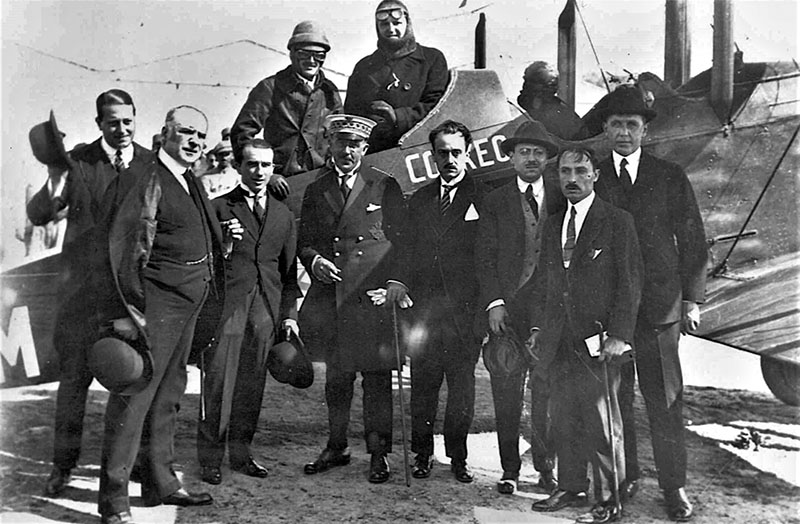 For the new passenger and freight services, CETA continued to be authorised to use the military airfields of Tablada and Larache, immediately starting commercial activity, with the main users being military officers and commanders travelling to the Moroccan protectorate. The round-trip fare for civilian passengers was 300 pesetas (€1.8) and 150 pesetas for military passengers.
In the summer of 1922 CETA found itself in the position of having to replace two of the English pilots, Barbe and Wolley, with Spanish pilots, as was stipulated in the concession contract. Loring turned to his friends in Barcelona and in June he brought in the enthusiastic Catalan driver Josep Canudas and the Argentinian driver Juan José Stegui. Canudas did not adapt to the harsh conditions of the line and he himself soon sought a replacement in the pilot Joaquín Cayón, also a great friend of Loring's, who managed to demobilise from military aviation and joined CETA probably at the end of 1922 or beginning of 1923.
Stegui, a volunteer military pilot in the Moroccan squadrons, had no luck in CETA and on 23 October 1922 he died when he crashed his plane, the M-AAAG. Seville, The first Spanish commercial aviation casualty sadly became the first Spanish commercial aviation casualty in the mountains south of Tangier.
Also joining CETA at this time was Jacobo de Armijo, who a few months later would become a teacher at the pilot school of the Spanish Aviation Company, CEA, in Albacete and who years later, in 1931, would be the first director of Barajas airport. Armijo was followed in CETA by a group of great Spanish aviators such as Escribano, Lasterra, Angulo, Vela, etc., who formed the first embryo of Spanish commercial aviation pilots on the Seville-Larache line. In 1922, CETA pilots were paid a salary of 1,250 pesetas, plus a bonus of 150 pesetas for each return flight they successfully completed, with flights being made on alternate days from Monday to Saturday.
At the end of 1922, in the month of November, CETA added a new DH-9C to its fleet, number 16, registered as M-AAGG, replacing the accident-prone M-AAAG, with which the line had been inaugurated. CETA also acquired the first of the two Dornier Komets that the company would have, the M-AAIA. The main novelty of this modern aircraft was its enclosed cabin, which provided great comfort for its four passengers, although the pilot still flew in the open air.
The Komet had a length of 9.50 metres and a wingspan of 17 metres. It was powered by a 185 HP BMW engine. The other CETA Komet was to carry the M-AAAI registration.
Following the design of the Komet, the De Havilland was also fitted with an enclosed passenger cabin, but in this case a little more modest. This cabin, designed and built by CETA in Seville, consisted of a cover that was placed on the fuselage covering the rear seats, whose hollow had been enlarged and joined, placing the seats facing each other and enabling the area between them to place the mail bag. The canopy of the DH-9C was closed from the outside with straps, once the passengers were seated, which is why it was affectionately known as “the coffin”. In return, the front seat was called “the postmark”, as it was the first to be hit in the event of an accident.
On 21 May 1923, two new DH-9Cs were registered in the name of CETA, the M-AFAF and the M-AGAG, on this occasion second-hand aircraft that had already operated in England and whose airworthiness tests in Spain were carried out by Joaquín Cayón, CETA's test pilot. These DH-9Cs bore the registration numbers G-EAUN, the M-AGAG, and G-EAUI, the M-AFAF. The latter aircraft was disabled in an accident on 20 January 1926.
CETA's life ended with its “integration” into the state-owned company Concesionaria de Líneas Aéreas Subvencionadas S.A., CLASSA, after almost a decade of providing a commendable service of safety and regularity in those difficult years of the birth of Spanish air transport.
[1] Chronicle published in the newspaper El Sol on 16 October 1921.