We are at the gates of the fourth industrial revolution. You may wonder how this is possible, whether you missed school on the day the second and third revolutions were given, or whether you are so old (and absent-minded) that you missed two revolutions without realising it. Don't worry too much. I will try to explain in this article how history has not changed much from what we learned at school; only the names people give to things have changed.
The Factory of the Future will connect all elements in the supply chain and the factory itself.
The future of manufacturing has always been closely linked to the development of new technology, but in general, technology has only been a catalyst for a broader concept, It is a paradigm that underlies an industrial philosophy in its broadest sense.
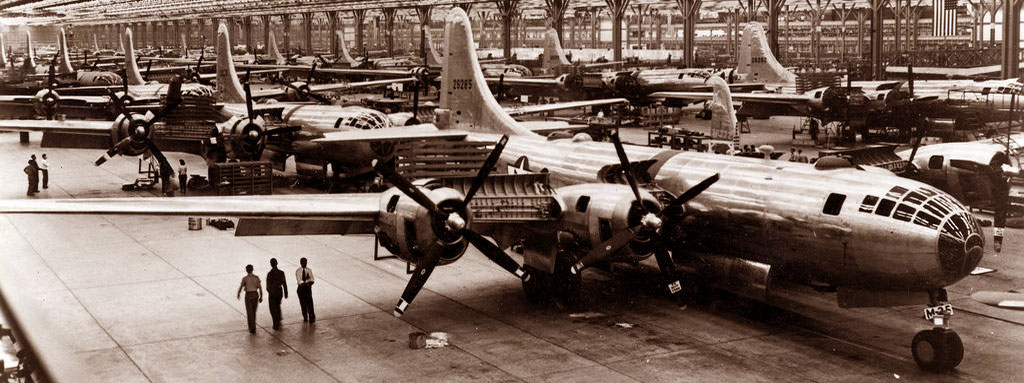
The first industrial revolution, the one we are most familiar with, began at the end of the 18th century and made it possible to pass from manual to mechanical production. The second industrial revolution came with the turn of the 20th century and with the electrification of the means of production. In the 1900s, the new paradigm was chain production, adapted by the American automobile industry. I say «adapted» intentionally, as it is interesting to note that assembly line production was not invented by Henry Ford or any of his acolytes. In fact, this industrial pioneer borrowed the idea from the Chicago red meat industry, where some visionaries realised that the most efficient way to butcher animals for human consumption was to break down the rather inelegant set of slaughter and boning operations into very basic tasks that could be carried out repetitively on a line much more quickly than if individual slaughtermen attempted to butcher their own cattle or lamb into edible portions.
These anecdotes not suitable for vegans aside, the second industrial revolution was driven by electricity and the production chain, a factor in the development of economies of scale.
 The third industrial revolution came later in the same century with the digitisation of processes. Programmed control, PLCs, electronic data storage, robotics... We could also say that the «spiritual» backbone of this third revolution was the LEAN philosophy, which took manufacturing to higher levels.
However, in the aviation industry, some of the elements of this third industrial revolution have taken a long time to be adopted. Moreover, some of them have only just arrived in the industry or have not yet been massively adopted. For example, LEAN production has only been definitively adopted in the aeronautics industry in the last 10-15 years, whereas in the automotive world it has been around for several decades.
Another example is the automation and robotics. Yes, we can now see robots in an aeronautical production plant, but the reality is that the human component largely prevails, albeit with the help of tools. Of course, we have been witnessing for some years now the significant advances in robotics applied to aeronautics, such as ATL machines for large composite components, or drilling machines for specific riveting tasks. However, these are generally large machines whose cost is only justified for very specific tasks, and their adoption was mainly driven by reasons of precision or complexity.
Ironically, aeronautics, for some one of the most advanced areas of human development, lags behind other industries. Probably the main reason is the craftsmanship required for manufacturing in the aeronautical sector. Aircraft are complex and generally large machines, and producing them requires multiple tasks, from the most mundane to the most sophisticated assembly operations, which are generally produced in very short runs. I would also argue that the aircraft industry is comparatively slower, older and not particularly innovative, but I will save that controversial thought for another time.
But the good news is that the fourth revolution with its paradigm shift may come to the rescue of the aerospace industry this time. Industry 4.0, the Factory of the Future, or whatever term we want to use, connect all the elements (the so-called internet of things) in the supply chain and the factory itself., and will allow customised production to enter into a game where it is even possible to produce large series while each item is personalised following specifications potentially defined by each individual customer. This new trend, facilitated by technological discoveries such as Big Data or advanced robotics, although again driven by the automotive or consumer electronics sectors, will this time be much more tailored to the needs of the aerospace industry. How this will play out will be the subject of our next debate....