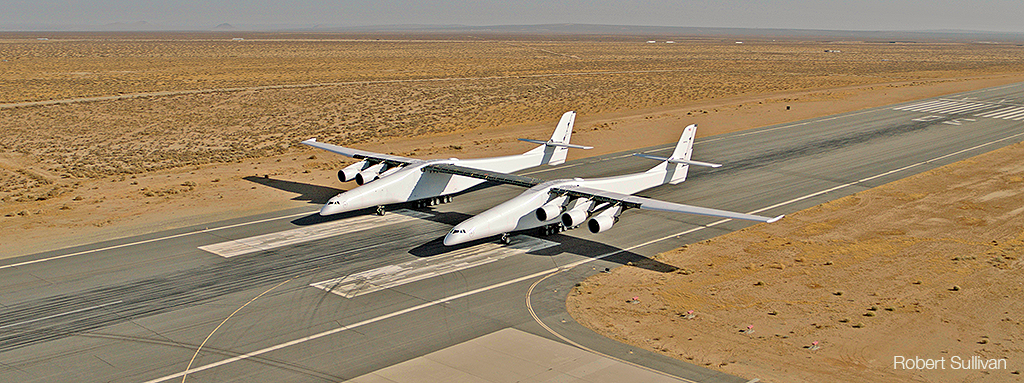
After cancelling its first flight in 2016 due to design and engine power issues, on 13 April The world's largest aeroplane made its first flight. It remained airborne for two and a half hours, reaching a speed of 304 km/h and an altitude of 5,185 metres. Among its design specifications, the reinforcement of the central wing is noteworthy in order to support approximately 227,000 kg, enough to carry multiple launch vehicles.
Already the world's largest aircraft, Stratolaunch is just one link in a tough race to position itself in an ever-growing orbital launch market.
Paul Allen, co-founder of Microsoft, founded the company in 2011 Stratolaunch Systems with the aim of Optimise the costs of an orbital launch. He designed a jet aircraft with a wingspan of 117 metres, six engines originally designed for the Boeing 747, and a double fuselage., capable of carrying a rocket to an altitude of approximately 10,600 metres. At this point the rocket separates from its transport aircraft and with its own engines completes its ascent into Earth orbit.
With this aircraft, Stratolaunch Systems achieves A new mobile launch platform which allows to put payloads and people into orbit more cheaply and routinely, as well as much lower maintenance costs, setting aside the expensive traditional staged rocket method. Furthermore, dependence on weather conditions is minimised, as is the near necessity of launching from the equator for that reason and subsequently diverting the trajectory to reach the desired point.
£10,000,000 70%% cheaper with Stratolaunch. In addition, the aircraft would return to land in perfect condition, requiring little time for the next mission.
However, this is not such a novel concept, as there are numerous preceding projects that have made progress on this matter. For example, in Russia there were projects such as an airborne launch from the An-124 Ruslan, the Burlak with a Tu-160, Ishim with the MiG-31 and the Svityaz with the An-225 Mriya; but none of them prospered.
The company Orbital Sciences developed a project of this kind that has been functioning for over 20 years. It consists of Pegasus rockets launched from the Stargazer: a Lockheed TriStar modified for this purpose. In total, it carried out 43 launches, 40 of which were successful. However, all of these took place at the beginning of the programme and in the last 10 years only three launches were carried out, which may indicate that this project is merely staying afloat for scientific and technological purposes. The commercial failure of this system has several explanations. First and foremost, there's the limitation in the payload capacity of launches with Pegasus rockets: a maximum of 450 kilograms to low Earth orbit. Added to this is the high launch price, which in 2014 amounted to $56 million. For comparison, launching the Russian Proton-M rocket, which can send 23,000 kilograms to the same orbit, costs $65 million. That capacity is important because one must remember that operators of small satellites often share costs by launching several devices on the same rocket, thereby achieving cost reductions.
With the competitiveness of this market, the future of Stratolaunch is not entirely clear. Despite it being a young company, it took a relatively short time to develop the project. It had been announced in 2011 and the aircraft was already presented to the public in 2017.
Among the points with some uncertainty is the fact that The project is suffering greatly from the launch vehicles.. Initially, cooperation with SpaceX was planned, but in 2012, Elon Musk's company withdrew from the programme.
There was then a collaboration with Orbital Sciences which planned to develop the Pegasus II rocket, which should be capable of launching up to six tonnes into low orbit. However, development has not been fruitful. In fact, in 2016 they proposed an idea that is difficult to commercialise: launching three conventional Pegasus rockets with each flight. Considering that only three rockets of this type have been launched in the last 10 years, it doesn't seem like a good idea.
Probablemente lo único que mantiene al programa de Stratolaunch a flote sea el hecho de que The company is cooperating with NASA on the development of its own space rocket. with a payload of 3.4 tonnes. Although its prospects may seem uncertain, the project might go ahead thanks to the rise of satellite groups that are foreseen with the development of satellite internet.
Thus, the OneWeb project plans to launch more than 600 satellites, SpaceX's Starlink will launch 1,528 satellites with the option to increase the number to 12,000, while Amazon's Project Kuiper plans to put 3,236 spacecraft into orbit.
In such a broad market, there could be room not only for Stratolaunch, but also for Richard Branson's Virgin Orbit project, which also has a small satellite launch system: the LauncherOne. This is a two-stage rocket that is lifted to an altitude of 10,700 metres via a customised Boeing 747-400.
NASA already has two modified Boeing 747s for transporting the space shuttles, but only to the landing and launch points; it does not have the capacity to take them into space as it only reaches an altitude of 5,000 metres when carrying the shuttle.
Another possibility could come from the defence sector. The US Defence Advanced Research Projects Agency (DARPA) has announced the upcoming Launch Challenge, in which three companies will take part. Participants will be informed of the launch location several weeks in advance and will receive their payload for the launch a few days prior. The same operation will be repeated several times. In this way, the military will simulate situations where they have to deal with unforeseen circumstances in a rapid and operational manner.
Then there's SpaceX, owned by billionaire Elon Musk, with its reusable two-stage vertical rockets, the Falcon. This company aims even higher, specifically at the space race to send people to Mars.
There is no doubt that Space is no longer a matter confined exclusively to the big national agencies, with technological capacity and enormous budgets to tackle projects of this magnitude, but rather that private enterprise has already entered the aerospace world with force and is here to stay.