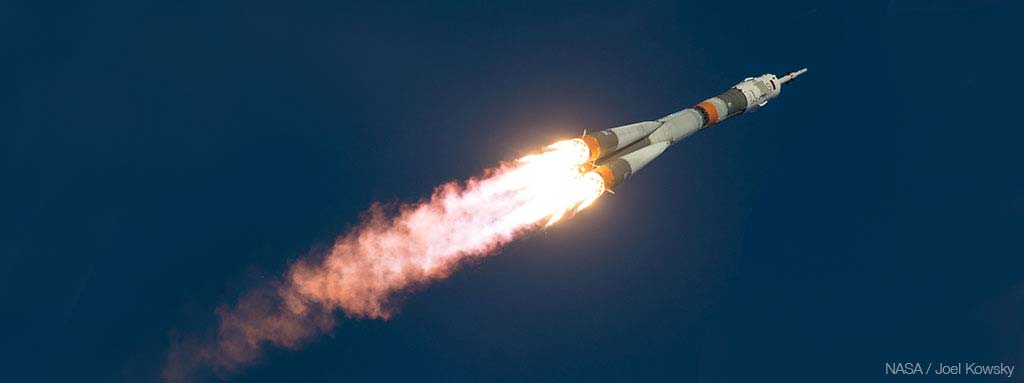
Even today, after sixty years, the Soyuz spacecraft travelling to the ISS are powered by a rocket derived from the R-7.
In the mid-20th century, the two global superpowers of that time, the United States and the Soviet Union, gazed towards the sky with the obsession of deciphering who would lead the space race. These were the times of the Cold War. For both sides, it was vital to demonstrate to the world who was the most powerful and technologically advanced. This was synonymous with military supremacy.
However, despite having less advanced technology, it was the Soviet Union that took the lead. It put the first artificial satellite, Sputnik (1957), into orbit and took Yuri Gagarin into outer space (1961) before its eternal rival could do anything similar. How was this possible?
As with many scientific advancements.
In the late 1940s, Sergei Korolev (1) was at the head of the NII-88 Institute, dedicated to the design of long-range missiles. Its first developments were based on the German V-2 missile, much of whose technology had come into the hands of both powers after the world war. With its first independent development, designated R-1 (2), The Soviets achieved results similar to those previously obtained by the Germans. The R-2 managed to double the performance of the previous model, reaching up to 600 km. The problematic development of the R-3, with a planned range of 3000 km, was cancelled due to their inability to achieve a sufficiently powerful engine. Instead, the R-5 was designed, which was smaller but incorporated some new concepts, with a range of 1200 km and a payload of around 1.4 tonnes.
By November 1953, the highest Soviet authorities decided that one of the national strategic priorities was the development of an intercontinental ballistic missile (ICBM). It should be able to to transport a nuclear load and get it to the USA from Soviet territory. The requirements for transporting that bomb were to be determined by those responsible for the USSR's nuclear development.
This task fell to Andrei Sakharov (3), who was asked to specify the nuclear payload the new missile would be capable of carrying. In other words, how much would a non-existent Soviet nuclear bomb weigh?
In 1953, Sakharov did not have a clear idea regarding this. His developments of the fusion bomb followed two lines of work based on very different concepts. One of these was based on the “Sloyka” design, which consisted of alternating layers of fusion and fission fuel. The other development concept was called “Teller-Ulam,” a staged fusion bomb. Over time, The second of the models was revealed to be much more effective although possessing a much greater destructive capacity for a much lower weight. But the eminent Soviet scientist did not yet know that.
To avoid getting his fingers burnt, given that it was still in the development phase, Sakharov opted to inflate the report he wrote for the authorities. He took the data assuming a bomb based on the Sloyka model, much heavier (and ineffective). The result was a load requirement of 5.5 Tm for the missile.
Time showed this to be a mistake, as the Teller-Ulam process was ultimately chosen, which would have required equivalent yields of 1 to 3 kilotons.
But the challenge that Sergei Korolev faced was to build a huge rocket capable of carrying a payload like the one Andrei Sakharov had proposed. According to his initial calculations, he needed an engine with a thrust of about 120 tonnes, something unthinkable at the time, given that the evolved V-2 engine had a thrust of up to about 25 tonnes. The solution he came up with was a missile (rocket) in which five units would be joined together in a configuration known as “in a package” consisting of a central stage surrounded by four conical rocket boosters. This giant missile, designated R-7 (4), measured 34 metres in length, weighed 280 tonnes, and had an overall diameter of 10 metres at its base (3 metres on its central body). It had a capacity for transport up to 5 Tm over a distance of 8,800 km.
The R-7 first took off in 1957 from the Baikonur Cosmodrome facility, in what is now Kazakhstan. It was a colossus with immense capacity that Made all strategic missiles or rockets developed in the United States look small.. Korolev had managed to develop the biggest shuttle in history which, moreover, has demonstrated an effectiveness of 97% in its more than 1,700 launches.
On 4 October 1957, the R-7 orbited Sputnik 1, the first artificial satellite. Shortly afterwards it took the dog Laika into space, and then made Yuri Gagarin the first astronaut in history.
Even today, after sixty years, the Soyuz spacecraft that travel to the ISS (International Space Station) do so propelled by a rocket derived from the R-7. As a missile, it was a fiasco, but conversely, it has been and is a magnificent rocket.
Without a doubt, Andrei Sakharov's miscalculation (or inaccuracy) became one of the greatest successes in aerospace history.
Sergei Korolev (or Korolyov) was arguably the most significant Soviet rocket engineer and designer during the space race. He was known as the “Chief Designer”. The book “How One Man Masterminded the Soviet Drive to Beat America to the Moon” by James Hartford is recommended reading.
(2) Russian rockets are prefixed.
(3) Andrei Sakharov is known worldwide, among other things, for being a Nobel Peace Prize winner (1975), as well as an eminent Soviet nuclear physicist who stood up to his country's regime. The reading of the book "Memoirs of Andrei Sakharov" is also highly recommended, where this and other chapters related to nuclear and ballistic development in the former Soviet Union are addressed in much greater detail.
The R-7 was also called the Semyorka (“the seventh”, in Russian) and is known in the West as the “SS-6 Sapwood”. Its later developments are also known as: Sputnik, Vostok, Voskhod, Luna, Molniya, Polet and Soyuz.