One of the most notable aspects of current aeronautics is the trend towards a More sustainable industry. This vocation affects both the industrial process and the final product, the aircraft themselves. All those industrial areas where innovations aimed at reducing their impact can be applied are systematically optimised in this regard. For our part, we are simultaneously witnessing a race to achieve mayor eficiencia en el vuelo de los aviones, consisting of reducing its impact while increasing performance.
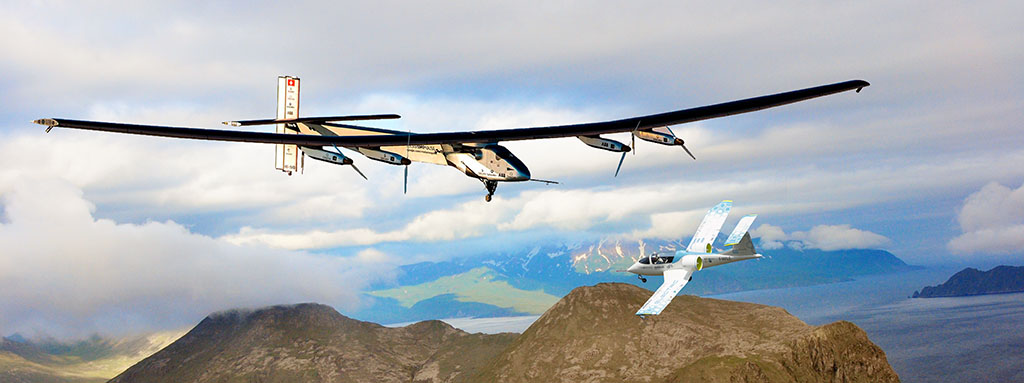
Solar Impulse and E-Fan are two initiatives that demonstrate, once again, that the aeronautical industry still has a lot to show us in the context of sustainability.
In recent weeks, two aviation initiatives have captured global attention. From different perspectives, they reflect a long-pursued objective: minimising, and even eliminating, the use of fossil fuels.
In the early days of July, the Solar Impulse 2 flew non-stop between Nagoya (Japan) and Hawaii (USA). A journey of 7,200 kilometres that took 4 days and 22 hours, breaking several records. The unique feature of this aircraft is that all the energy it uses in its flight comes from the 17,248 photovoltaic cells distributed across its structure.
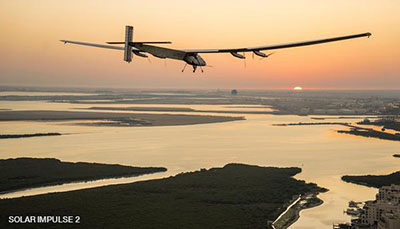 This is a genuine aeronautical achievement which, however, has not been without its difficulties and limitations. In fact, the presence of adverse weather conditions decisively influenced a delay of several weeks in the undertaking of this flight. On the other hand, the special thermal insulation of the batteries (the aircraft flew at altitudes of 8,635 metres, with extreme minimum temperatures) and the energy generated by their operation, caused irreparable damage to them. But there is no doubt that, despite these drawbacks, this is a a giant leap towards achieving alternatives The project is supported by a slogan that, thanks to the feat of its circumnavigation without using fossil fuels, is making an impact on society: “The future is clean” The future is clean.
The Solar Impulse project was born in Switzerland and is sponsored by over a hundred institutional and corporate partners, including Solvay, Omega, Schindler and ABB.
Another aeronautical achievement, also carried out in July 2015, was the crossing of the English Channel with a small and innovative electric aircraft, the E-Fan. In this case the energy required for the flight came from a series of Lithium-ion polymer batteries mounted in the inner section of the wings. Thrust comes from two variable-pitch fans which allow it a cruising speed of about 160 km/h. Beyond propulsion, the integration of aircraft systems aviation, flight control, and energy management—is crucial for certifying these new platforms.
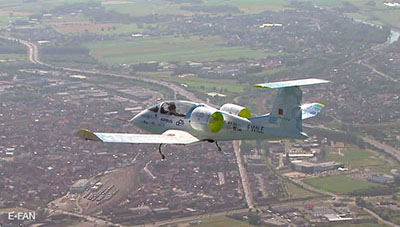 On the 10th of July, after more than 100 test and demonstration flights, this aircraft flew over the English Channel, between the towns of Lydd (United Kingdom) and Calais (France). A 74-kilometre journey that the E-Fan completed in 37 minutes, flying at an average altitude of 1,000 metres (3,500 feet). In the same month of July, but 106 years earlier, the Bleriot XI was the first aircraft to fly over the English Channel (although that time in the opposite direction), piloted by its creator, Louis Blériot.
The E-Fan has been developed by the European consortium Airbus Group, which continues to develop this aircraft with the aim of giving it more power and less weight. They are already working on a new version for two passengers (in parallel) and another for four passengers. The idea the manufacturer has in mind is to commencing its commercialisation in 2016, which will undoubtedly be another milestone in the development of more sustainable aeronautics. These milestones inspire the engineering work that AERTEC carries out on Aeronautical electrification, developing HVDC power distribution architectures for commercial aircraft, UAS and eVTOL.
Solar Impulse and E-Fan are two initiatives that demonstrate, once again, that the aeronautical industry still has much to show us in the context of sustainability. They are two exciting projects that have gone one step further.
You can find more information at the following links: Solar Impulse 2 years E-Fan
That we have come this far does not, however, mean that we have achieved it. There is a long way to go. But there is no doubt that we are heading in the right direction. Do you agree?