In the the dawn of aviation, Any air journey, however small it may seem to us now, was a real challenge. In the early 20th century, there were numerous patrons who offered large prizes to those who dared to break new records. Each crossing, each altitude, each speed or each innovation was treated as a true feat. And they were.
The Atlantic Ocean has been a common point for Western cultures for centuries, and effectively communicating between both shores was always the great challenge to overcome. When the first flying machines appeared, crossing it became an obsession for many. However, The state of technology It didn't make it possible until just after the First World War.
Some of the most important feats in the early days of aviation were carried out over the waters of the Atlantic.
Right then, Who was the first pilot to cross the Atlantic? There are several answers to this question, and they always have nuances.
In 1919, the prestigious newspaper Daily Mail offered a prize of £10,000 to the first aviator who could achieve Join both continents non-stop. Several teams signed up to try it. One of them was made up of two RAF officers, Captain John William Alcock and the lieutenant of Scottish origin, Arthur Whitten Brown. They were 26 and 32 years old respectively.
Alcock chose a bomber Vickers Vimy modified. It was a biplane 13 metres long with a wingspan of 21 metres. It was manufactured by Vickers Limited, the company where Brown worked (and the fundamental reason why Alcock chose him as co-pilot).
Logic suggested that The most suitable route should have been between Ireland and Newfoundland, the shortest distance between both continents. Given that the prevailing winds in that area of the Atlantic flow from West to East, and after an accident that befell one of the teams departing from Ireland, they decided to undertake the flight from Newfoundland. They were not the first. Two other teams had attempted it previously from the same location, although they failed in their attempt.
Now in Saint John, Newfoundland, and awaiting a window of good weather that would guarantee a smooth flight, they received the news that a US Army seaplane had crossed the Atlantic, albeit with an enforced stop in the Azores, which invalidated their claim to the prize. But Alcock accepted the need to hasten their departure to avoid surprises.
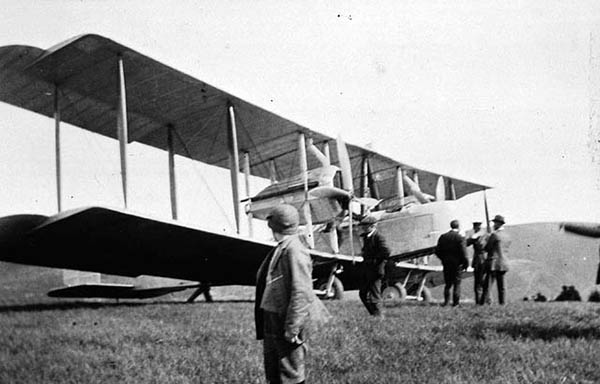
The day 14 June It wasn't ideal to attempt it, even the air currents weren't particularly favourable. But a sudden change in the wind turned it in their favour, and with a speed of 60 km/h. The decision was immediate.
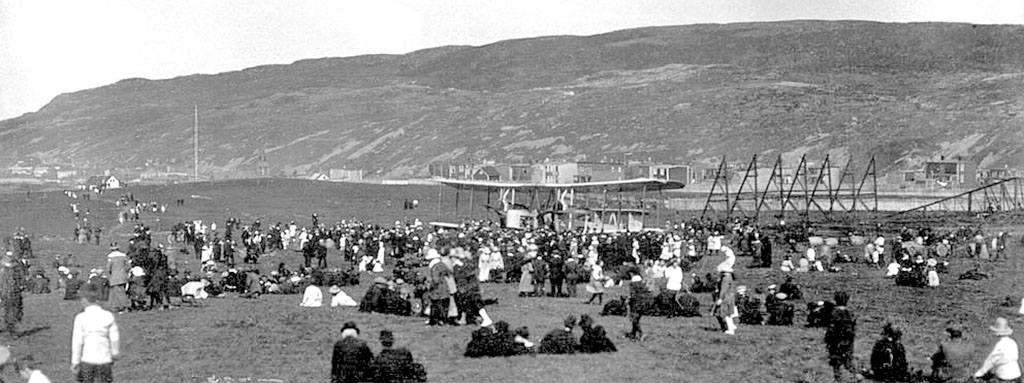
After a hesitant takeoff from a very bumpy field, and under the gaze of several hundred onlookers (header image), they set a course towards the East. An hour later, already over open sea, they were immersed in a dense fog, in the midst of which a fundamental piece of the radio generator detached. From that moment on, they could receive messages, but not transmit them. No one would know anything about them until they reached their destination.
The exhaust pipe also detached from one of them shortly after. Rolls Royce Eagle VIII engines, 350 horsepower, which was powering the aircraft, the starboard one. The noise became deafening. Both airmen could barely communicate except by making signals.
After an interminable night, they awoke amidst clouds so dense that they prevented them from seeing the end of the wings. They even lost their sense of horizontality and orientation. Upon emerging from the clouds, they found themselves in an embarrassing situation: they were flying barely 15 metres above the waves and in the opposite direction to where they should have been heading. Just as they regained their route towards Europe, a terrible snow and hail storm descended upon them, which caused the obstruction of some basic flight indicators and ducts. They were forced to crawl out of the cockpit, over the fuselage and wings, to clear these elements of snow (fuel gauge, carburettors, airspeed indicator…) with a feeling of cold of about -20 degrees Celsius. To warm up, they had some sandwiches, chocolate, and coffee.
Around 8:30 on June 15th, they reached the Irish coast to land in a marshy area four kilometres from Clifden, in County Galway, where the Vickers Vimy nosedived into the mud. Both pilots were unharmed. They had done it. They had just crossed the Atlantic Ocean, for the first time non-stop, on a 3,124-kilometre journey in just over 16 hours.
Three years later, two Portuguese aviators, Coutinho and Artur de Sacadura who did The first non-stop flight across the South Atlantic aboard the Lusitania, a single-engine Fairey IIID that was specially designed for this journey. It was originally a British reconnaissance aircraft with a length of 11 metres and a wingspan of 14 metres.
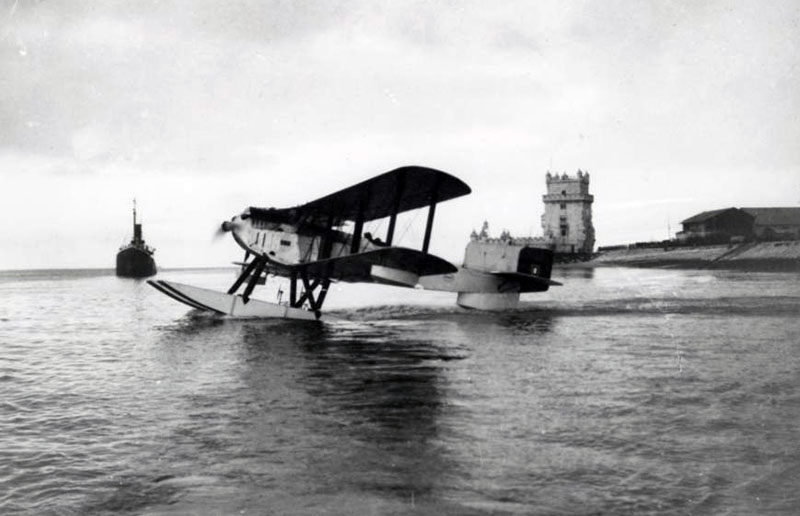
The flight departed from Lisbon and was scheduled to make several stops. The longest leg, and the one that ultimately involved crossing the Atlantic, was the one that took them from Praia, in Cape Verde, to the St Peter and St Paul Archipelago, in Brazil. On this journey of just over 1,700 kilometres, one of the seaplane's floats was lost upon landing, as a consequence of the enormous swell.
After several more stages, forced landings, drifts, more swell, and two more replacement Fairey IIID aircraft, they arrived in Rio de Janeiro.
But this flight had, in addition, another merit. Gago Coutinho, who was acting as navigator, had the idea of to adapt an artificial horizon to a sextant, which allowed him/her to carry out For the first time in history, a flight solely with the help of astronomical navigation.. This undoubtedly represented an extraordinary advance for aviation.
But returning to the Atlantic, if there is one name that truly achieved more popularity than those who first flew across the ocean, it is that of Charles Lindbergh.
It also had the incentive of a $25,000 reward (offered by New York businessman Raymond Orteig) for whoever flew between the two continents, not the islands as was the case in Alcock's flight. From that moment on, several aviators attempted the flight between New York and Paris, all of them failing.
Charles Lindbergh set out to make the solo flight in a single-engine aircraft. It seemed reckless given the attempts that preceded it.
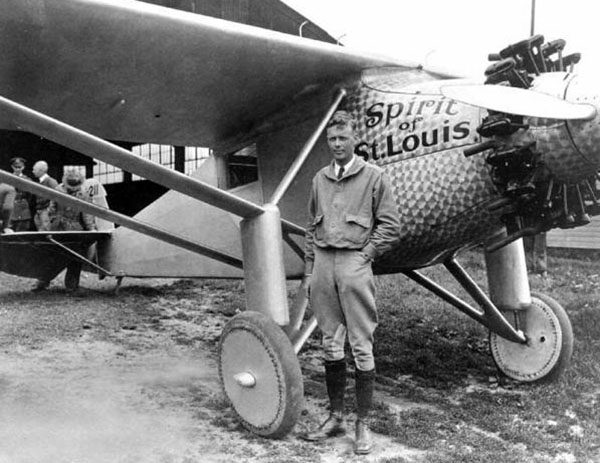
The 20 May 1927, Lindbergh took off from Long Island, in New York, on a high-wing monoplane built specifically for this flight by Ryan Co, of San Diego. It was powered by a single 9-cylinder Whirlwind engine, which allowed it to maintain an average speed of 173 km/h. The premise behind the aircraft's design had been clear: increase range, reduce weight, and optimise aerodynamics.
Already immersed in the flight preparations, Lindbergh's priority and great challenge was to stay awake for many hours. In his pre-flight training, he spent 55-hour stretches without sleep. Even during the flight itself, he flew as low as he could so that the spray from the waves would help him stay awake. It was his greatest challenge.
Unlike Alcock's flight, where the few locals who approached the newly landed aircraft to help paid little attention when they were told that the biplane had just arrived from America, a hundred thousand people were waiting for Lindbergh at the aerodrome in Le Bourget, on the outskirts of Paris. The pilot's name went down in history and, precisely at that moment, changed the course of aviation forever.
In all those years, new milestones related to aviation and the Atlantic occurred that have joined names, sometimes little recognised, to the list of pioneers already mentioned: Dieudonné Costes, Joseph Le Brix, Amelia Earhart, Mariano Barberán, Joaquín Collar… And a few years after Lindbergh's flight, the first airlines that crossed the ocean with passengers already emerged.
But that's all another story.