One of the most booming businesses in the world today is that of the photovoltaic solar energy. It is an industry that is steadily achieving greater efficiency as well as increased competitiveness.
So what impact does this industry have on the world of aeronautics in general and the airport industry in particular?
Airport managers should start considering the alternative of including solar photovoltaic installations in their master plans and analyse whether or not they are feasible at their airport.
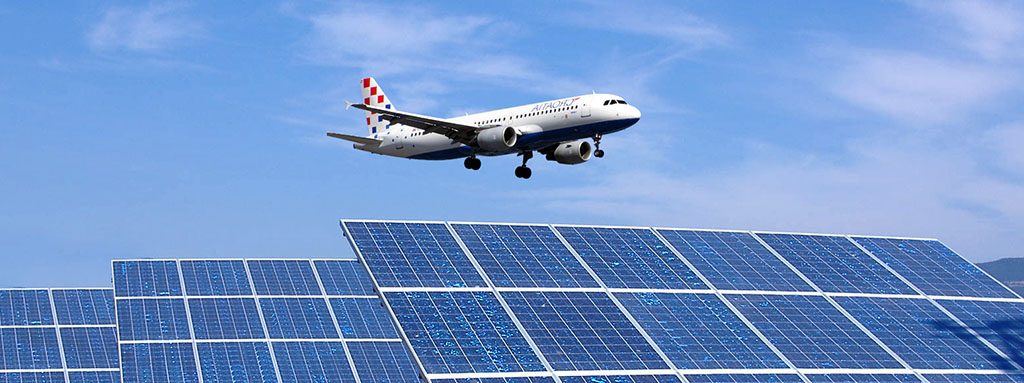
It is worth noting as a first idea that the airport environment is ideal for hosting a photovoltaic installationThe reason for this is that electricity consumption is high, there is usually a lot of land available for installation (including building roofs), and the energy produced is consumed directly in the infrastructure, so it does not need to be transported over long distances. In short, this type of energy can significantly reduce operating costs at an airport.
However, there are a number of constraints that airport operators should take into account when planning a photovoltaic installation at their airport:
- Physical easements. Panels shall not infringe any physical easement established by ICAO. Panels may also not be installed in runway safety areas or taxiways. Due to the shape of the panels and their height, this issue does not normally present too many problems at the design stage.
- Glare. Perhaps the issue of glare is what most concerns an airport manager when implementing a project of this type. This is because it has a direct impact on the safety of operations.
Firstly, it is worth mentioning that photovoltaic panels are designed to absorb light, not reflect it. Thus, only 3% of the light is considered to be reflected, which is very similar to a calm lake by the airport.
At this point it should be noted that the FAA has made available software that analyses the potential impact of glare at the design stage: "...the FAA has made available software that analyses the potential impact of glare at the design stage: "...".Solar Glare Hazard Analysis Tool"(SGHAT), developed by the DOE's Sandia National Laboratories.
This programme analyses where and when glare is likely to occur throughout the year and, if so, calculates the irradiance and whether it can cause eye damage or injury.
Two points are analysed: the control tower and the aircraft's approach path, from 2 miles back to touchdown. The FAA has, in fact, established criteria according to which glare is considered unacceptable (although this is not a regulation, but merely a guide). These are: for the tower, glare that could cause eye damage is not permitted, and for the approach path, the glare must not be such that it causes temporary loss of vision.
Despite the reluctance of airport managers to address this issue, it should not be considered a significant element in decision-making, if the design is done correctly.
- Interference in communication systems. The panels should not be placed near any radio communications facilities, as this may reflect or block the signal.
They should also not be placed close to the approach path, as during sunset the plates release heat and this heat can be picked up by aircraft causing unexpected signals.
Moreover, these systems do not emit electromagnetic waves that could cause interference.
In any case, a communications impact analysis should be carried out during the design phase. The approval or not of the installation will be in the hands of the competent authorities.
Prior to the start-up of such a facility, each airport operator must carry out its own feasibility study, which should cover at least the following aspects:
- Available land for installation, also analysing availability on roofs of buildings and halls.
- Electrical energy expected to be obtained. This will take into account factors such as climate, sunny days, plate orientation, shading or available area.
- Analysis of the airport's electricity consumption. There are many airports in the world, for example, that are seasonal, i.e. there is a period of the year when they can double or triple the number of passengers. Thus, electricity consumption would not be constant. In these cases, the possibility of selling the surplus energy to the general grid during the off-peak period can be considered. In this case, it should be taken into account that the own grid will have to be adjusted to the parameters of the general grid of the country in question, which may involve an increase in the initial investment. The price at which this energy would be sold must also be taken into account.
- Electricity price study. This will be done by analysing, inter alia, historical data on price behaviour in the country concerned or national and international political factors that may have an impact in the short, medium and long term.
- Possible government policies on renewablesThe Commission's proposal for a new regulation is based on the following principles: - possible aid or, on the contrary, possible levies, as is currently the case in countries such as Spain.
- Analysis of the return of the installation. It should be noted that this type of installation represents a high initial investment, but the maintenance cost during operation is minimal, according to some studies, 0.02% compared to the initial investment. The lifetime of a photovoltaic panel is typically 20 years or more.
So much for the theory, but is such a project really feasible at an airport today? The answer is yes, and for reference here are a number of examples to illustrate this.
Cochin International Airport (CIA).
It is a medium-sized airport, with 7.7 million passengers per year, located in India, in the state of Kerala.
This airport is the first in the world to be powered entirely by photovoltaic panels. It has 46,000 panels on an area of 17.4 hectares, generating 52,000 kW/day. At present, the airport consumes approximately 48,000 kW/day (the surplus is sold to the general grid).
Denver International Airport (DEN).
Two projects have been developed in parallel at this airport. The first one came into operation in July 2008, producing 2 MW. The second one came into operation in December 2009, producing 1.6 MW. This airport has been one of the pioneers in the USA and has been of great help for the development of similar installations at other airports.
These are two examples, but there are many more in the world, especially in smaller airports. This is the case of Galapagos Airport, with an exemplary ecological philosophy. Or George Airport, a small airport of 560,000 passengers per year located in South Africa, which is the second airport in the world, after the aforementioned CIA, to be powered entirely by photovoltaic energy.
Finally, what about regulations, are there specific regulations for this type of installation? At present, no.
The FAA has drafted a non-binding guide entitled "Technical Guidance for Evaluating Selected Solar Technologies on Airports". This guidance, as indicated on its cover page, is currently under review and is therefore subject to possible modifications in the future.
With regard to European legislation EASA is only referred to in GM1 ADR-DSN.M.615, where it explains that an operational safety study shall be drawn up taking into account glare during descent, touchdown and taxiing phases.
In terms of ICAOThe only references are found in Doc. 9157 Part 5 Electrical Systems, where the airport's power supply sources are mentioned. In this regard, one of the possible scenarios included in this document would be: power supply by a local generating plant (in line with photovoltaic energy production) and by a distribution system outside the airport (public or private). Thus, airports are encouraged to have at least one alternative power supply.
In any case, it is in the hands of the competent authorities whether or not to approve this type of project, with the safety of operations naturally taking precedence over any other consideration.
In conclusion, I believe that airport managers should start to consider the alternative of Include solar photovoltaic installations in their master plans. and analyse whether or not they are viable at their airport, firstly, because of the significant economic savings they can bring to the operation and, secondly, because of environmental responsibility, of which we should all be aware.
Finally, I would like to end the article with a quote from Thomas Edison: "I'd put my money on the sun and solar energy. What a source of power! I hope we don't have to wait until oil and coal run out before we tackle that. I wish I had more years left" (*).
(*) "I would like to put my money into the sun and solar energy. What an energy source! I hope we don't have to wait until oil and coal run out to tackle it. I wish I had more years left.