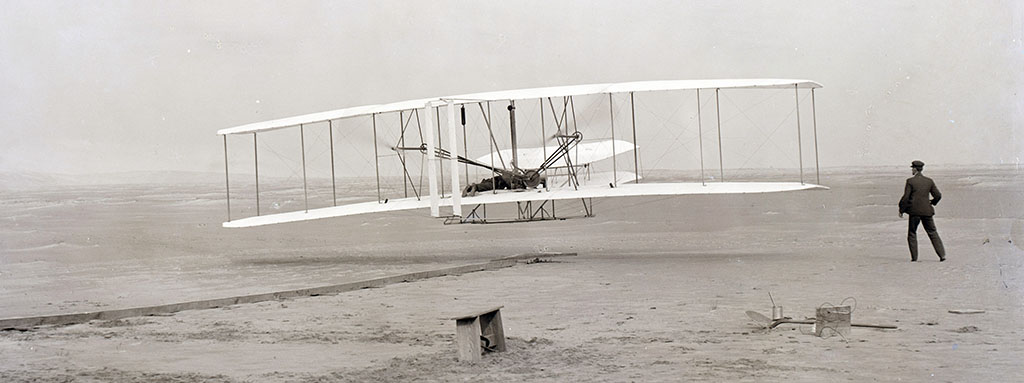
In 1903, the Flyer I, created by the Wright brothers, made its first public flight. This flight is considered to be the first in the history of aviation, due to the significance of being an aeroplane with an engine and control over flight command. It was made of steel, wood and glued cloth, a feat of engineering considering the knowledge and engines available at the time.
Today, there are those who question the basic principles of aircraft structure as we have known it since the Wright brothers took flight.
The first aircraft that were built based their structural construction on wood and glued fabric, and the flight controls were controlled by means of steel cables. The aim was to achieve a rigidity capable of supporting the aircraft in flight with the materials used, so a design was needed where the distribution of force vectors was divided in such a way that the stress suffered by the wood did not reach points that could cause excessive torsion or breakage. For this purpose, the design included structures where the number and dimensions of beams and ribs required were such that contributed a great deal of weight in general. This was compounded by the problem of instability of materials in relation to flight conditions, manoeuvrability and weather conditions. Despite the engineering calculations made in relation to lift surfaces and the structure in general, there were undetermined and uncontrolled factors that caused the flight capabilities to be quite low.
At the time of the Second World War, there was a need to obtain heavy means of transport, The first of these was the ability to carry troops and armament with vehicles superior to those that existed, as well as speed and manoeuvrability, especially in escort and fighter aircraft. This is when the development of new control techniques and, most importantly, a more structure-focused study and in the search for the highest possible performance in the capacity - speed - consumption ratio; the metal structure began to be used, with aluminium as the main element.
The transport capacity of the new vehicles required a higher traction capacity The new propulsion and propeller manufacturing techniques were studied. The new engines that appeared from that time onwards gave the necessary impulse for the planned payload, but they required greater fuel consumption and increased the total weight of the aeroplane, both for the engines used and for the sum of the fuel. At this point in history, the first turbine-powered jet engine for human transport and the rocket propulsion engine as a means of lifting unmanned vehicles were born. In addition to the new propulsion systems, it becomes apparent that the aircraft's lift and control surfaces require quite high manoeuvring forces. It is the case that a pilot with the steel cable systems cannot handle certain control surfaces (ailerons, flaps), which leads to the conclusion that there is a need for indirect control systems by means of hydraulic servos. The power-assisted power steering that we currently have in cars.
All this added up to weights and forces exerted on the aircraft structure, so the design was modified with a much more complex vector distribution in mind. The most immediate consequence was that, by trying to eliminate direct actions through the application of ribs or stringers, the aircraft as a whole would increase its weight even more. The study of aeronautical design is beginning to be taken as a fairly important section of engineering.
After the war, civil aviation took advantage of all the advances of this period and increased the study of the new capabilities of air transport. Measurements of in-flight stresses and forces began to be made, which led to changes in structural design and the use of new materials that gave more flexibility, resistance to forces and less weight. The birth of the composite materials.
Thanks to composite materials such as fibres (carbon, polyester, etc.), metal sandwiches and other similar techniques, the above-mentioned ratio is gradually being increased to obtain a higher performance with minimum consumption. Currently, it is assumed that the payload of a commercial aircraft is about 30% of the total vehicle weight, with the largest proportion of weight in take-off fuel, engines and other equipment.
But the most important of today's advances lies not in the philosophy of looking for a lighter or more robust structure, but in to obtain means of thrust that do not require a large amount of fuel and in remove weight from equipment through the manufacture of lightweight electronic systems, the use of fibre optics instead of hard-wired logic or even wireless robust, so that the aircraft's payload exceeds its empty weight. Obviously, the study in relation to aircraft structure is moving towards materials that are stronger but as light as possible. Studies are currently focusing on the search for lighter materials and have come up with a new one known as “Metal Foam”.
There are three ways to improve the strength to weight ratio of a material: try to improve strength, lower density, or both.. In order to try to create this relationship where the density is lowered by improving its strength, a material has been created in the form of foam where the existence of internal voids is controlled and corrected so that they have a direction, separation and number determined in the design, to subsequently make the structure more rigid with a thin layer of aluminium oxide. This achieves a hardness similar to steel but with a density similar to that of water (scientific journal «PNAS»).» Proceedings or the National Academy of Science of the United States of America). The problem with this new material is its cost, which is currently unaffordable.
There are currently many innovative avenues that aim to do all of the above, but there are those who want to go even further. questioning the basic principles of aircraft structure as we have known them since the Wright brothers took flight. It is possible that in a few years all these concepts will be obsolete, but today there is no doubt that there is no let-up in the constant evolution of aircraft structure.